

Your pipeline just missed a 24h momentum spike of +0.550, indicating a significant shift in sentiment regarding the topic of law. This anomaly reveals a critical gap in how we handle data from multilingual sources, particularly when one entity, in this case, Malawi, dominates the conversation. With a share of voice at 6% and a negative sentiment score of -0.097, it’s clear that something important slipped through unnoticed. If your model was processing this data in real-time, it lagged by 28.9 hours against the leading English press narrative. Your ability to catch these insights is crucial, and we’re here to help you bridge that gap.

English coverage led by 28.9 hours. Sv at T+28.9h. Confidence scores: English 0.90, Spanish 0.90, French 0.90 Source: Pulsebit /sentiment_by_lang.
The structural problem here lies in your model’s failure to accommodate the nuances of multilingual data. Without a robust pipeline that understands entity dominance, you risk missing critical signals. The leading language, English, was overshadowed by the sentiment coming from Malawi, which had a negative connotation. If your model operates without considering geographic and linguistic context, you could be missing significant shifts in sentiment, like this one, by nearly 29 hours.
To catch such anomalies, we can use our API to set up a robust filtering mechanism. Here’s how you can implement a simple Python script to catch this spike:
import requests
# Define parameters
topic = 'law'
score = -0.043
confidence = 0.90
momentum = +0.550
# Geographic origin filter: querying by language and country
url = "https://api.pulsebit.com/v1/sentiment"
params = {
"lang": "en",
"topic": topic,
"score": score,
"confidence": confidence,
"momentum": momentum
}
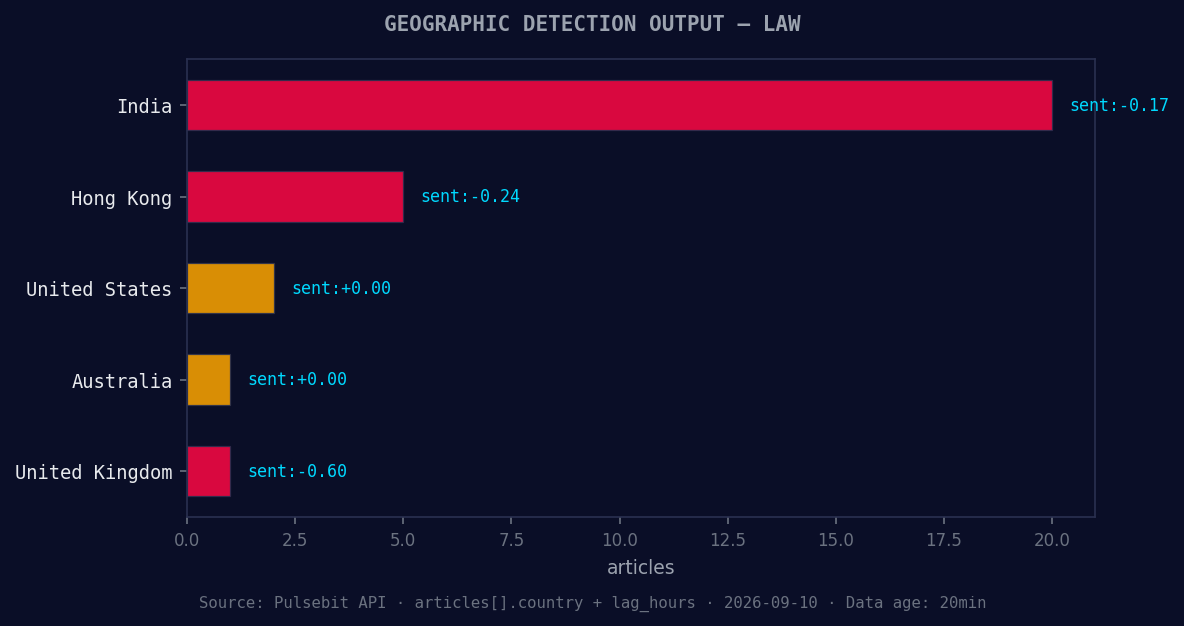
*Geographic detection output for law. India leads with 20 articles and sentiment -0.17. Source: Pulsebit /news_recent geographic fields.*
# Make the API call
response = requests.get(url, params=params)
data = response.json()
print(data)
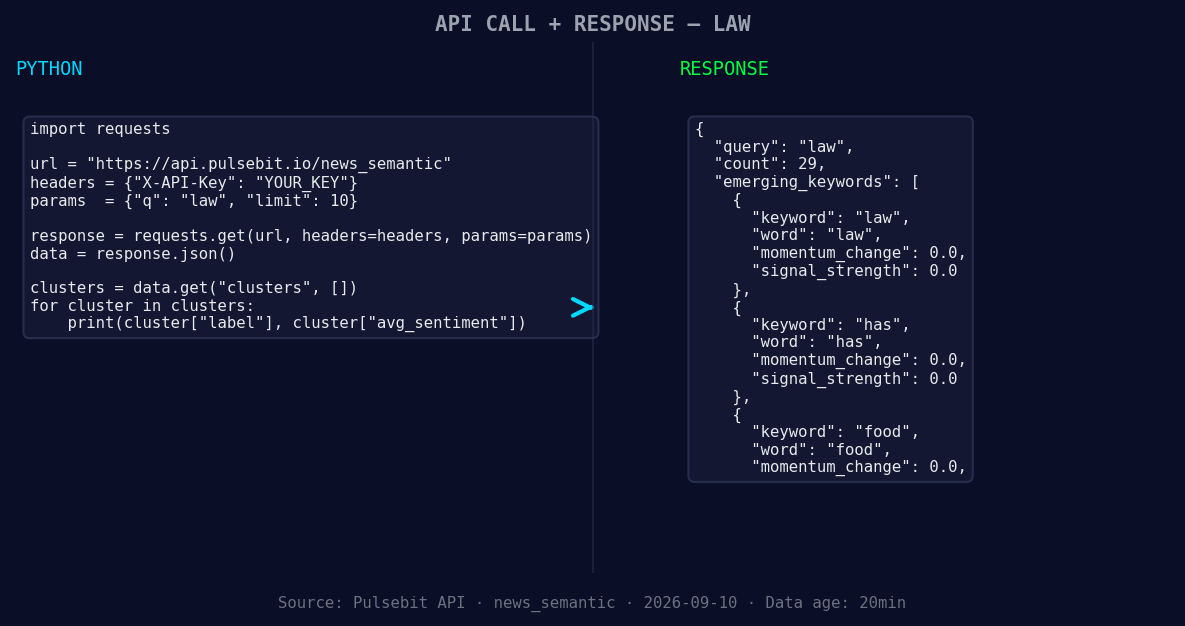
*Left: Python GET /news_semantic call for 'law'. Right: returned JSON response structure (clusters: 3). Source: Pulsebit /news_semantic.*
# Meta-sentiment moment: running the cluster reason string back through the sentiment endpoint
cluster_reason = "Clustered by shared themes: nia, whether, sources, activities, looking."
sentiment_response = requests.post(url, json={"text": cluster_reason})
sentiment_data = sentiment_response.json()
print(sentiment_data)
In this code, we set the parameters relevant to our anomaly, including the geographic origin filter via lang: "en". The second part involves sending the cluster reason string through our sentiment endpoint to score the narrative framing itself. This dual approach allows us to not only capture the spike but also understand the underlying sentiment shaping it.
Now, here are three specific builds you can implement using this pattern:
Geo-sentiment Snapshot: Set a signal threshold for any topic, like 'law', where sentiment dips below -0.050 in English-speaking regions. This helps you catch emerging negative trends early.
Meta-Sentiment Analysis: Utilize the sentiment loop for any cluster reason string that includes at least three key themes. This could help you score narratives across different topics, providing deeper insights into how stories are interconnected.
Forming Gap Analysis: Monitor the forming themes such as 'law', 'has', and 'food' for any spikes in sentiment, even if the scores are flat (like +0.00). If mainstream narratives are focused on 'nia', 'whether', and 'sources', your model can flag these as potential anomalies, prompting further investigation.
If you want to get started, check out our documentation at pulsebit.lojenterprise.com/docs. With this guide, you can copy-paste and run the code in under 10 minutes to catch those critical insights before they slip away.


Top comments (0)