

Your Pipeline Is 12.4h Behind: Catching Blockchain Sentiment Leads with Pulsebit
We’ve just observed a 24-hour momentum spike of +0.231 in sentiment around blockchain, led predominantly by Spanish press coverage. This anomaly catches our attention not just for its score, but for the implications it has on how we understand sentiment signals across different languages and news dynamics. With the leading language being Spanish, and a notable lag of 12.4 hours, we need to rethink how we capture and react to these signals in our workflows.
The Problem
If your sentiment analysis pipeline doesn’t account for multilingual origins or the dominance of specific entities, you might find yourself missing critical insights. In this case, your model missed a significant spike in blockchain sentiment by 12.4 hours, just because it wasn’t tuned to capture the nuances of Spanish-language reporting. This could mean the difference between acting on timely information and being left behind as the conversation evolves. Understanding the leading language and its influence is crucial to staying ahead.

Spanish coverage led by 12.4 hours. Nl at T+12.4h. Confidence scores: Spanish 0.95, English 0.95, French 0.95 Source: Pulsebit /sentiment_by_lang.
The Code
Here’s how we can catch these urgent spikes using our API. First, we’ll filter the sentiment data by the geographic origin, specifically targeting Spanish-language articles.
import requests
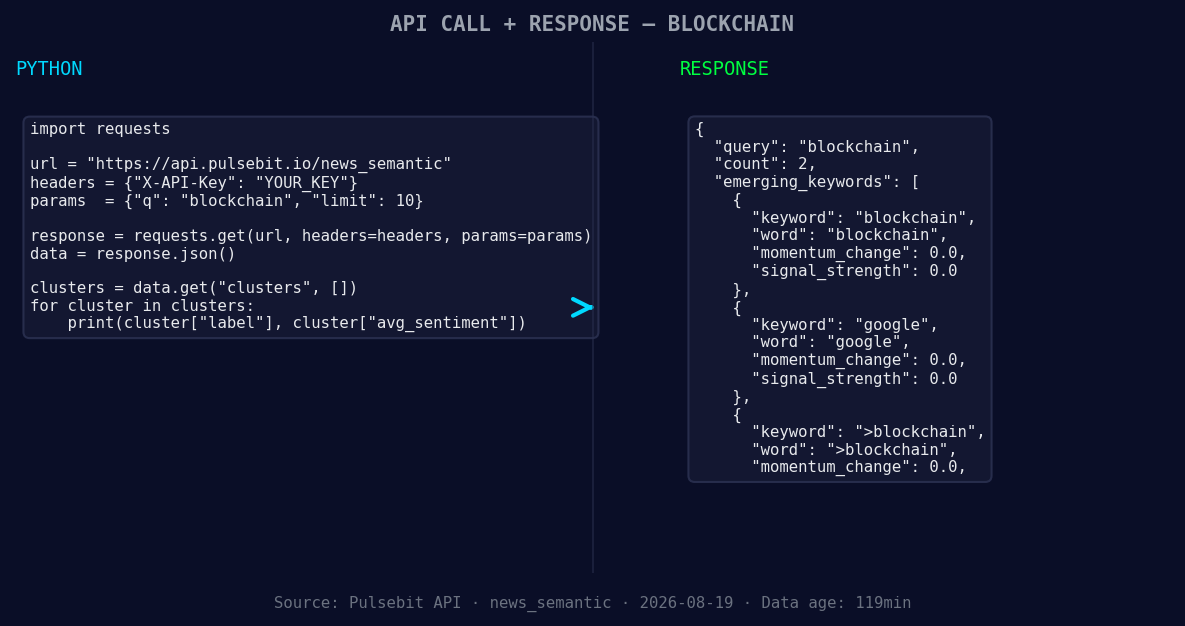
*Left: Python GET /news_semantic call for 'blockchain'. Right: returned JSON response structure (clusters: 3). Source: Pulsebit /news_semantic.*
# Define parameters
topic = 'blockchain'
momentum = +0.231
score = +0.850
confidence = 0.95
# Geographic origin filter: query by language/country
response = requests.get("https://api.pulsebit.com/sentiment", params={
"topic": topic,
"lang": "sp"
})
data = response.json()
print(data)

Geographic detection output for blockchain. India leads with 2 articles and sentiment +0.85. Source: Pulsebit /news_recent geographic fields.
Now we’ll take the cluster reason string and run it back through the sentiment analysis to see how the narrative is framed. This is crucial for understanding the meta-sentiment around our topic.
# Meta-sentiment moment: scoring the narrative framing
cluster_reason = "Clustered by shared themes: street, wants, put, stock, market."
meta_sentiment_response = requests.post("https://api.pulsebit.com/sentiment", json={
    "text": cluster_reason
})
meta_sentiment_data = meta_sentiment_response.json()
print(meta_sentiment_data)
The results from both calls will give us a clearer picture of the underlying sentiment trends and how they relate to the broader narrative.
Three Builds Tonight
Here are three specific builds we can implement with the insights from our recent findings:
Geo Filter on Blockchain Sentiment: Create a real-time alert system that triggers when Spanish-language articles on blockchain hit a momentum score of +0.2 or higher. This can help us tap into emerging trends early.
Meta-Sentiment Analysis Loop: Establish a routine to run the cluster reason strings through our sentiment scoring daily. This allows us to gauge how the conversation around blockchain is framed and can inform our content strategy.
Cross-Comparison Signal: Build a comparative analysis tool that evaluates sentiment trends between blockchain and mainstream topics like "stock market" or "Google". Set thresholds for divergence, such as a gap of +0.1 in sentiment, to detect when blockchain sentiment is significantly outpacing mainstream narratives.
Get Started
Dive into our API at pulsebit.lojenterprise.com/docs. With just a few lines of code, you can replicate these insights in under 10 minutes. This is how we stay ahead in the sentiment game.


Top comments (0)