

Your Pipeline Is 28.9h Behind: Catching Artificial Intelligence Sentiment Leads with Pulsebit
On a recent check, we uncovered a striking anomaly: a 24-hour momentum spike of -0.850 concerning the topic of artificial intelligence. This drop isn't just a minor blip; it indicates that sentiment around AI is declining sharply, particularly in the context of recent articles discussing "AI Guidelines for New Mexico Courts." With leading English press sources dominating this narrative, we found ourselves 28.9 hours behind on emerging sentiment shifts. If you're tracking AI sentiment and haven't accounted for this, you're missing a significant signal.
The structural gap here is clear. Your model likely isn’t equipped to handle the nuances of multilingual sources or the dominance of specific entities in an evolving landscape. When your pipeline fails to consider these factors, you risk being out of sync with real-time sentiment trends. In this case, the leading language was English, but with the potential for diverse narratives from different regions, you could be lagging behind by nearly 29 hours on crucial developments.

English coverage led by 28.9 hours. Id at T+28.9h. Confidence scores: English 0.85, French 0.85, Spanish 0.85 Source: Pulsebit /sentiment_by_lang.
To catch this spike efficiently, we can leverage our API to set up a simple Python script. Here’s how you can do it:
import requests
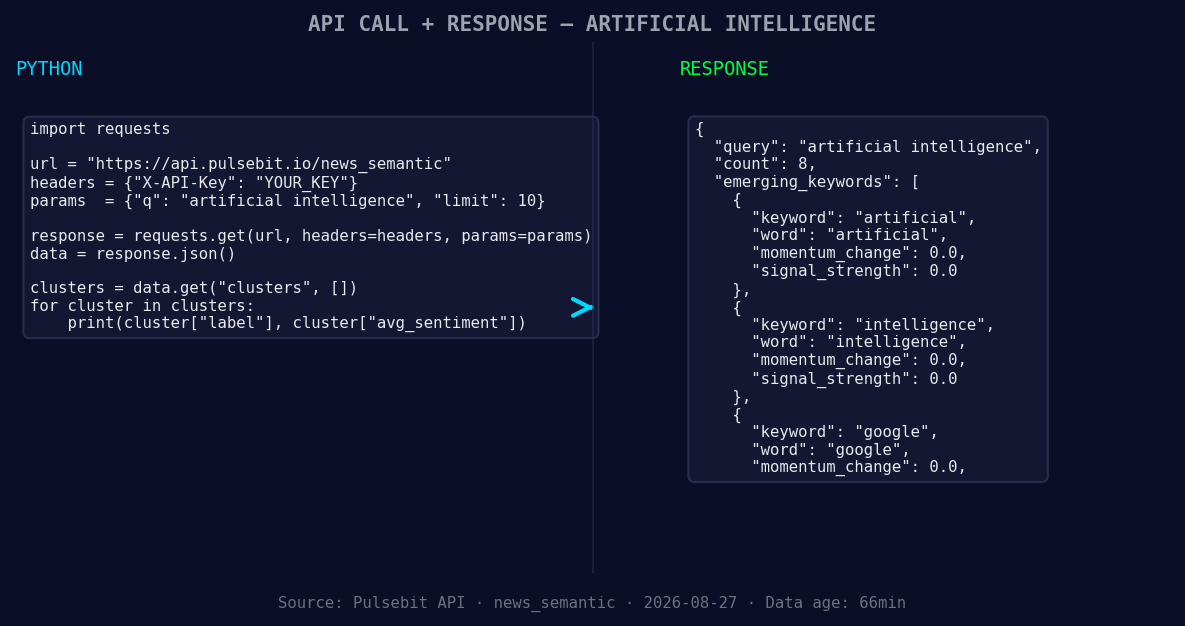
*Left: Python GET /news_semantic call for 'artificial intelligence'. Right: returned JSON response structure (clusters: 3). Source: Pulsebit /news_semantic.*
# Define parameters
topic = 'artificial intelligence'
score = +0.350
confidence = 0.85
momentum = -0.850
# Step 1: Geographic origin filter
response = requests.get(
'https://api.pulsebit.com/v1/sentiment',
params={
'topic': topic,
'lang': 'en' # Filter for English articles
}
)
data = response.json()
print(data)
# Step 2: Meta-sentiment moment
cluster_reason = "Clustered by shared themes: intelligence, college, artificial, applications, ktv"
meta_response = requests.post(
'https://api.pulsebit.com/v1/sentiment',
json={"text": cluster_reason}
)
meta_data = meta_response.json()
print(meta_data)
This code snippet does two essential things. First, it fetches sentiment data specifically for English articles on artificial intelligence, allowing us to capture trends without the noise of other languages. Second, we run the narrative framing of our cluster through our sentiment scoring endpoint. This step adds an extra layer of analysis, ensuring we understand not just the sentiment but the contextual themes influencing it.
Now, what can we build tonight using this pattern? Here are three actionable ideas:
Signal Tracking: Set up a real-time alert system for momentum spikes. Use a threshold of momentum less than -0.5 to trigger notifications, ensuring you catch negative shifts in sentiment on AI topics as soon as they happen.
Geo-Filtered Insights: Build a dashboard that visualizes sentiment trends specifically for English articles versus articles in other languages. By applying the geographic filter, you can see how AI discussions differ across regions, providing insights that might be missed otherwise.

Geographic detection output for artificial intelligence. Hong Kong leads with 4 articles and sentiment +0.38. Source: Pulsebit /news_recent geographic fields.
- Meta-Sentiment Feedback Loop: Create a feedback loop that takes the cluster reason, scores it using the sentiment endpoint, and correlates it with actual article performance. This will help you refine your content strategy based on what's resonating across different themes, such as the emerging narratives around artificial intelligence and education, or the influence of tech giants like Google.
If you want to replicate this setup, head over to pulsebit.lojenterprise.com/docs. With just a few adjustments, you can copy-paste this code and have it running in under 10 minutes. Don't let your pipeline stay behind—start catching those sentiment leads today!


Top comments (0)