

Your pipeline just missed a significant 24-hour momentum spike of +0.174. This spike isn’t just a number; it represents a critical shift in sentiment towards the topic of “world” led by English press narratives. The data shows a leading language influence at 17.6 hours, leaving your model lagging behind. If your pipeline isn’t tuned to handle multilingual origins or entity dominance, you’re likely missing out on key insights like this one. Specifically, Africa’s 2% share of voice and a positive sentiment of +0.417 highlight how crucial it is to stay ahead in sentiment detection.

English coverage led by 17.6 hours. Da at T+17.6h. Confidence scores: English 0.90, Spanish 0.90, French 0.90 Source: Pulsebit /sentiment_by_lang.
The gap here is glaring: your model missed this shift by 17.6 hours. In a world where sentiment can drive decisions, being late to the party means losing valuable insights. The leading language of English press, combined with the dominant entity of Africa, emphasizes the need for a robust pipeline that can adapt to global narratives without losing context. If you’re only focusing on mainstream sources, you’re likely blind to emerging trends that could affect your strategies.
To catch this anomaly efficiently, we can leverage our API. Here’s a straightforward Python snippet that demonstrates how to tap into this spike in momentum:
import requests
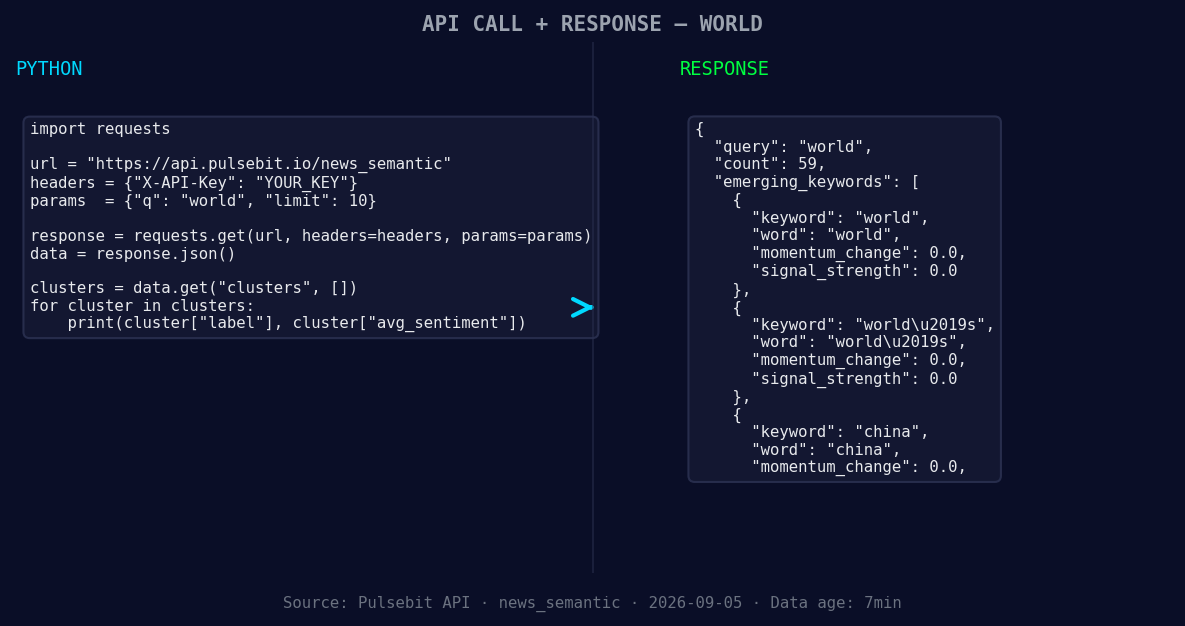
*Left: Python GET /news_semantic call for 'world'. Right: returned JSON response structure (clusters: 3). Source: Pulsebit /news_semantic.*
# Step 1: Geographic origin filter
url = "https://api.pulsebit.io/insights"
params = {
"topic": "world",
"lang": "en"
}
response = requests.get(url, params=params)
data = response.json()
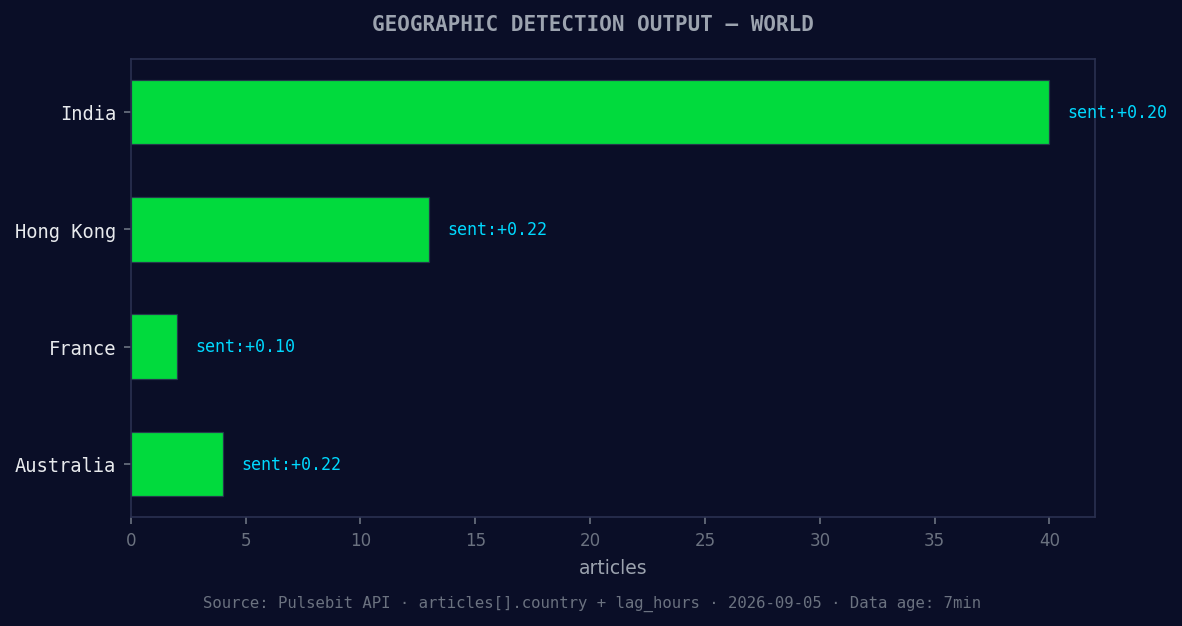
*Geographic detection output for world. India leads with 40 articles and sentiment +0.20. Source: Pulsebit /news_recent geographic fields.*
# Output the response data for verification
print(data)
# Step 2: Meta-sentiment moment
meta_sentiment_url = "https://api.pulsebit.io/sentiment"
meta_input = "Clustered by shared themes: rise, data, state, worldfinance, com."
meta_response = requests.post(meta_sentiment_url, json={"text": meta_input})
meta_sentiment_data = meta_response.json()
# Output the sentiment evaluation
print(meta_sentiment_data)
In this code, we first filter the insights based on the topic 'world' and the language 'en'. This ensures we’re capturing the relevant narratives in English that are contributing to the momentum spike. The second part of the code runs the cluster reason string through our sentiment endpoint, allowing us to evaluate the framing of the narrative itself. This is where we get to see if the underlying themes about the rise of data states are positively or negatively influencing sentiment.
Now let’s explore three specific builds we can implement with this pattern:
Geo-filtered Insights: Develop a real-time alert system that triggers whenever there’s a significant sentiment shift for a specific region, like Africa, using the geographic origin filter. Set a threshold of sentiment score +0.047 or greater, and watch for spikes in English press narratives.
Meta-Sentiment Analysis: Create a dashboard that visualizes sentiment shifts based on clustered themes. For example, input strings like "rise, data, state" can be fed into our sentiment endpoint, allowing for a deeper understanding of how narratives evolve, especially when juxtaposed against mainstream topics.
Forming Themes Monitoring: Set up a monitoring service for forming themes, particularly watching for keywords like "world," "world’s," and "china." By tracking these terms against the mainstream narratives of "rise," "data," and "state," we can anticipate shifts in sentiment and adjust our models accordingly.
If you want to dive deeper into implementing these features or need more examples, check out our documentation at pulsebit.lojenterprise.com/docs. You can copy-paste and run this code in under 10 minutes, getting you on track to catch sentiment leads before the competition even realizes they’re behind.


Top comments (0)