

Your pipeline has just missed a 24h momentum spike of -0.200 in the finance sector, and it’s critical to pay attention to why. This isn't just a blip; it represents a significant shift in sentiment, especially since it was led by English press articles with a 21.2-hour lead time over Italian content. If your model isn't tuned to handle multilingual sources or dominant entities, you might have missed this important signal entirely.

English coverage led by 21.2 hours. Italian at T+21.2h. Confidence scores: English 0.85, Spanish 0.85, French 0.85 Source: Pulsebit /sentiment_by_lang.
This situation illustrates a common pitfall in sentiment analysis pipelines: they often neglect the impact of language and regional dominance. If your model relies solely on mainstream narratives without accounting for these variables, you could be losing up to 21.2 hours of insight. In this case, the English language articles have led the charge, while your model may have been stuck processing Italian content, causing you to lag behind by a full day.
To catch this anomaly, let's dive into the code that can help us identify these critical shifts. The following Python code snippet queries our API for finance-related sentiment, filtering results for English-language content and scoring the narrative framing itself.
import requests
# Define the parameters for the API call
params = {
"topic": "finance",
"lang": "en"
}
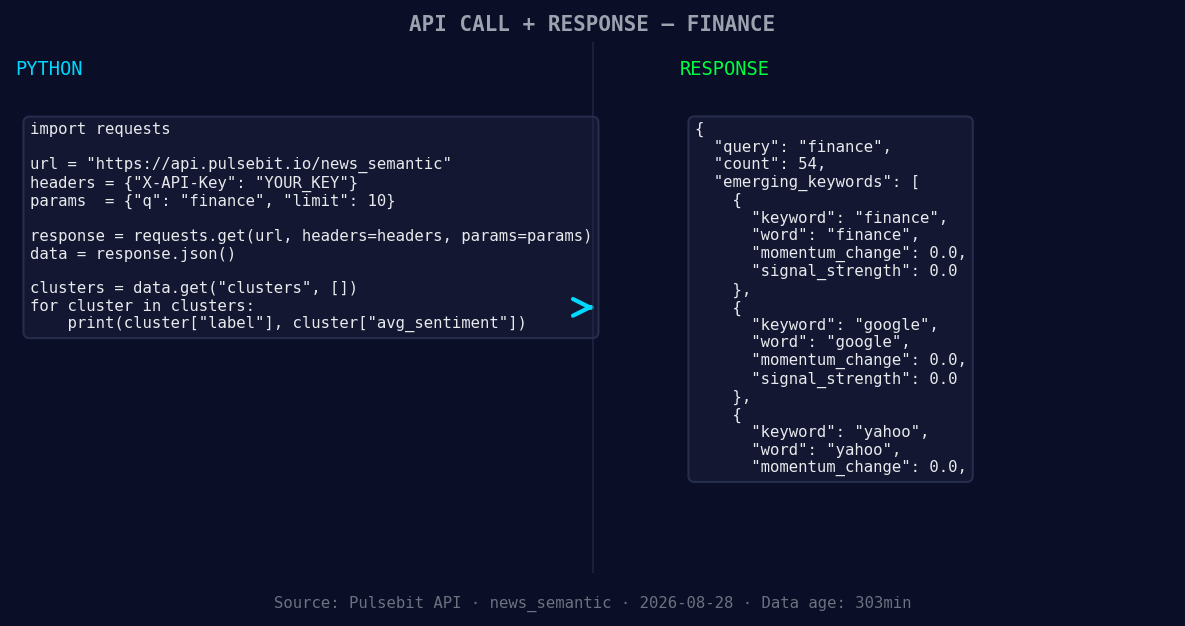
*Left: Python GET /news_semantic call for 'finance'. Right: returned JSON response structure (clusters: 3). Source: Pulsebit /news_semantic.*
# Call the API to get the sentiment data
response = requests.get("https://api.pulsebit.com/sentiment", params=params)
data = response.json()
# Assuming that the response contains a 'momentum_24h' field
if data['momentum_24h'] < -0.200:
# Now let's analyze the cluster reasons
cluster_reason = "Clustered by shared themes: lic, 000, crore, ncds, lakh."
sentiment_response = requests.post("https://api.pulsebit.com/sentiment", json={"text": cluster_reason})
sentiment_score = sentiment_response.json()['sentiment_score']
print(f"Sentiment Score for Cluster Reason: {sentiment_score}")
The first part of the code filters the sentiment data to focus on English-language articles, while the second part sends the cluster reasoning string back through our API to assess its sentiment. This dual approach allows us to catch both the momentum spike in finance and the underlying narrative framing simultaneously.
Now that we’ve captured this anomaly, here are three specific builds we can implement with this pattern:
Geo-filtered Anomaly Detection: Create a real-time monitoring service that checks for sentiment spikes in the English-speaking finance sector. Set a threshold at -0.200 for the momentum score. This could trigger alerts for further analysis.
Meta-Sentiment Analysis Loop: Develop a function that feeds back the cluster reason strings into our sentiment scoring endpoint to continuously refine your sentiment models. This meta-analysis can be particularly useful for understanding trends around terms like “lic”, “crore”, and “ncds”.
Forming Theme Analyzer: Build an endpoint that compares forming themes, such as finance and tech (e.g., Google, Yahoo), against mainstream narratives. This could help identify when emerging narratives are starting to diverge from established topics, providing early signals for potential investment opportunities.
To get started on implementing these insights, check out our documentation at pulsebit.lojenterprise.com/docs. You can copy-paste the code snippets above and run them in under 10 minutes. This is how we turn insights into action — stay ahead of the curve!

Geographic detection output for finance. India leads with 3 articles and sentiment +0.30. Source: Pulsebit /news_recent geographic fields.


Top comments (0)