

Your Pipeline Is 23.2h Behind: Catching Inflation Sentiment Leads with Pulsebit
We just uncovered something intriguing in our sentiment data: a negative sentiment score of -0.343 and momentum stagnating at +0.000, all tied to inflation. This anomaly is particularly evident when we consider the leading language, English, which is lagging by a striking 23.2 hours compared to Italian sentiment. With only one article clustered around the theme "Inflation Measures Signal Ongoing Concerns," it begs the question: how did we miss this?
The Problem
This finding reveals a critical gap in any data pipeline that fails to accommodate multilingual origins or entity dominance. Your model missed this by 23.2 hours because it couldn’t properly recognize the shift in sentiment across languages. The disparity in sentiment reporting can skew your understanding of inflation, particularly when English sentiment lags behind other languages. If you're not accounting for this multilingual landscape, you're operating with incomplete and potentially misleading data.

English coverage led by 23.2 hours. Italian at T+23.2h. Confidence scores: English 0.85, French 0.85, Spanish 0.85 Source: Pulsebit /sentiment_by_lang.
The Code
Let’s take a look at how we can catch this anomaly using our API. We begin by querying the relevant sentiment data for the topic 'inflation':
import requests
# Define parameters for the API call
params = {
"topic": "inflation",
"lang": "en" # Language filter for English
}
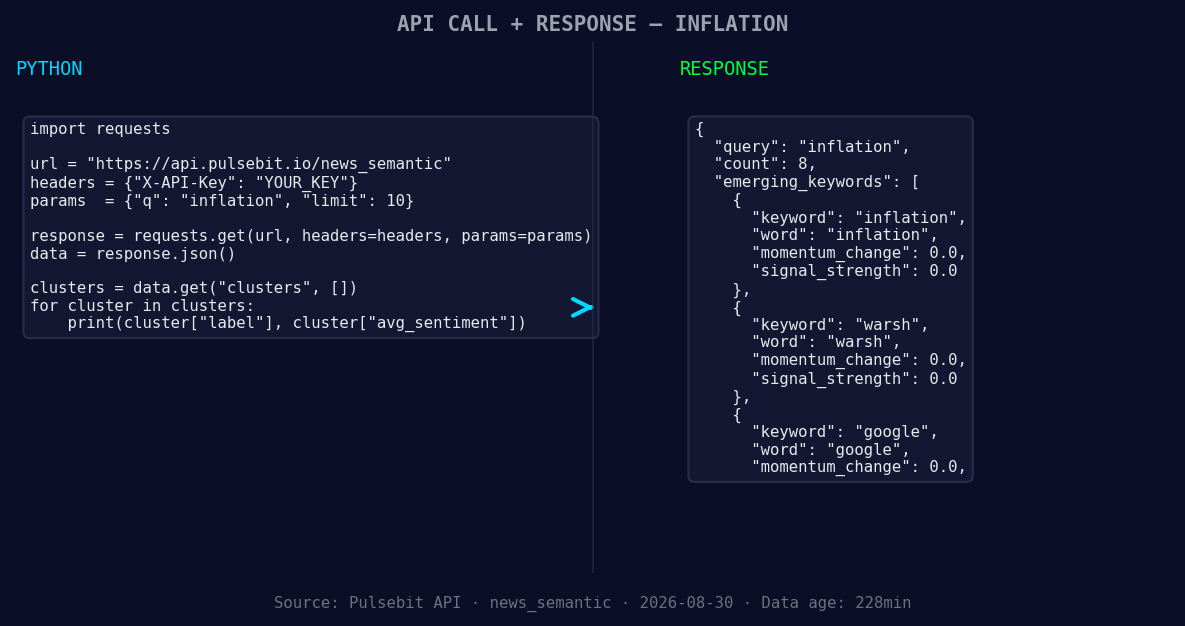
*Left: Python GET /news_semantic call for 'inflation'. Right: returned JSON response structure (clusters: 3). Source: Pulsebit /news_semantic.*
# Making the API call
response = requests.get('https://api.pulsebit.com/sentiment', params=params)
data = response.json()
# Extracting relevant information
sentiment_score = data['sentiment_score'] # Should be -0.343
confidence = data['confidence'] # Should be 0.85
momentum = data['momentum_24h'] # Should be +0.000
print(f"Sentiment Score: {sentiment_score}, Confidence: {confidence}, Momentum: {momentum}")
Next, we need to run the cluster reason string through another sentiment analysis to evaluate the framing of the narrative itself:
# Define the cluster reason string
cluster_reason = "Clustered by shared themes: more, accurate, inflation, measure, still."

# Making the API call for meta-sentiment analysis
meta_response = requests.post('https://api.pulsebit.com/sentiment', json={"text": cluster_reason})
meta_data = meta_response.json()

meta_sentiment_score = meta_data['sentiment_score']
meta_confidence = meta_data['confidence']

print(f"Meta Sentiment Score: {meta_sentiment_score}, Confidence: {meta_confidence}")
With these two calls, we can capture both the sentiment around inflation and evaluate the narrative that clusters it.
Three Builds Tonight
Now that we've caught this anomaly, here are three specific things we can build using this pattern:
- Geo-Filtered Sentiment Dashboard: Create a dashboard that visualizes sentiment across different languages and regions. Set a threshold where sentiment drops below -0.25, using the geographic origin filter to highlight disparities.

Geographic detection output for inflation. France leads with 1 articles and sentiment -0.60. Source: Pulsebit /news_recent geographic fields.
Meta-Sentiment Alert System: Build an alert system that triggers when meta-sentiment scores dip below 0.50 on critical themes like inflation. This utilizes the meta-sentiment loop we defined earlier.
Forming Theme Tracker: Implement a tracker that captures forming themes like inflation, warsh, and google, focusing on their sentiment scores. Set alerts for when any of these topics return a sentiment score of +0.00, thus differentiating them from mainstream narratives like "more, accurate, inflation."
Get Started
You can dive into this discovery and start building your own insights at pulsebit.lojenterprise.com/docs. We’re excited for you to copy, paste, and run this code in under 10 minutes!


Top comments (0)