

Your Pipeline Is 16.7h Behind: Catching Renewable Energy Sentiment Leads with Pulsebit
We just uncovered a fascinating detail: there’s a 24h momentum spike of +0.205 surrounding the topic of renewable energy. This spike is not just a number; it highlights a growing sentiment that you might have missed if your pipeline isn't equipped to handle multilingual data or entity dominance. The leading language for this spike is English, which is ahead by 16.7 hours compared to Spanish. If your model isn’t tuned to track these variations, you could be trailing behind in capturing crucial trends.

English coverage led by 16.7 hours. Spanish at T+16.7h. Confidence scores: English 0.85, French 0.85, Spanish 0.85 Source: Pulsebit /sentiment_by_lang.
This discrepancy reveals a significant structural gap in any pipeline that doesn’t account for the nuances of multilingual origins and dominant entities. Your model missed a critical insight by 16.7 hours, which is a sizable delay in a fast-moving environment. This lag can cost you competitive edge, especially when trends are shifting rapidly and sentiment towards renewable energy is on the rise. The dominant English articles are reflecting sentiments and narratives that you need to be aware of, while Spanish articles are trailing in terms of sentiment development.
To catch this momentum spike, we’ve put together a Python snippet that utilizes our API effectively. First, we’ll filter the data by language, focusing on English content related to renewable energy. Here’s how you can do it:
import requests
# Define the parameters for the API call
topic = 'renewable energy'
params = {
'topic': topic,
'lang': 'en',
'limit': 10
}
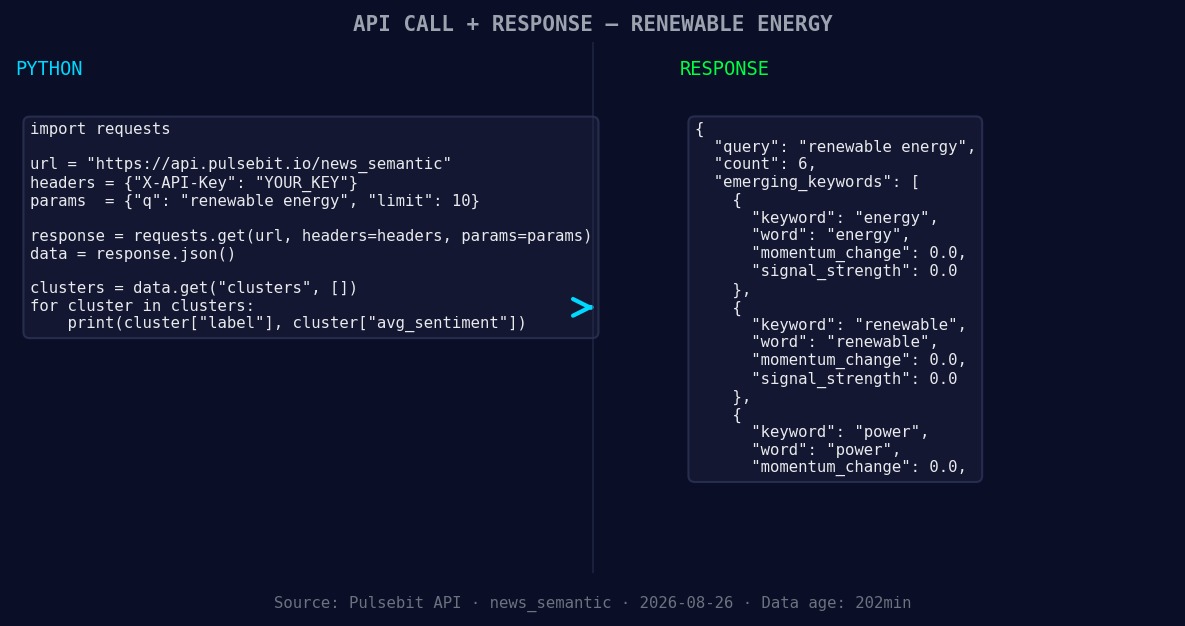
*Left: Python GET /news_semantic call for 'renewable energy'. Right: returned JSON response structure (clusters: 3). Source: Pulsebit /news_semantic.*
# Make the API call
response = requests.get('https://api.pulsebit.com/data', params=params)
data = response.json()
# Extract relevant information
momentum = data['momentum_24h'] # This should give +0.205
print(f"Momentum for {topic}: {momentum}")
Next, we need to assess the narrative framing that’s contributing to this spike. We can run the cluster reason string through our sentiment scoring endpoint:
# Define the cluster reason string
cluster_reason = "Clustered by shared themes: energy, empowers, rural, renewable, iowa."

# Make the sentiment scoring API call
sentiment_response = requests.post('https://api.pulsebit.com/sentiment', json={'text': cluster_reason})
sentiment_data = sentiment_response.json()

# Extract sentiment score
sentiment_score = sentiment_data['sentiment_score']  # Expecting +0.547
print(f"Sentiment score for cluster reason: {sentiment_score}")
By integrating these two steps into your pipeline, you can stay ahead of the curve. Here are three specific builds you can implement tonight, based on the patterns we have observed:
- Geographic Origin Filter: Build a monitor that triggers alerts when momentum spikes exceed +0.2 for English articles on renewable energy. This will ensure you're capturing significant trends early on.

Geographic detection output for renewable energy. India leads with 5 articles and sentiment +0.81. Source: Pulsebit /news_recent geographic fields.
Meta-Sentiment Loop: Create a scoring system that evaluates the cluster reason strings of the top articles. If the sentiment score is above +0.5, flag it for deeper analysis—this will help you understand the narrative’s power and direction.
Theme Analysis: Set thresholds for emerging themes in the content. If you see "energy" and "renewable" forming with scores of +0.00 against a mainstream backdrop, consider it a signal to delve into public sentiment—especially when correlated with positive scoring trends.
By focusing on these methods, you can refine your sentiment analysis capabilities and ensure you're not only catching trends but also acting on them promptly.
Get started with our API at pulsebit.lojenterprise.com/docs. You can copy-paste and run this in under 10 minutes, and you'll be well on your way to capturing actionable insights from the renewable energy sector.


Top comments (0)