

Your pipeline just missed a significant 24h momentum spike of +0.370 in the topic of governance. This spike indicates an emergent trend in sentiment that could have implications for decision-making, particularly if you're not tracking multilingual sources or dominant entities. With the leading language being English, and a notable cluster story titled "Fellow's New Governance Suite Brings Compliance-Grade Controls to AI Meeting Not," it's clear that there's a growing discourse around compliance and governance that requires immediate attention.

English coverage led by 27.7 hours. Nl at T+27.7h. Confidence scores: English 0.85, French 0.85, Spanish 0.85 Source: Pulsebit /sentiment_by_lang.
The problem here is clear: your model missed this by 27.7 hours. If your pipeline isn’t set up to handle multilingual origins or entity dominance, you're effectively blind to critical shifts like this one. The leading language being English and the entity in focus—governance—suggests that ignoring these factors could cost you vital insights.
Here's how we can catch this kind of anomaly using our API:
import requests
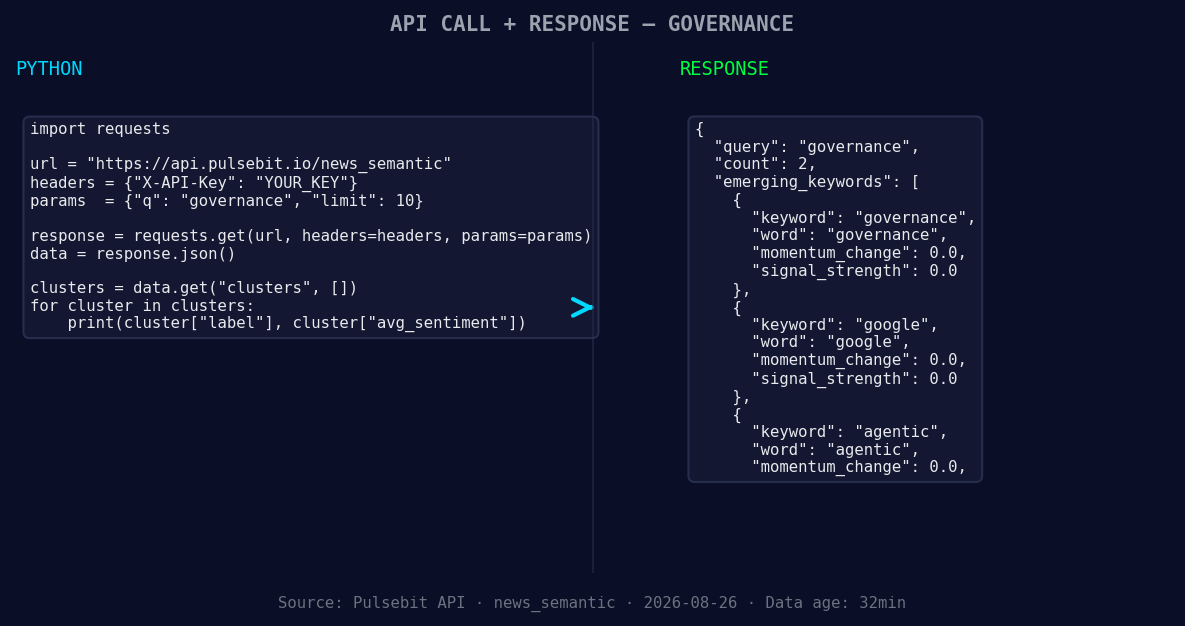
*Left: Python GET /news_semantic call for 'governance'. Right: returned JSON response structure (clusters: 3). Source: Pulsebit /news_semantic.*
# Set the parameters
topic = 'governance'
lang = 'en'
# Geographic origin filter: query by language/country
response = requests.get(f'https://api.pulsebit.com/topics/{topic}?lang={lang}')
data = response.json()
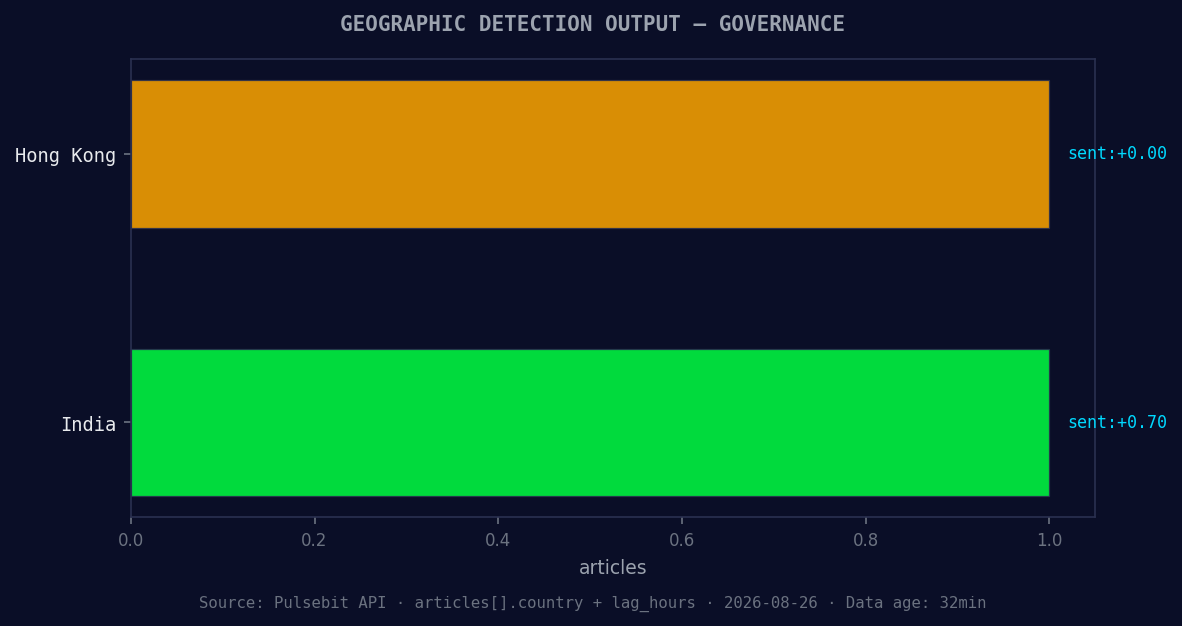
*Geographic detection output for governance. Hong Kong leads with 1 articles and sentiment +0.00. Source: Pulsebit /news_recent geographic fields.*
# Output the relevant data
print(data)
Next, we want to assess the narrative framing surrounding the spike. We can use our API to run the cluster reason string through the POST /sentiment endpoint:
import requests

# Meta-sentiment moment: running the cluster reason string through POST /sentiment
cluster_reason = "Clustered by shared themes: new, governance, suite, brings, compliance-grade."
payload = {
    "text": cluster_reason,
    "confidence": 0.85,
}

response = requests.post('https://api.pulsebit.com/sentiment', json=payload)
meta_sentiment = response.json()

# Output the sentiment score
print(meta_sentiment)
From this anomaly, we can derive three specific builds:
Sentiment Monitoring with Geo-Filter: Set up a pipeline that monitors governance sentiment specifically in English-speaking regions. This could be a simple cron job that hits our API every hour and alerts you if momentum crosses a predefined threshold, say +0.300.
Meta-Sentiment Analysis: Create a dashboard that visualizes the meta-sentiment scores for clustered articles, specifically looking for themes like governance, compliance, and AI. This could allow you to understand not just the sentiment but the narrative context that drives it.
Actionable Insights on Forming Themes: Implement a feature that flags articles with forming themes such as governance, Google, and agentic. You can set a signal threshold based on a combination of sentiment scores and article counts. For instance, alert if there are three or more articles clustering around these themes with a sentiment score above +0.300.
With these builds, you can ensure that your sentiment analysis pipeline remains agile, adaptable, and insightful.
Get started building your own insights at pulsebit.lojenterprise.com/docs. In under 10 minutes, you can copy-paste and run this code to catch opportunities like this in real-time.


Top comments (0)