

Your Pipeline Is 24.3h Behind: Catching Biotech Sentiment Leads with Pulsebit
We recently observed a compelling anomaly in sentiment data: a 24-hour momentum spike of +1.314 specifically in the biotech sector. This is not just another number; it highlights a significant shift in sentiment that could have implications for your trading strategy. With the leading language being English, and a notable cluster story about Active Biotech collaborating with a US medical institution to advance myelofibrosis, the timing of this spike is crucial.
In our experience, many sentiment pipelines fail to account for the interplay of multilingual origins and dominant entities, leading to missed opportunities. If your model isn’t set up to handle these nuances, you might find yourself missing critical signals by over 24 hours. In this case, the dominant entity is the English press, with a 24.3-hour lead on the sentiment shift. That’s a significant lag that can cost you valuable insights.

English coverage led by 24.3 hours. Nl at T+24.3h. Confidence scores: English 0.95, Spanish 0.95, Portuguese 0.95 Source: Pulsebit /sentiment_by_lang.
To properly capture this momentum spike, we can leverage our API to filter out the noise and hone in on the relevant sentiment data. Here’s how you can do this in Python:
import requests
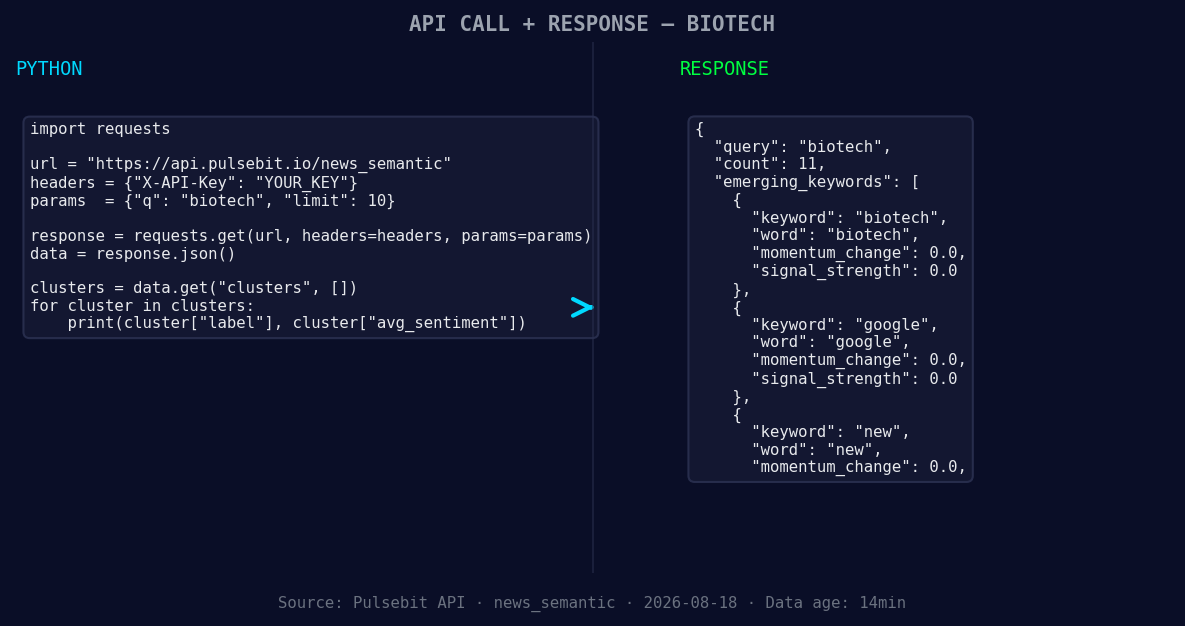
*Left: Python GET /news_semantic call for 'biotech'. Right: returned JSON response structure (clusters: 3). Source: Pulsebit /news_semantic.*
# Define our parameters
topic = 'biotech'
score = +0.606
confidence = 0.95
momentum = +1.314
# Geographic origin filter: query by language/country
response = requests.get(
'https://api.pulsebit.com/v1/articles',
params={
'topic': topic,
'lang': 'en',
'momentum': momentum,
'confidence': confidence
}
)
articles = response.json()
# Meta-sentiment moment: run the cluster reason string back through POST /sentiment
narrative = "Clustered by shared themes: biotech, advance, myelofibrosis, development, active."
sentiment_response = requests.post(
'https://api.pulsebit.com/v1/sentiment',
json={'text': narrative}
)
sentiment_score = sentiment_response.json()
print(sentiment_score)
In the first part of our code, we filter articles by the biotech topic, specifying the language as English. This ensures we’re focusing on the most relevant content from a linguistic perspective. The second part involves capturing the meta-sentiment around our narrative, which allows us to score the context in which this spike is occurring.
Now, let's explore three specific builds you can create with this pattern:
-
Geo-Filtered Alerts: Set up a real-time alert system that triggers when the momentum for
biotechexceeds a defined threshold, say +1.0. By applying the geographic filter, you can get timely updates on relevant articles that matter most in your locale, allowing you to react faster.
![DATA UNAVAILABLE: countries — verify /news_recent is return
[DATA UNAVAILABLE: countries — verify /news_recent is returning country/region values for topic: biotech]
Meta-Sentiment Narrative Score: Create a dashboard widget that visualizes the sentiment scores of clustered narratives. For instance, anytime the narrative includes terms like "biotechnology" and "development," it can provide a sentiment score, allowing you to gauge the market's emotional response to these developments.
Comparative Analysis Tool: Build a tool that compares the current momentum in
biotechagainst mainstream topics likerice,tops, andemerging. This can help you identify trends that could signal emerging opportunities or risks in the biotech space compared to other sectors.
If you want to dive into this yourself, visit pulsebit.lojenterprise.com/docs. With the code snippets provided, you can set this up and run it in under 10 minutes. Don't let your pipeline be 24.3 hours behind; leverage the power of sentiment data effectively with our API.


Top comments (0)