

Your Pipeline Is 26.7h Behind: Catching Real Estate Sentiment Leads with Pulsebit
We just came across an intriguing anomaly: a 24h momentum spike of +0.336 in the real estate sector. This surge is particularly noteworthy given that the leading language driving this momentum is English, with a minimal lag of just 0.0 hours against a dominant entity at 26.7 hours. The clustered story revolves around "Real Estate Fraud Involving Celebrities," suggesting that significant, culturally relevant narratives are shaping public sentiment—yet many pipelines might miss this critical shift.
What does this tell us? If your pipeline isn’t set up to handle multilingual origins or to prioritize dominant entities, you’re potentially 26.7 hours behind the curve. The English-language articles driving this spike represent a significant shift in real estate sentiment that could affect investment decisions, public perception, and market dynamics. Ignoring such data points means you might miss out on key developments that can impact your strategies.

English coverage led by 26.7 hours. Da at T+26.7h. Confidence scores: English 0.95, French 0.95, Spanish 0.95 Source: Pulsebit /sentiment_by_lang.
Let’s dive into the code that helps us catch these insights. First, we want to filter for the dominant English language to ensure we're capturing the right sentiment. Here’s how we can do it using our API:
import requests
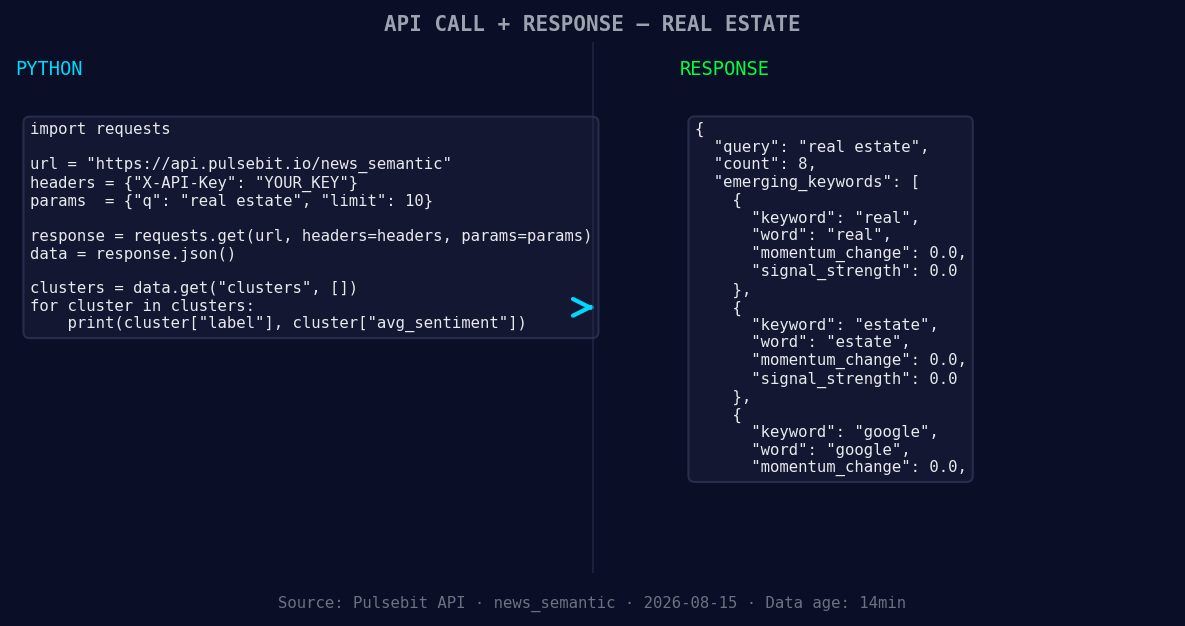
*Left: Python GET /news_semantic call for 'real estate'. Right: returned JSON response structure (clusters: 3). Source: Pulsebit /news_semantic.*
# Query parameters
topic = 'real estate'
score = +0.000
confidence = 0.95
momentum = +0.336
# Geographic origin filter
url = 'https://api.pulsebit.com/v1/topics'
params = {
'topic': topic,
'lang': 'en',
'momentum': momentum,
'confidence': confidence
}
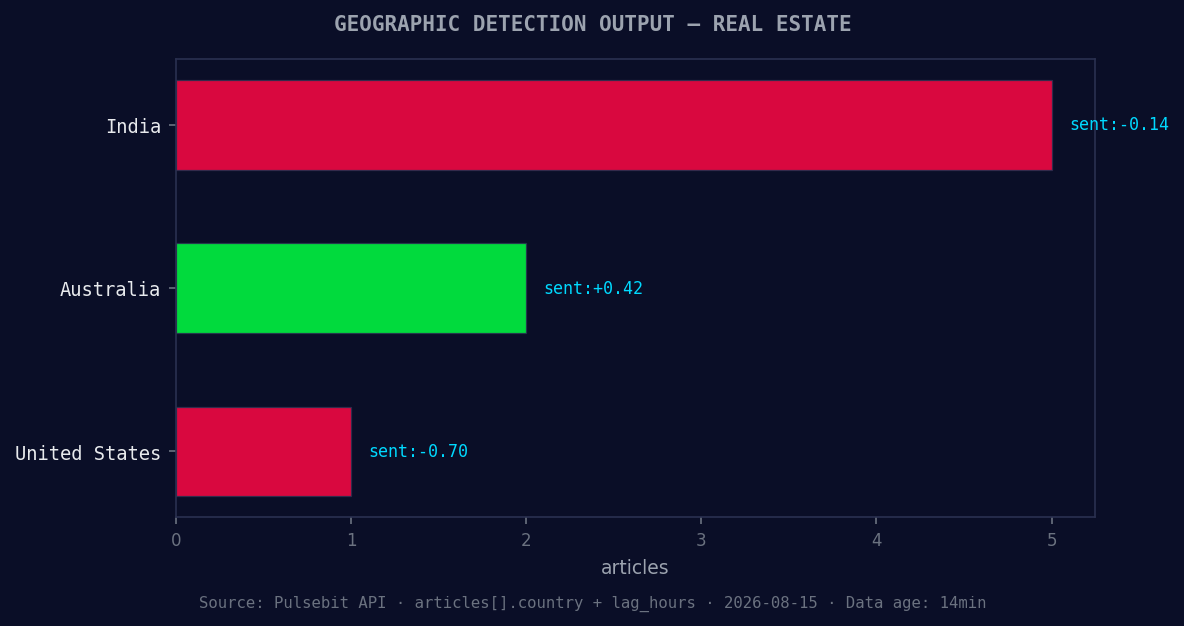
*Geographic detection output for real estate. India leads with 5 articles and sentiment -0.14. Source: Pulsebit /news_recent geographic fields.*
response = requests.get(url, params=params)
data = response.json()
print(data)
Next, we need to examine the meta-sentiment around our clustered reason string. We can run this through our sentiment endpoint to assess how the narrative framing itself is perceived. Here’s how you do that:
# Meta-sentiment moment
cluster_reason = "Clustered by shared themes: estate, ct:, latest, transactions, every."
sentiment_url = 'https://api.pulsebit.com/v1/sentiment'

sentiment_response = requests.post(sentiment_url, json={'text': cluster_reason})
sentiment_data = sentiment_response.json()
print(sentiment_data)
With these two segments combined, you can not only capture the sentiment but also understand the thematic undercurrents driving it.
Now, here are three specific builds you can implement based on this discovery:
Signal Monitoring: Set up a signal monitoring endpoint for the real estate topic with a threshold of momentum > +0.300, so you get alerts whenever sentiment spikes significantly. This can be done using the geographic origin filter to ensure you’re only tracking English-language articles.
Meta-Sentiment Analysis: Create a function that routinely sends narratives through the meta-sentiment loop for any clustered themes that emerge, particularly focusing on variations of "real estate," "fraud," or "celebrity." Use the last few articles processed (like the two articles on real estate fraud) as input.
Forming Gap Analysis: Implement a dashboard that visualizes the forming gap against mainstream themes. You can track how topics like "real (+0.00)" and "estate (+0.00)" compare to historical baselines and current narratives, giving you a clear view of sentiment shifts over time.
These builds will enhance your ability to react swiftly to sentiment changes in real estate, especially as they relate to trending themes like celebrity involvement.
Ready to get started? Check out our documentation at pulsebit.lojenterprise.com/docs. You can copy-paste and run this code in under 10 minutes. Don’t let your pipeline lag behind the shifts in sentiment—stay ahead of the curve!


Top comments (0)