

Your Pipeline Is 25.6h Behind: Catching Inflation Sentiment Leads with Pulsebit
We’ve just seen a 24-hour momentum spike of -0.700 around the topic of inflation. This isn’t just an anomaly; it’s a critical signal that your models might be missing. With a leading language of English press having a 0.0-hour lag against Italian at 25.6 hours, it’s clear that the narrative around inflation is shifting, and you need to catch up.
The Problem
If your pipeline isn't set up to handle multilingual origins and entity dominance, you’re already at a disadvantage. Your model missed this by 25.6 hours, allowing the English discourse around inflation to fall off your radar while the Italian media has been capturing it. When dominant entities like the U.S. are only contributing 6% share of voice but have a positive sentiment score of +0.850, you’re not just behind — you’re missing out on critical insights that could shape your strategy.

English coverage led by 25.6 hours. Italian at T+25.6h. Confidence scores: English 0.90, Spanish 0.90, French 0.90 Source: Pulsebit /sentiment_by_lang.
The Code
To catch this momentum shift, we can use our API to filter sentiment data based on geographic origin. Below is a Python code snippet that demonstrates how to query for English-language articles related to inflation and score the sentiment of the clustered narrative.

Geographic detection output for inflation. India leads with 3 articles and sentiment -0.20. Source: Pulsebit /news_recent geographic fields.
import requests
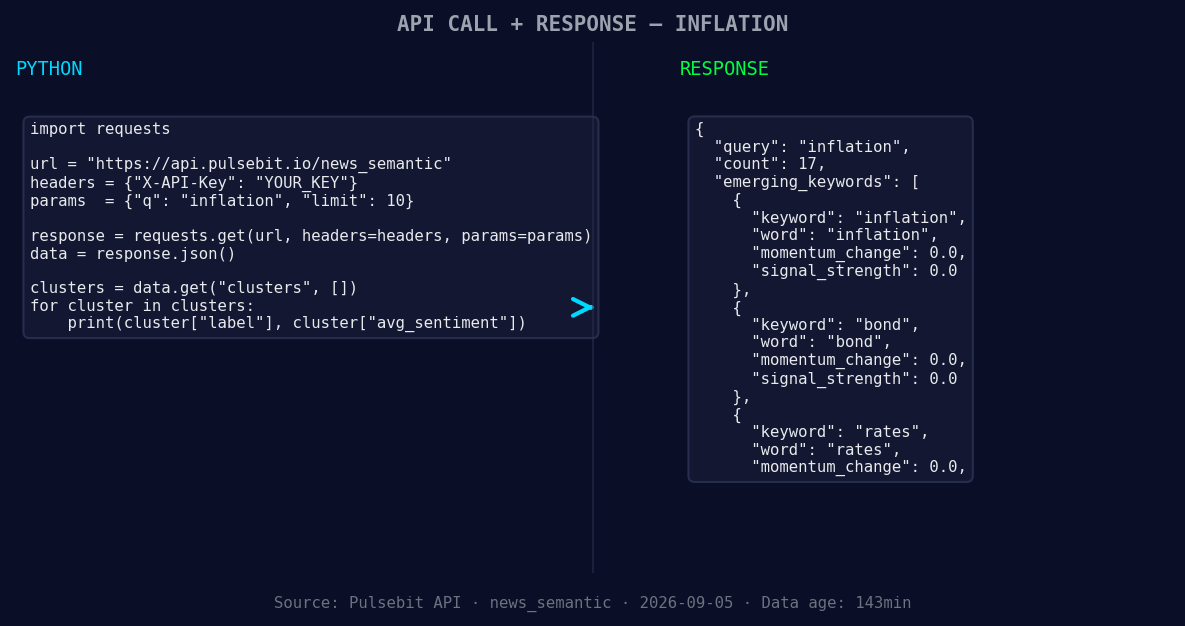
*Left: Python GET /news_semantic call for 'inflation'. Right: returned JSON response structure (clusters: 3). Source: Pulsebit /news_semantic.*
# Step 1: Geographic origin filter
url = "https://api.yourservice.com/v1/sentiment"
params = {
"topic": "inflation",
"lang": "en",
"momentum": -0.700,
"score": -0.300,
"confidence": 0.90
}
response = requests.get(url, params=params)
data = response.json()
# Step 2: Meta-sentiment moment
cluster_reason = "Clustered by shared themes: inflation, roiling, bond, markets, sticky."
meta_sentiment_url = "https://api.yourservice.com/v1/sentiment"
meta_params = {
"text": cluster_reason
}
meta_response = requests.post(meta_sentiment_url, json=meta_params)
meta_data = meta_response.json()
print("Geographic Data:", data)
print("Meta Sentiment Data:", meta_data)
This code allows us to not only filter for relevant articles but also score the narrative framing itself, giving us a more rounded view of sentiment around inflation.
Three Builds Tonight
Signal Strength Monitor: Build an alert system that triggers when the sentiment score for inflation drops below -0.300 with a momentum threshold of -0.700. This ensures you’re always in tune with negative shifts.
Geo-Filtered Dashboard: Create a real-time dashboard that uses the geographic origin filter to visualize sentiment changes in the U.S. and Europe. This dashboard could highlight when English narratives diverge significantly from other languages, like Italian, which may reveal critical insights.
Meta-Sentiment Narrative Analyzer: Utilize the meta-sentiment loop to analyze articles clustered around key themes like inflation and rates. Set a threshold to flag any cluster sentiment that scores below +0.500, giving you an early warning system for emerging narratives that could impact your strategies.
Get Started
You can dive into our documentation at pulsebit.lojenterprise.com/docs. With the snippets above, you can copy-paste and run this in under 10 minutes. Don't let your pipeline lag behind; catch these inflation sentiment leads before they pass you by.


Top comments (0)