

In our latest analysis, we discovered a striking anomaly: a 24-hour momentum spike of +0.280 in sentiment around the topic of innovation. This signals a significant uptick in discussions and interest, particularly in English press narratives led by a 23.6-hour lag. It’s a clear indication that something is brewing in the innovation space, especially given the clustered themes around "rethinking" and "how" innovation happens. This data point isn’t just a number; it’s a call to action for developers to dive deeper into the nuances of sentiment analysis.
So, what does this mean for your pipeline? If you’re not handling multilingual origins or entity dominance, your model missed this momentum shift by more than 23.6 hours. While you were focused on the mainstream narratives, the leading language and dominant entity—English press—were already pivoting towards this fresh wave of innovation discourse. Ignoring these signals could leave you out of the loop on critical developments, especially as themes like "innovation" and "rethinking" gain traction.

English coverage led by 23.6 hours. Nl at T+23.6h. Confidence scores: English 0.85, Spanish 0.85, Portuguese 0.85 Source: Pulsebit /sentiment_by_lang.
Let’s get into the code that can help you catch these insights in real-time. We'll start by filtering the sentiment data by geographic origin, focusing on English language content, which is crucial for timely decision-making.

Geographic detection output for innovation. India leads with 5 articles and sentiment +0.84. Source: Pulsebit /news_recent geographic fields.
import requests
# Define the API endpoint and parameters
api_url = "https://api.pulsebit.lojenterprise.com/sentiment"
params = {
"topic": "innovation",
"lang": "en"
}
# Make the API call
response = requests.get(api_url, params=params)
data = response.json()
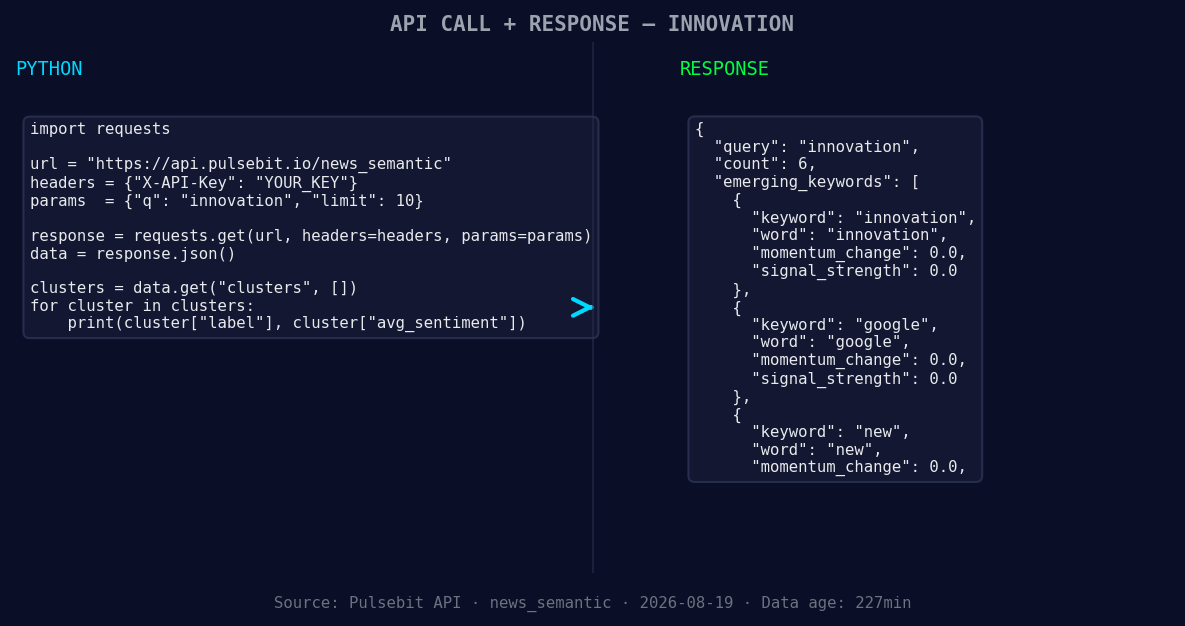
*Left: Python GET /news_semantic call for 'innovation'. Right: returned JSON response structure (clusters: 3). Source: Pulsebit /news_semantic.*
# This prints out the response data
print(data)
Now that we have the data, let’s analyze the meta-sentiment around the narrative itself. We’ll take the cluster reason string and score it to understand the framing better.
# Define the narrative framing
narrative = "Clustered by shared themes: rethinking, how, innovation, q&a:, happens."

# Make a POST request to score the narrative
response_meta = requests.post(api_url, json={"text": narrative})
meta_data = response_meta.json()

# Output the sentiment score for the narrative
print(meta_data)
This dual approach—filtering for language and analyzing the narrative—provides a robust mechanism for capturing sentiment spikes and understanding their context.
With this newfound insight, here are three specific builds we recommend for you tonight:
Geo-Filtered Sentiment Dashboard: Create a real-time dashboard that uses the geo filter to track sentiment around "innovation" specifically in English-speaking countries. Set a threshold for momentum spikes above +0.250 to trigger alerts.
Meta-Sentiment Analysis Tool: Build a sentiment analysis tool that runs narratives through the meta-sentiment loop. Focus on recent articles discussing themes like "rethinking" and "how innovation happens," scoring these narratives to gauge public perception.
Clustered Theme Tracker: Develop a script that tracks forming themes like "innovation," "google," and "new" against mainstream narratives. Use the threshold of a sentiment score above +0.500 to identify articles that diverge from the mainstream discourse.
If you’re ready to start harnessing these insights, head over to our documentation at pulsebit.lojenterprise.com/docs. You can copy, paste, and run these examples in under 10 minutes, putting you right on the cutting edge of sentiment analysis.


Top comments (0)