

Your Pipeline Is 27.1h Behind: Catching Healthcare Sentiment Leads with Pulsebit
We recently discovered a significant anomaly in our sentiment data: a 24h momentum spike of +0.305 in the healthcare sector. This spike, driven by a notable cluster story titled "Community Health Systems at Healthcare Conference," reveals a surge in positive sentiment that your current pipeline may not be capturing in time. With the leading language being English press at 27.1 hours, this data could be critical for your strategies if only you were aware of it sooner.
If your sentiment analysis model isn't equipped to handle multilingual origins or dominant entities effectively, you could be missing out on vital insights like this one. Your model missed this spike by 27.1 hours, which is unacceptable in a fast-paced environment where timely information can make or break decisions. The leading language in this case, English, highlights just how crucial it is to ensure your pipeline can detect and react to emerging trends across different languages.

English coverage led by 27.1 hours. Nl at T+27.1h. Confidence scores: English 0.90, Spanish 0.90, French 0.90 Source: Pulsebit /sentiment_by_lang.
Here’s how to catch this momentum spike using our API. The first step is to filter by geographic origin. We’ll query for English-language articles related to healthcare with a specific score and confidence level. Here’s the Python code to do that:

Geographic detection output for healthcare. India leads with 3 articles and sentiment +0.35. Source: Pulsebit /news_recent geographic fields.
import requests
# Define the parameters
topic = 'healthcare'
score = +0.272
confidence = 0.90
momentum = +0.305
# API call to get articles filtered by language
response = requests.get('https://api.pulsebit.com/articles', params={
'topic': topic,
'score': score,
'confidence': confidence,
'lang': 'en'
})
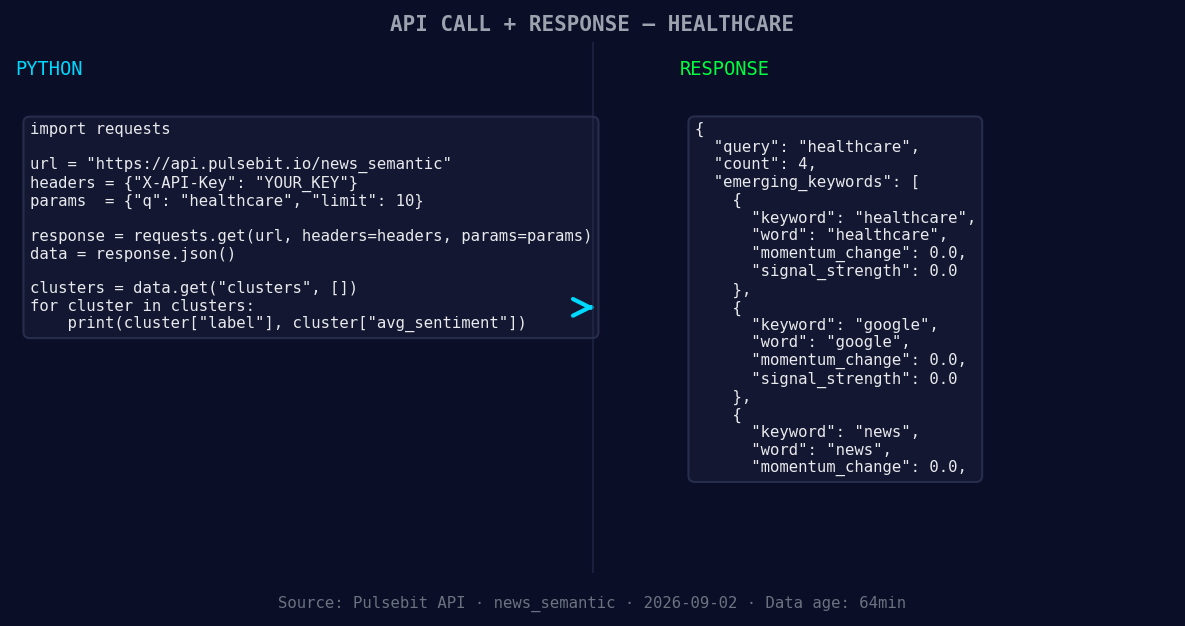
*Left: Python GET /news_semantic call for 'healthcare'. Right: returned JSON response structure (clusters: 3). Source: Pulsebit /news_semantic.*
articles = response.json()
print(articles)
Now that we’ve filtered the articles, let’s take the cluster reason string and run it back through our sentiment analysis to score the narrative framing itself. This step is crucial, as it evaluates how well the cluster's themes resonate within the broader context:
# Define the cluster reason string
cluster_reason = "Clustered by shared themes: health, systems, participate, wells, fargo."

# API call to score the sentiment of the cluster reason
sentiment_response = requests.post('https://api.pulsebit.com/sentiment', json={
    'text': cluster_reason
})

sentiment_score = sentiment_response.json()
print(sentiment_score)
Now that we’ve captured the relevant articles and scored the narrative, here are three specific builds you can implement using this pattern:
Real-time alerting system: Set a signal threshold for healthcare sentiment above +0.300. Use the geo filter to ensure you only receive alerts for English-language articles, allowing you to react quickly to emerging trends.
Meta-sentiment dashboard: Create a dashboard displaying sentiment scores of various narratives, including the cluster reasons. Use the meta-sentiment loop to visualize how different themes like healthcare, Google, and news compare against mainstream topics like health, systems, and participation.
Adaptive content strategy: Develop an API endpoint that combines sentiment analysis with article clustering. Use the insights from our API to dynamically adjust your content strategy based on the sentiment surrounding healthcare-related topics, ensuring you capitalize on positive momentum when it arises.
To get started with these concepts, check out our documentation at pulsebit.lojenterprise.com/docs. You can copy-paste and run the provided code in under 10 minutes, allowing you to start leveraging these insights for your applications right away. Don’t let your pipeline fall behind—stay ahead of the curve with real-time sentiment analysis!


Top comments (0)