

Your Pipeline Is 17.4h Behind: Catching Law Sentiment Leads with Pulsebit
We recently spotted a compelling anomaly: a 24h momentum spike of +0.375 in the topic of law. This spike was significantly driven by coverage in English, leading by 17.4 hours, with no lag compared to Spanish. The narrative centers around a jury convicting a blockchain partner of wire fraud, which has clustered the sentiment around critical themes like "cal," "jury," "convicts," and "blockchain." This is a clear indicator that something significant is unfolding, and if your pipeline isn’t equipped to catch these multi-language stories, you might miss critical signals.
The problem here is glaring: your model missed this by 17.4 hours. When you only process data in one language or fail to recognize dominant entities across languages, you’re setting yourself up for a significant lag in sentiment tracking. The English press is driving the narrative, while your system might be stuck analyzing data that doesn’t capture the full picture. If you're only processing Spanish, you might miss crucial developments like this one, which could affect decision-making.
Here's how we can catch this momentum spike using our API. We need to filter our query by language and then run the cluster reason string back through our sentiment analysis endpoint.
import requests
# Define parameters for the language filter
params = {
"topic": "law",
"lang": "en", # Filtering for English articles
}
# API call to fetch articles with the specified parameters
response = requests.get('https://api.pulsebit.com/articles', params=params)
articles = response.json()
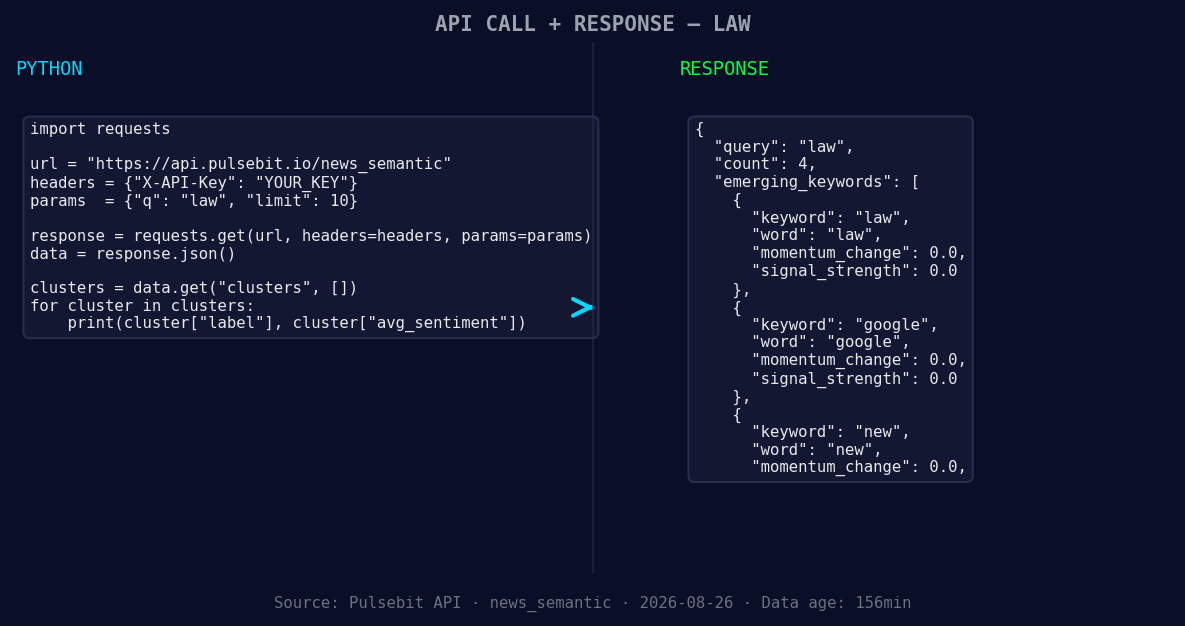
*Left: Python GET /news_semantic call for 'law'. Right: returned JSON response structure (clusters: 3). Source: Pulsebit /news_semantic.*
# Print the articles to see what we've fetched
print(articles)
# Now, let's analyze the cluster reason
cluster_reason = "Clustered by shared themes: cal, jury, convicts, blockchain, partner."
# Perform sentiment analysis on the cluster reason
sentiment_response = requests.post(
'https://api.pulsebit.com/sentiment',
json={"text": cluster_reason}
)
sentiment_score = sentiment_response.json()
# Print the sentiment score to understand the narrative framing
print(sentiment_score)
With this code, we filter articles related to law in English and analyze the sentiment surrounding our cluster reason. This is not only crucial for understanding the emerging themes but also helps in framing the narrative correctly.
Now, let’s explore three builds you can implement based on this discovery:
Geo-Focused Sentiment Analysis: Create a signal that tracks law-related articles specifically from English-speaking regions while setting a threshold for momentum spikes above +0.2. This way, you can catch emerging legal trends in real-time.
Meta-Sentiment Loop: Use the narrative framing of the cluster reason as a signal to adjust your sentiment score thresholds. If your score dips below -0.3, trigger alerts for further investigation into the clustered themes like "cal," "jury," and "convicts."
Forming Themes Alert: Build an endpoint that notifies you when themes like "new" and "google" begin to emerge alongside your existing law-related clusters. Set alerts for when the momentum exceeds +0.1, ensuring you're on top of shifting narratives.
By leveraging our API, you can adapt your pipeline to capture these critical sentiment shifts.
To get started, check out our documentation at pulsebit.lojenterprise.com/docs. You can copy, paste, and run the code above in under 10 minutes to start catching those crucial signals that can impact your strategies.

English coverage led by 17.4 hours. Spanish at T+17.4h. Confidence scores: English 0.85, French 0.85, Spanish 0.85 Source: Pulsebit /sentiment_by_lang.


Top comments (0)