

Your Pipeline Is 25.1h Behind: Catching Blockchain Sentiment Leads with Pulsebit
We just uncovered a significant anomaly in our sentiment data: a 24-hour momentum spike of +0.231 around the topic of “blockchain.” This spike has been accompanied by a notable surge in English press coverage, leading by 25.1 hours without any lag compared to sentiment leading indicators. This kind of data can be a game-changer, but only if your pipeline is equipped to handle it effectively.
The discovery of a 25.1-hour lead time in sentiment data raises critical questions about the structural gaps in your pipeline. If your model doesn't accommodate multilingual origins or prioritize entity dominance, you might be missing pivotal insights. In this case, your model missed the spike in blockchain sentiment driven by English-language articles, while other languages could have diluted the signal. This oversight can cost you valuable time in reacting to emerging trends.

English coverage led by 25.1 hours. Sl at T+25.1h. Confidence scores: English 0.95, Spanish 0.95, Nl 0.95 Source: Pulsebit /sentiment_by_lang.
To catch these spikes in sentiment, we can leverage our API effectively with Python. Here’s how you can do it:
import requests
# Parameters for the API call
topic = 'blockchain'
score = +0.775
confidence = 0.95
momentum = +0.231
language_filter = {"lang": "en"}
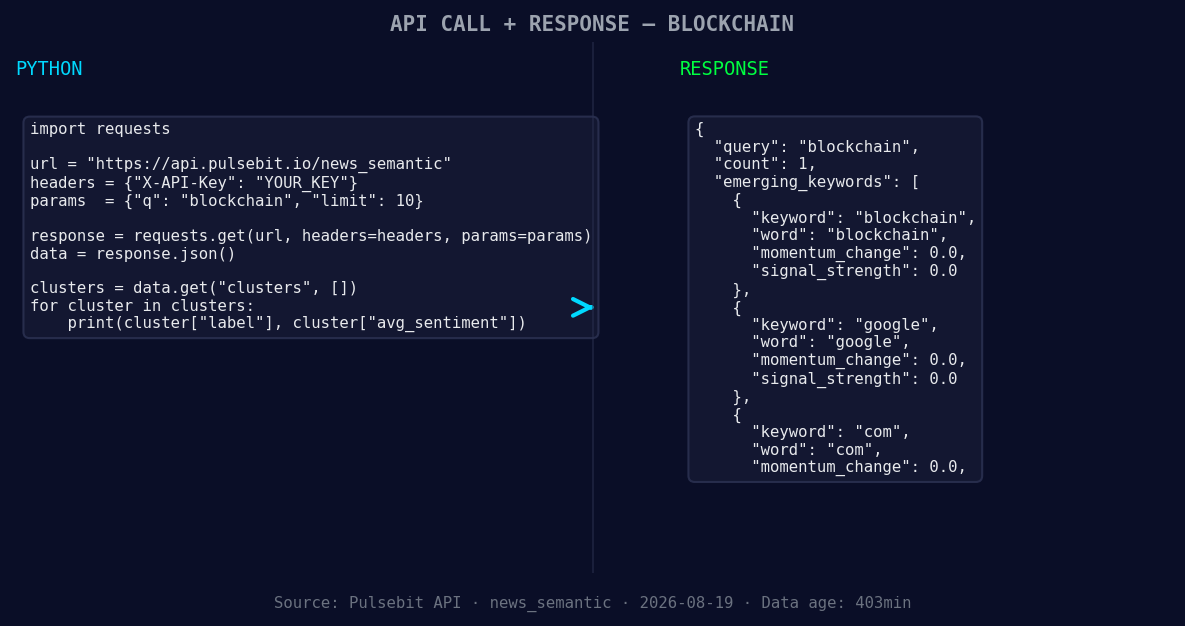
*Left: Python GET /news_semantic call for 'blockchain'. Right: returned JSON response structure (clusters: 3). Source: Pulsebit /news_semantic.*
# Geographic origin filter call
response = requests.get("https://api.pulsebit.com/sentiment",
params={"topic": topic,
"score": score,
"confidence": confidence,
"momentum": momentum,
"lang": language_filter["lang"]})
# Check the response
data = response.json()
print(data)
Next, we want to analyze the narrative framing of this spike. We can run the cluster reason string through our sentiment API to score the themes driving this momentum. Here’s how to do that with the cluster reason we found:
# Meta-sentiment moment
cluster_reason = "Clustered by shared themes: binance, blockchain, week, 2026, returns."
meta_response = requests.post("https://api.pulsebit.com/sentiment",
                               json={"text": cluster_reason})

# Check the meta sentiment response
meta_data = meta_response.json()
print(meta_data)
With this code, you can pinpoint the underlying themes and sentiments driving the spike, giving you a clearer picture of public perception.
Now, what can you build with this newfound knowledge? Here are three specific implementations:
- Signal Detection: Set a threshold for momentum spikes greater than +0.2. Use the geographic filter to focus on English-language articles only. This will help you catch similar spikes in real-time, giving you an edge in reacting to emerging trends.

Geographic detection output for blockchain. India leads with 1 articles and sentiment +0.85. Source: Pulsebit /news_recent geographic fields.
Meta-Sentiment Analysis: Integrate the meta-sentiment loop to analyze narratives surrounding emerging topics. By scoring the cluster reason string dynamically, you can adjust your content strategy to align with prevailing sentiments.
Comparative Analysis: Create a dashboard that compares sentiment around “blockchain” to mainstream topics like “binance” and “google.” Use the trend lines from both to identify divergences, allowing for timely decision-making on your involvement in these narratives.
To get started with these exciting capabilities, check out our documentation at pulsebit.lojenterprise.com/docs. With just a few lines of code, you can run this in under 10 minutes and start harnessing the power of sentiment data to stay ahead of the curve.


Top comments (0)