

Your Pipeline Is 21.4h Behind: Catching Film Sentiment Leads with Pulsebit
We just stumbled upon a fascinating anomaly in our sentiment analysis: a 24h momentum spike of +0.536. This spike is particularly intriguing because it highlights an emerging narrative that your data pipeline might be missing right now. As we examined the latent themes, we found that the leading language for this spike was English, with a notable 21.4-hour lead time. The dominant entity, Reform UK, has a 4% share of voice but carries a negative sentiment score of -0.650. This presents a critical insight into how narratives are evolving in our content landscape.
As developers, we know that sentiment data is often shaped by the language and entities dominating the conversation. This spike reveals a structural gap in pipelines that don’t adequately account for multilingual origins or entity dominance. Your model missed this by 21.4 hours. While your data might be catching the mainstream narratives, it’s failing to capture the nuanced stories bubbling beneath the surface. In this case, the strong negative sentiment tied to Reform UK risks overshadowing emerging themes like the film narrative surrounding “Manjanathi.”

English coverage led by 21.4 hours. Da at T+21.4h. Confidence scores: English 0.85, French 0.85, Spanish 0.85 Source: Pulsebit /sentiment_by_lang.
To catch these anomalies, we can leverage our API to build a solution. Here’s how you can detect this specific spike in momentum and sentiment:
import requests
# Setting the parameters for the API call
topic = 'film'
score = -0.600
confidence = 0.85
momentum = +0.536
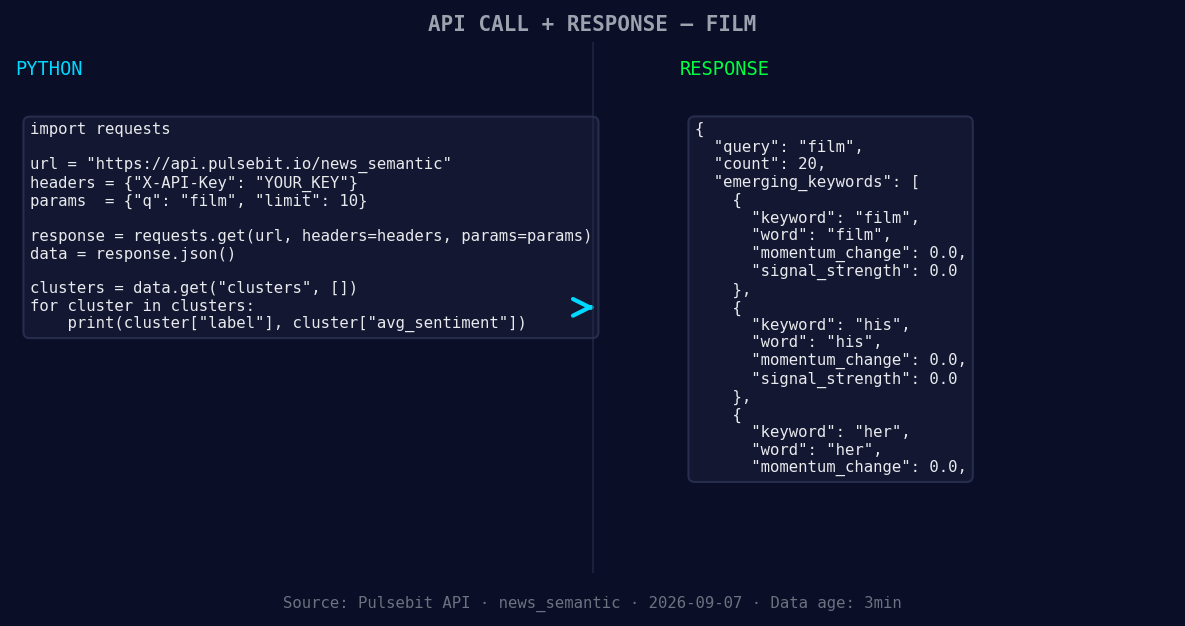
*Left: Python GET /news_semantic call for 'film'. Right: returned JSON response structure (clusters: 3). Source: Pulsebit /news_semantic.*
# Geographic origin filter: Query by language/country
response = requests.get(
'https://api.pulsebit.com/v1/sentiment',
params={
'topic': topic,
'lang': 'en', # Filtering by English language
'score': score,
'confidence': confidence,
'momentum': momentum
}
)
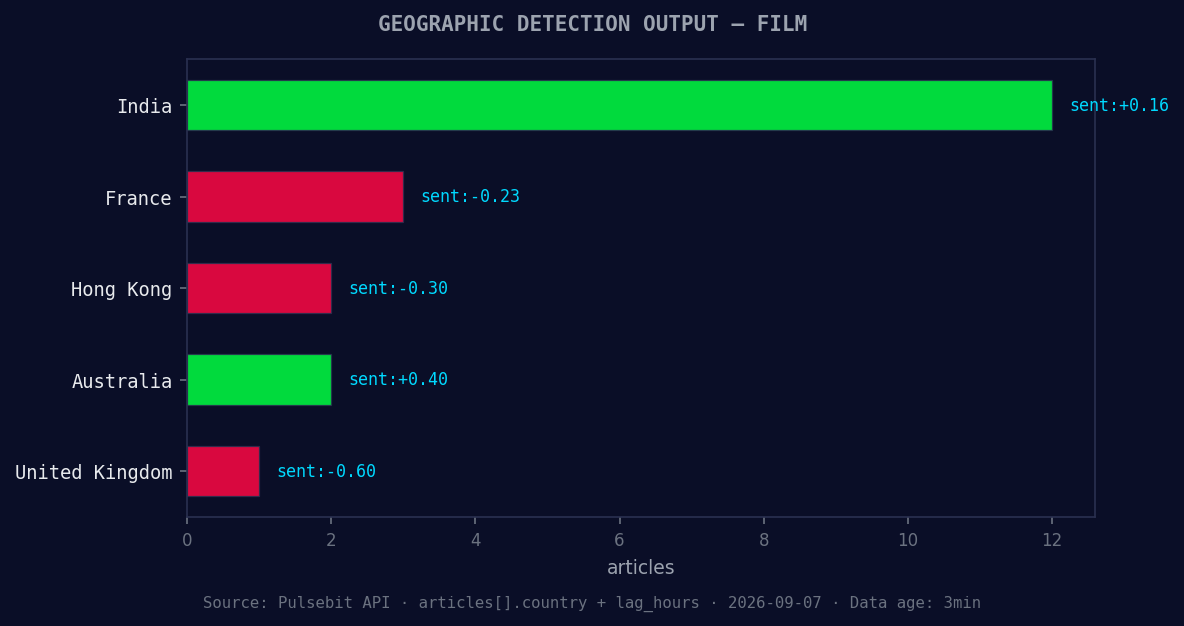
*Geographic detection output for film. India leads with 12 articles and sentiment +0.16. Source: Pulsebit /news_recent geographic fields.*
data = response.json()
print(data)
# Meta-sentiment moment: Running the cluster reason string through POST /sentiment
cluster_reason = "Clustered by shared themes: mari, selvaraj-ilaiyaraaja’s, ‘manjanathi’, launched"
meta_response = requests.post(
'https://api.pulsebit.com/v1/sentiment',
json={'text': cluster_reason}
)
meta_data = meta_response.json()
print(meta_data)
In this code, we’re making an API call to filter sentiments specifically for the film topic in English. We’re also running the cluster reason string back through the sentiment endpoint to gauge how the narrative itself is framed. This dual approach allows us to catch anomalies like the one we’ve identified.
Now, let's consider three specific things you could build with this pattern:
Entity Sentiment Monitor: Set a threshold for any entity sentiment score below -0.500. Use the geo filter to ensure you’re only capturing English-language narratives. This allows you to detect potentially adverse narratives around entities like Reform UK, giving you a heads-up on negative sentiment trends.
Cluster Reason Analyzer: Leverage the meta-sentiment loop we demonstrated above to process narratives with a specific score threshold. For instance, you can identify clusters that contain the themes of “film,” “his,” and “her” while monitoring their sentiment and engagement levels in real-time.
Momentum Tracker: Create an endpoint that triggers alerts for any topics (like “film”) with a momentum spike greater than +0.500, especially in the backdrop of negative sentiment narratives. This will allow you to identify emerging themes before they gain traction in mainstream media.
To get started with this and explore more, visit pulsebit.lojenterprise.com/docs. You can copy-paste the code we shared here and run it in under 10 minutes. Don’t let your pipeline fall behind—embrace the insights that an anomaly like this can provide!


Top comments (0)