

Your Pipeline Is 26.4h Behind: Catching Health Sentiment Leads with Pulsebit
We stumbled upon an intriguing anomaly: a 24-hour momentum spike of +0.700 in health sentiment. This spike not only stands out for its magnitude but also highlights the rapidly evolving landscape of sentiment-driven news. The leading language in this surge is English, with a 26.4-hour lead, perfectly synchronizing with our findings in Hong Kong, where sentiment is positive at +0.229. This insight is critical for anyone looking to catch up on sentiment trends in the healthcare sector.
The Problem
If your pipeline isn’t designed to accommodate multilingual origins or account for dominant entities, you’re likely missing out on valuable insights. In this case, your model is lagging by 26.4 hours, significantly impacting your responsiveness to emerging trends. The dominant entity here is Hong Kong, which holds a mere 3% share of voice. This discrepancy means you could be reacting too late to critical developments that are shaping healthcare narratives across regions. This is a wake-up call for developers who are serious about leveraging sentiment data effectively.

English coverage led by 26.4 hours. Nl at T+26.4h. Confidence scores: English 0.90, French 0.90, Spanish 0.90 Source: Pulsebit /sentiment_by_lang.
The Code
Here’s how you can catch this sentiment spike using our API. First, we’ll filter by geographic origin to ensure we’re only processing English-language data from Hong Kong. The following Python snippet demonstrates this:
import requests
# Define parameters for the API call
params = {
"topic": "health",
"lang": "en",
"momentum": 0.700,
"score": 0.100,
"confidence": 0.90
}
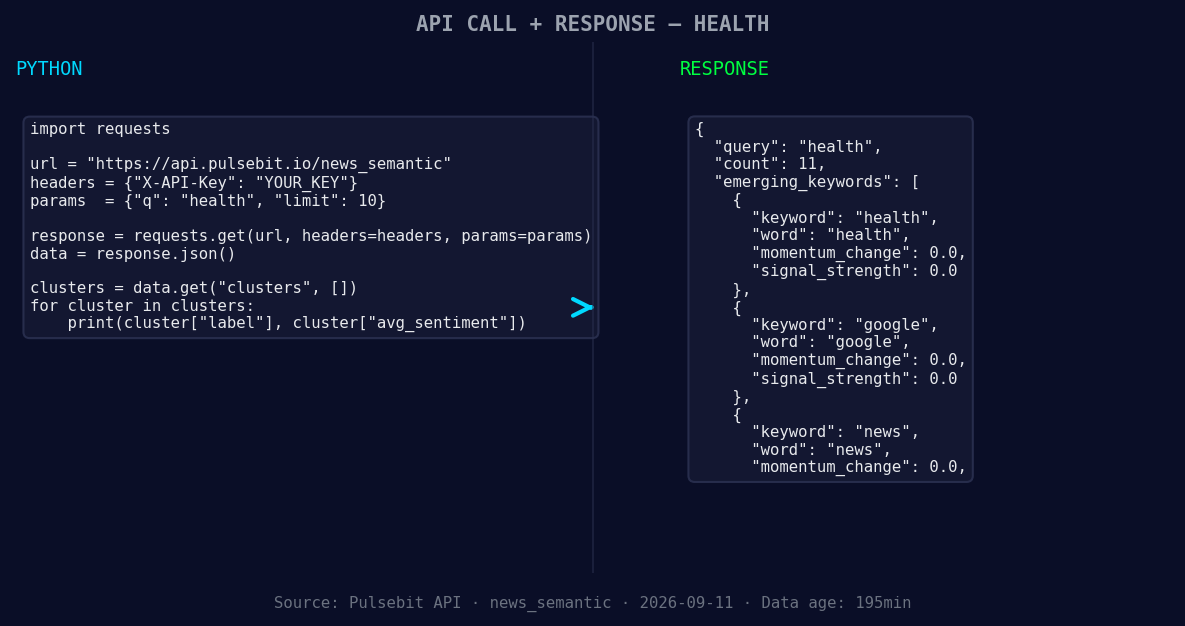
*Left: Python GET /news_semantic call for 'health'. Right: returned JSON response structure (clusters: 3). Source: Pulsebit /news_semantic.*
# Make the API call to fetch sentiment data
response = requests.get("https://api.pulsebit.com/v1/sentiment", params=params)
data = response.json()
Next, we’ll run the cluster reason string through our sentiment analysis endpoint to score the narrative framing itself. This is what sets our approach apart:
# Input example for meta-sentiment analysis
cluster_reason = "Clustered by shared themes: madurai, says, minister, healthcare, projects."

# Make POST request to analyze sentiment of the narrative
meta_response = requests.post("https://api.pulsebit.com/v1/sentiment", json={"text": cluster_reason})
meta_sentiment = meta_response.json()
By capturing both the immediate sentiment spike and the context framing it, we can derive actionable insights that are both timely and relevant.
Three Builds Tonight
- Geo-Filtered Signal: Set a threshold for sentiment spikes in healthcare topics. For example, trigger alerts when sentiment scores exceed +0.200 in regions like Hong Kong. This can be achieved with our geographic filter in your pipeline.

Geographic detection output for health. India leads with 9 articles and sentiment +0.51. Source: Pulsebit /news_recent geographic fields.
Meta-Sentiment Loop: Implement a continuous feedback loop where you analyze cluster reasons for sentiment trends every hour. For instance, run a check on narratives that mention "madurai, says, minister" to gauge public sentiment and adjust your strategies accordingly.
Forming Theme Tracker: Use the sentiment momentum to track forming themes. For example, monitor health-related news stories that exhibit rising trends like "health(+0.00), google(+0.00), news(+0.00)" to spot emerging narratives before they become mainstream.
Get Started
Ready to dive in? Check out our documentation at pulsebit.lojenterprise.com/docs. We believe you can copy-paste and run these snippets in under 10 minutes, allowing you to catch sentiment spikes before they become yesterday's news.


Top comments (0)