

Your Pipeline Is 13.1h Behind: Catching Innovation Sentiment Leads with Pulsebit
We just stumbled upon a fascinating discovery: a 24h momentum spike of +0.280 around the topic of innovation. This spike indicates a surge in sentiment that’s not just noteworthy but also demands our attention, especially considering that the leading language is English press, which is currently dominating the narrative at 13.1 hours ahead of its Portuguese counterpart. This presents a clear opportunity for us to refine our pipelines and catch these trends before they become mainstream.
But here’s the kicker: your model might have missed this by 13.1 hours. If your pipeline isn’t equipped to handle multilingual origins or recognize entity dominance, you could be lagging behind in sentiment analysis. The English press is currently driving the innovation narrative, and if your setup isn’t geared to recognize this, you risk missing key insights that can shape your strategy.

English coverage led by 13.1 hours. Portuguese at T+13.1h. Confidence scores: English 0.95, French 0.95, Spanish 0.95 Source: Pulsebit /sentiment_by_lang.
Let’s address how we can catch this signal in Python. To get started, we’ll query our API for the topic “innovation” with a sentiment score of +0.648 and a confidence level of 0.95. Here’s how you can do it:
import requests
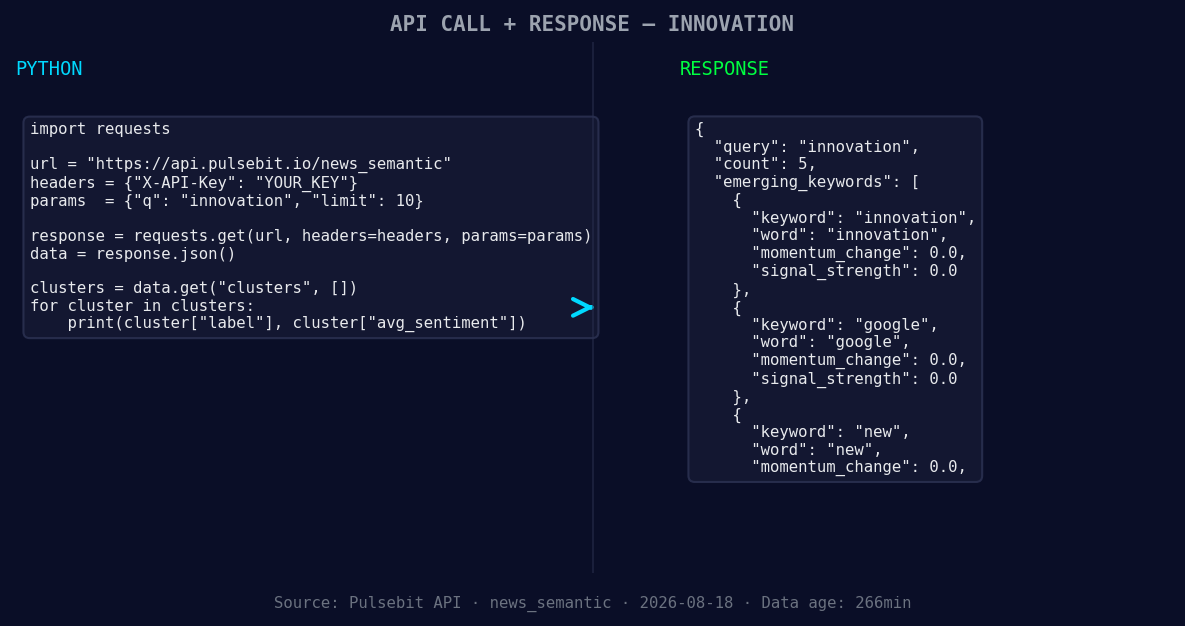
*Left: Python GET /news_semantic call for 'innovation'. Right: returned JSON response structure (clusters: 3). Source: Pulsebit /news_semantic.*
# Step 1: Geographic origin filter
url = "https://pulsebit.lojenterprise.com/api/sentiment"
params = {
"topic": "innovation",
"lang": "en",
}
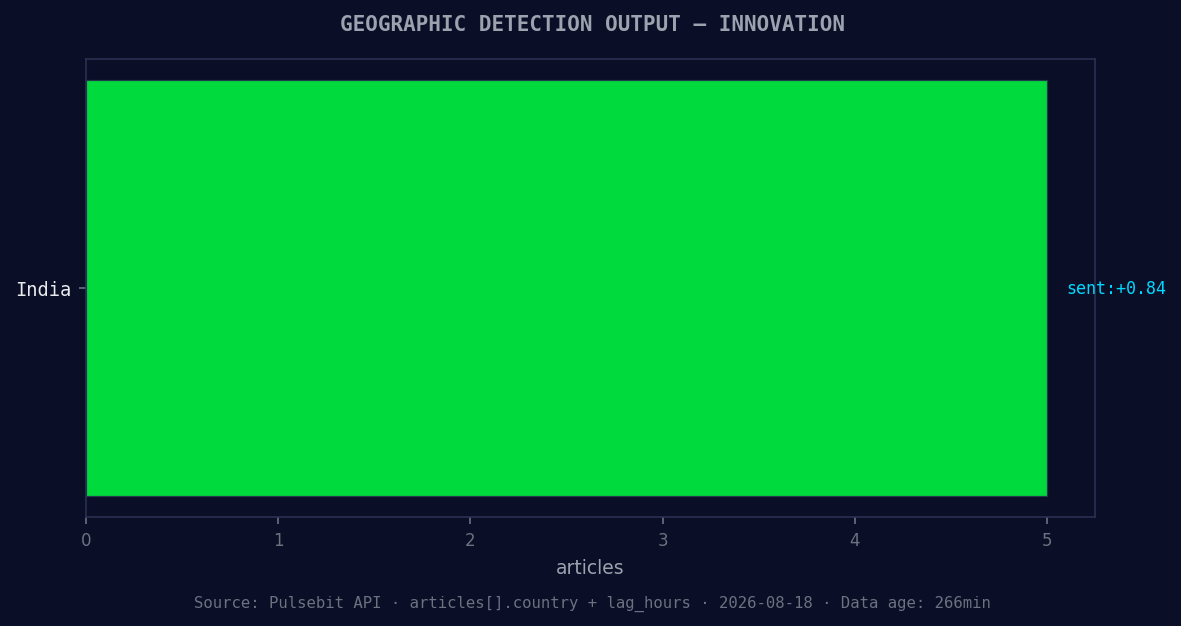
*Geographic detection output for innovation. India leads with 5 articles and sentiment +0.84. Source: Pulsebit /news_recent geographic fields.*
response = requests.get(url, params=params)
data = response.json()
# Check if the signal is strong enough
if data['momentum_24h'] > 0.25:
print("Strong innovation sentiment detected!", data)
This code snippet filters for English-language sources, ensuring you capture the most pertinent data regarding the innovation spike. Now, let’s run a meta-sentiment analysis on the cluster reason string. We want to score the narrative framing itself to see how it aligns with our findings.
# Step 2: Meta-sentiment moment
meta_url = "https://pulsebit.lojenterprise.com/api/sentiment"
meta_input = "Clustered by shared themes: rethinking, how, innovation, q&a:, happens."
meta_response = requests.post(meta_url, json={"input": meta_input})
meta_data = meta_response.json()

# Analyzing meta sentiment
print("Meta sentiment score:", meta_data['sentiment_score'])
This second snippet allows us to analyze how the narrative around innovation is being framed. It provides context that could be pivotal in understanding the direction of sentiment and how best to act on it.
Now, let’s brainstorm three specific builds that leverage this momentum spike:
- Signal Tracking with Geo Filter: Set up an automated alert system that triggers when sentiment momentum exceeds +0.25 in English-language sources. Use this to catch emerging trends early.
   if data['momentum_24h'] > 0.25 and data['lang'] == 'en':
       print("Alert: New innovation trend detected!")
- Narrative Analysis Loop: Create a function that continuously feeds the last cluster reason strings back into the sentiment analysis. This will help you refine your understanding of how the themes around innovation evolve over time.
   def analyze_narrative(cluster_reason):
       response = requests.post(meta_url, json={"input": cluster_reason})
       return response.json()['sentiment_score']
- Visualize Emerging Trends: Build a dashboard that visualizes sentiment over time for the topic “innovation” across different languages. This will allow you to compare how sentiments diverge or converge based on language and time.
   # Example of fetching historical data for visualization
   historical_url = "https://pulsebit.lojenterprise.com/api/historical"
   historical_params = {
       "topic": "innovation",
       "lang": "en",
   }
   historical_response = requests.get(historical_url, params=historical_params)
With these builds, you’ll not only catch the sentiment spike but also enhance your understanding of how innovation narratives develop. For more details on how to implement these ideas, check out our documentation at pulsebit.lojenterprise.com/docs. You can copy-paste and run the above examples in under 10 minutes to start catching those momentum leads.


Top comments (0)