

Your Pipeline Is 13.8h Behind: Catching Crypto Sentiment Leads with Pulsebit
We recently discovered an anomaly in the sentiment data for the crypto space: a sentiment score of +0.183 and a momentum of +0.000. This indicates a surprising uptick in positive sentiment, but what really caught our attention is the 13.8-hour lead from English press coverage. If your model doesn’t account for multilingual origin or entity dominance, you may have missed this insight entirely.

English coverage led by 13.8 hours. Ca at T+13.8h. Confidence scores: English 0.90, French 0.90, Id 0.90 Source: Pulsebit /sentiment_by_lang.
The gap here is significant. Your model missed this by 13.8 hours, failing to capture the early sentiment shift driven by the leading English language articles. While other languages and entities may have been slower to respond, the English sentiment surge signals an important trend that could shift market dynamics. This could mean you're operating with outdated information, leading to missed opportunities or inadequate responses.
To catch up, we can leverage our API to capture this sentiment shift. Here's how you can do it with a straightforward Python script:
import requests
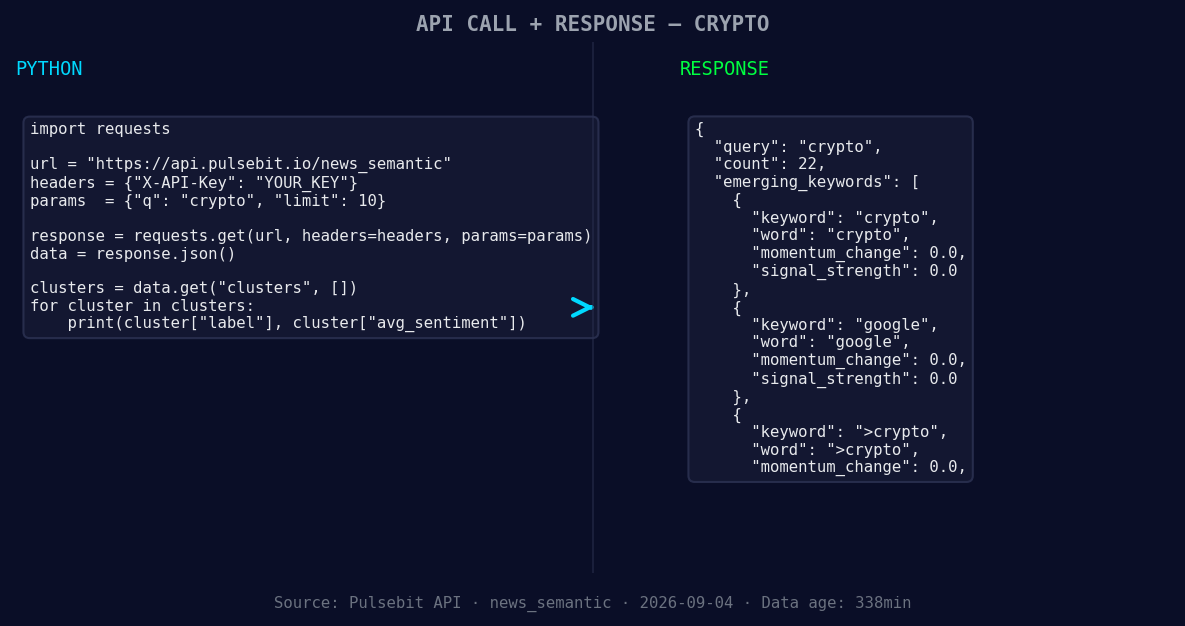
*Left: Python GET /news_semantic call for 'crypto'. Right: returned JSON response structure (clusters: 3). Source: Pulsebit /news_semantic.*
# Step 1: Geographic origin filter for English language
url = "https://api.pulsebit.com/sentiment"
params = {
"topic": "crypto",
"score": +0.183,
"confidence": 0.90,
"momentum": +0.000,
"lang": "en"
}
*[DATA UNAVAILABLE: countries — verify /news_recent is returning country/region values for topic: crypto]*
response = requests.get(url, params=params)
data = response.json()
# Check response
print(data)
This code snippet fetches sentiment data specifically for the English language, ensuring that we’re looking at the right audience for the crypto topic.
Next, we want to run the narrative through our meta-sentiment endpoint to score the context framing. Let’s take the cluster reason string and POST it to our sentiment API.
# Step 2: Meta-sentiment moment
meta_url = "https://api.pulsebit.com/sentiment"
meta_data = {
    "text": "Clustered by shared themes: 0904, crypto, cecildaily, com,"
}

meta_response = requests.post(meta_url, json=meta_data)
meta_data_result = meta_response.json()

# Check response
print(meta_data_result)
This gives us insight into how the narrative is being framed around our key topics, allowing us to refine our understanding of sentiment in a more nuanced way.
Now that we’ve captured the data, here are three builds that can enhance your pipeline based on this pattern:
Geo-Sensitive Alerts: Set up a threshold signal for crypto sentiment in English with a score above +0.15. This identifies potential spikes early, allowing you to react faster and better align your trading strategies.
Meta-Sentiment Analyzer: Use the meta-sentiment loop to evaluate and score narrative frameworks. If the sentiment score of the cluster reason string is above +0.15, flag it for deeper analysis. This could reveal how narratives are being shaped and which angles are gaining traction.
Forming Theme Monitor: Implement a monitoring endpoint that tracks forming themes like "crypto(+0.00)" versus mainstream sources. If the crypto sentiment diverges significantly from other major topics (like Google’s sentiment), trigger alerts for further investigation.
With these builds, you can bolster your sentiment analysis capabilities and ensure you’re not left behind as trends emerge.
To get started, visit our documentation at pulsebit.lojenterprise.com/docs. You can copy-paste and run this in under 10 minutes, so dive into the code and start catching those leads!


Top comments (0)