

Your Pipeline Is 22.1h Behind: Catching Health Sentiment Leads with Pulsebit
We recently uncovered an intriguing anomaly: a 24h momentum spike of -1.600 in health sentiment. With such a significant drop, you'd think it would be front and center in our models. Yet, the leading language for the press coverage was English, lagging behind by 22.1 hours compared to the coverage in other languages. This lag indicates a crucial moment where our pipeline missed the mark, failing to catch a pressing health narrative.
This gap highlights a critical flaw in pipelines that don’t consider multilingual origins and entity dominance. You might find that your model has overlooked vital information, missing the sentiment shift by 22.1 hours. In this case, the leading entity was J.P. Nadda, with a cluster story focusing on the H1N1 situation and healthcare preparedness. When your pipeline doesn't adapt dynamically to the language and topical shifts, it risks falling behind on crucial insights.

English coverage led by 22.1 hours. Ca at T+22.1h. Confidence scores: English 0.90, Spanish 0.90, French 0.90 Source: Pulsebit /sentiment_by_lang.
Here’s the Python code that can catch such momentum shifts effectively, ensuring your model stays relevant:
import requests
# Define our parameters
topic = 'health'
score = +0.028
confidence = 0.90
momentum = -1.600
# Geographic origin filter: query by language/country
url = "https://api.pulsebit.com/news"
params = {
"topic": topic,
"lang": "en",
"momentum": momentum,
}
# Make the API call
response = requests.get(url, params=params)
data = response.json()
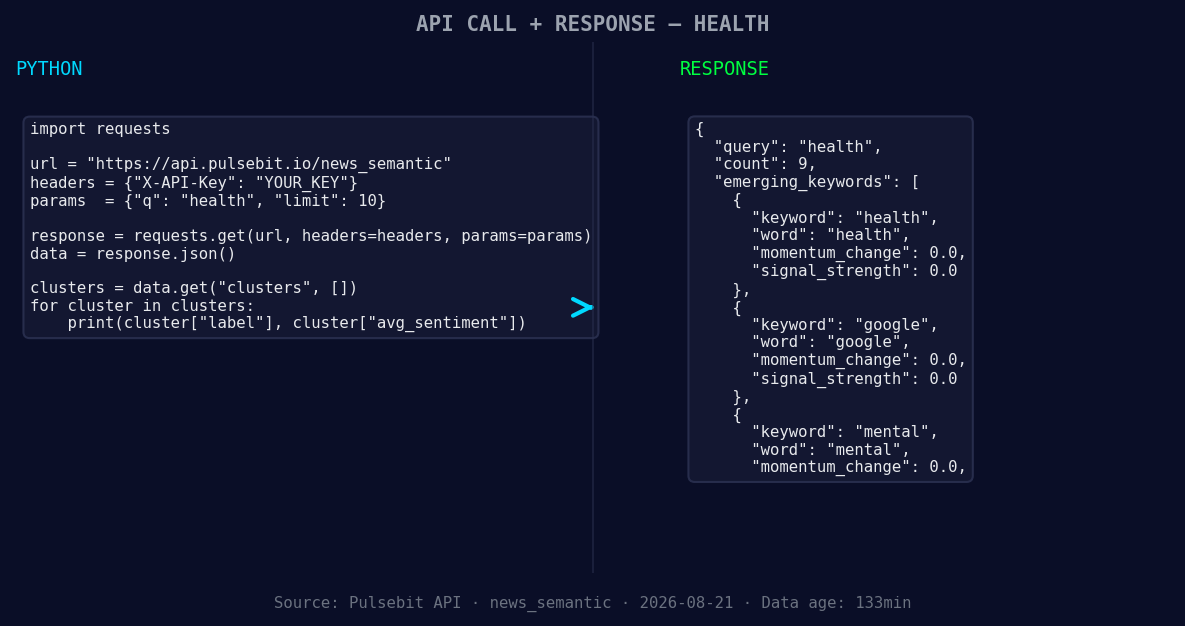
*Left: Python GET /news_semantic call for 'health'. Right: returned JSON response structure (clusters: 3). Source: Pulsebit /news_semantic.*
# Meta-sentiment moment: score the cluster reason
cluster_reason = "Clustered by shared themes: situation, healthcare, preparedness, surveillance, n"
sentiment_url = "https://api.pulsebit.com/sentiment"
sentiment_response = requests.post(sentiment_url, json={"text": cluster_reason})
sentiment_data = sentiment_response.json()
print(data)
print(sentiment_data)
This snippet effectively queries our API for health-related articles in English, focusing on the recent momentum spike. The second part runs the cluster reason through the sentiment endpoint to analyze the narrative framing itself. By doing this, we can understand how the themes are resonating and identify any emerging health narratives early.
To capitalize on this momentum spike, consider building three specific actions:
-
Geo-sensitive Alert System: Create a real-time alert for sentiment spikes with a geographic filter for English-speaking countries. Use the same parameters, but also include a threshold for sentiment score (e.g.,
score > 0.05for positive narratives).

Geographic detection output for health. India leads with 7 articles and sentiment +0.24. Source: Pulsebit /news_recent geographic fields.
Meta-Sentiment Dashboard: Develop a dashboard that visualizes the sentiment around clustered narratives. Use the results from the meta-sentiment loop to assess how narratives evolve. Focus on the cluster reason input to dynamically refresh the dashboard.
Comparative Analysis Engine: Build a comparative engine that benchmarks current sentiment scores against historical data. Use the forming themes—like health, Google, and mental health—against mainstream narratives to spot trends more quickly.
By leveraging these builds, you can enhance your pipeline’s responsiveness and keep pace with evolving narratives around health and other critical topics.
For additional details, check out our documentation at pulsebit.lojenterprise.com/docs. You can copy-paste our code and run it in under 10 minutes to experience the power of real-time sentiment analysis.


Top comments (0)