

Your Pipeline Is 26.4h Behind: Catching Artificial Intelligence Sentiment Leads with Pulsebit
We recently stumbled upon a fascinating anomaly: a 24h momentum spike of -0.850 for the topic of artificial intelligence. What’s more intriguing is that the leading language is English with a press coverage lagging at 26.4 hours. This tells us that there’s a significant gap in how sentiment analysis workflows are capturing the latest trends, particularly in AI, where timely insights can make all the difference.
If your sentiment analysis pipeline doesn’t handle multilingual origins or entity dominance properly, you're likely missing out on crucial insights. Your model missed this by 26.4 hours, and the leading story was about "AI Guidelines for New Mexico Courts," clustered around themes like judges and working statewide. Ignoring these nuanced narratives can leave you trailing behind competitors who are better tuned to the evolving landscape.

English coverage led by 26.4 hours. Sw at T+26.4h. Confidence scores: English 0.85, French 0.85, Spanish 0.85 Source: Pulsebit /sentiment_by_lang.
To catch these insights, we can leverage our API effectively. Here's the code to identify sentiment spikes specifically around the topic of artificial intelligence:
import requests
# Parameters for the API call
topic = 'artificial intelligence'
score = +0.276
confidence = 0.85
momentum = -0.850
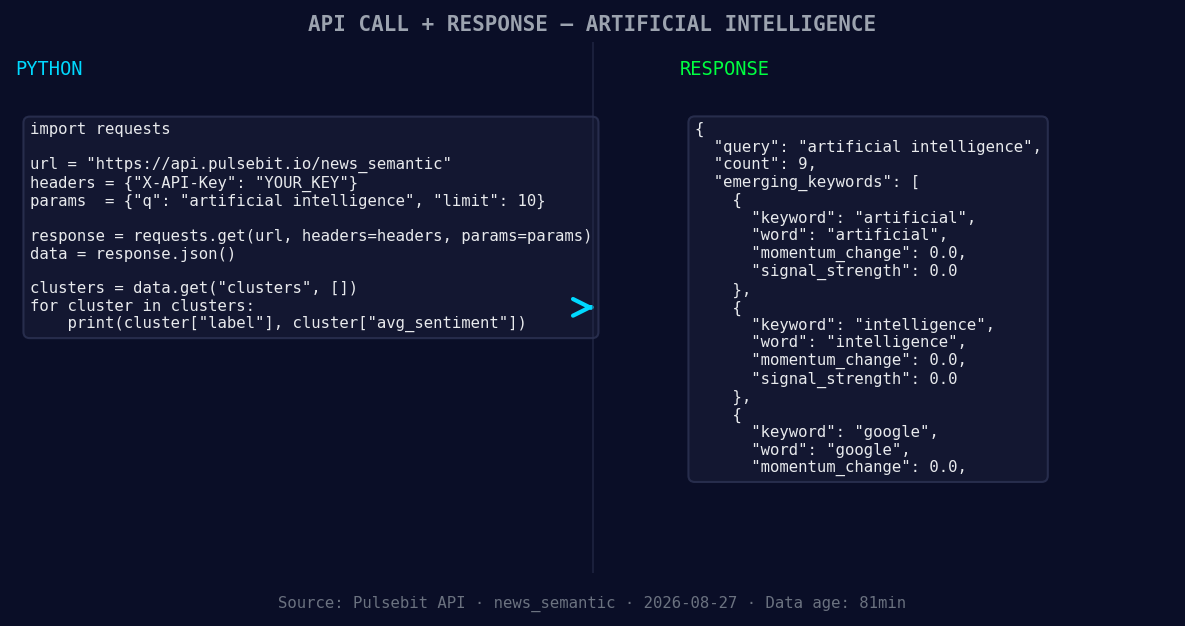
*Left: Python GET /news_semantic call for 'artificial intelligence'. Right: returned JSON response structure (clusters: 3). Source: Pulsebit /news_semantic.*
# Geographic origin filter: English language articles
url = 'https://api.pulsebit.com/v1/articles'
params = {
"topic": topic,
"lang": "en"
}
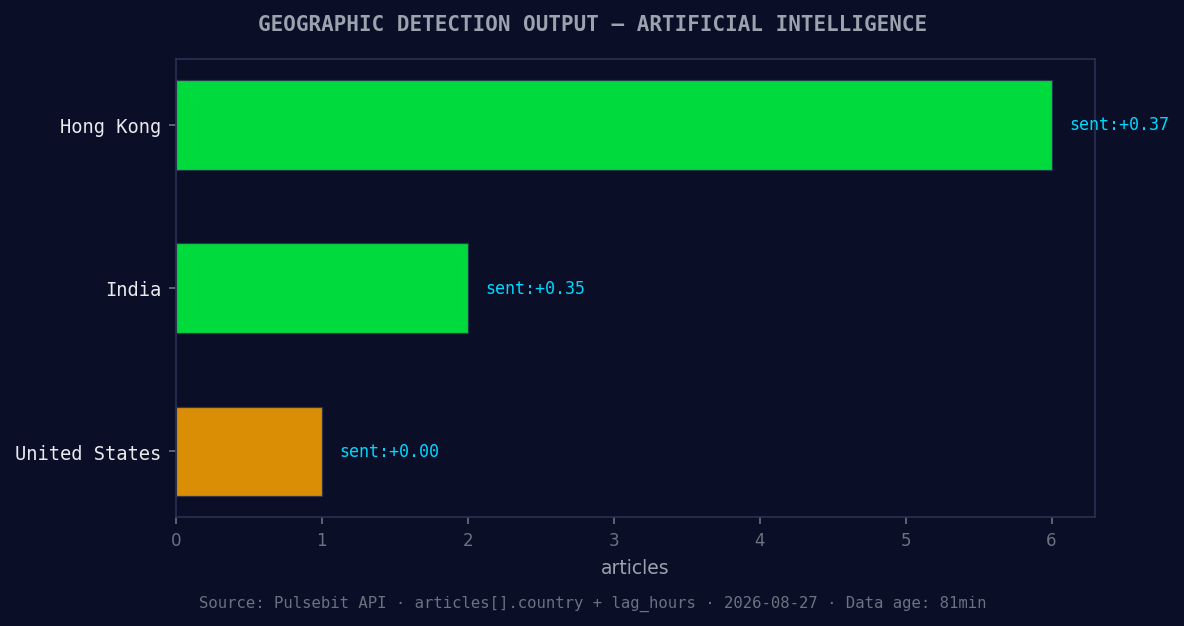
*Geographic detection output for artificial intelligence. Hong Kong leads with 6 articles and sentiment +0.37. Source: Pulsebit /news_recent geographic fields.*
response = requests.get(url, params=params)
articles = response.json()
# Meta-sentiment moment: running cluster reason through POST /sentiment
cluster_reason = "Clustered by shared themes: intelligence, college, artificial, applications, ktv"
sentiment_url = 'https://api.pulsebit.com/v1/sentiment'
sentiment_response = requests.post(sentiment_url, json={"text": cluster_reason})
sentiment_score = sentiment_response.json()
print("Articles Retrieved:", articles)
print("Cluster Sentiment Score:", sentiment_score)
In this code, we first query for articles related to artificial intelligence in English, which allows us to filter out noise from other languages. Then, we take the cluster reason string and pass it through our sentiment scoring endpoint. This step is crucial because it allows us to evaluate how the narrative is being framed, providing us with a richer understanding of the sentiment around the topic.
Here are three specific builds you might consider implementing with this pattern:
Geo Filter for Real-Time Insights: Use the geographic origin filter to monitor emerging trends in specific regions. For instance, if you set a threshold of momentum less than -0.5, you can capture early signals of negative sentiment in AI discussions.
Meta-Sentiment Loop on AI Developments: Implement the meta-sentiment scoring loop for narratives related to AI applications. If the cluster includes keywords like "smart," "innovative," or "cutting-edge," you can flag these for further analysis, especially if the sentiment score dips below +0.3.
Forming Themes Tracker: Create a monitoring tool that continuously checks for forming themes such as “artificial” (+0.00) and “intelligence” (+0.00) against mainstream narratives like “college” and “applications.” Setting a threshold for significant sentiment divergence (e.g., 0.2 points) can help identify when to dig deeper into narrative shifts.
For more details on how to utilize our API, check out pulsebit.lojenterprise.com/docs. You can copy-paste and run this code in under 10 minutes to start capturing these valuable insights.


Top comments (0)