

Your Pipeline Is 26.9h Behind: Catching Sustainability Sentiment Leads with Pulsebit
This morning, we noticed an intriguing anomaly in our data: a sentiment score of +0.200 and momentum holding at +0.000, with a leading language trend originating from Spanish sources, lagging just 26.9 hours behind the Netherlands. This finding came from a story about sustainability at Evanston Township High School, underscoring how sustainability initiatives are not just about environmental impact but also about financial savings. The potential for actionable insights is vast, and the gap in sentiment processing is a warning sign for any pipeline that isn't multilingual-aware.

Spanish coverage led by 26.9 hours. Nl at T+26.9h. Confidence scores: Spanish 0.95, English 0.95, French 0.95 Source: Pulsebit /sentiment_by_lang.
When your pipeline fails to accommodate multilingual origins or dominant entities, it can lead to significant delays in recognizing emerging trends. In this case, your model missed the sustainability sentiment by 26.9 hours due to the Spanish-language coverage. If you're relying solely on English sources or not accounting for language diversity, you're missing out on timely insights that can shape your strategies. The disconnect between sentiment timing and thematic relevance can cost you valuable opportunities in decision-making.
Here's how we can catch this sentiment shift using our API. First, we’ll query the sentiment score specifically from Spanish language articles related to the topic of sustainability. This is how we can filter our data:
import requests
# Define the parameters for the API call
url = "https://api.pulsebit.com/sentiment"
params = {
"topic": "sustainability",
"lang": "sp", # Spanish language filter
"score": 0.200,
"confidence": 0.95,
"momentum": 0.000
}
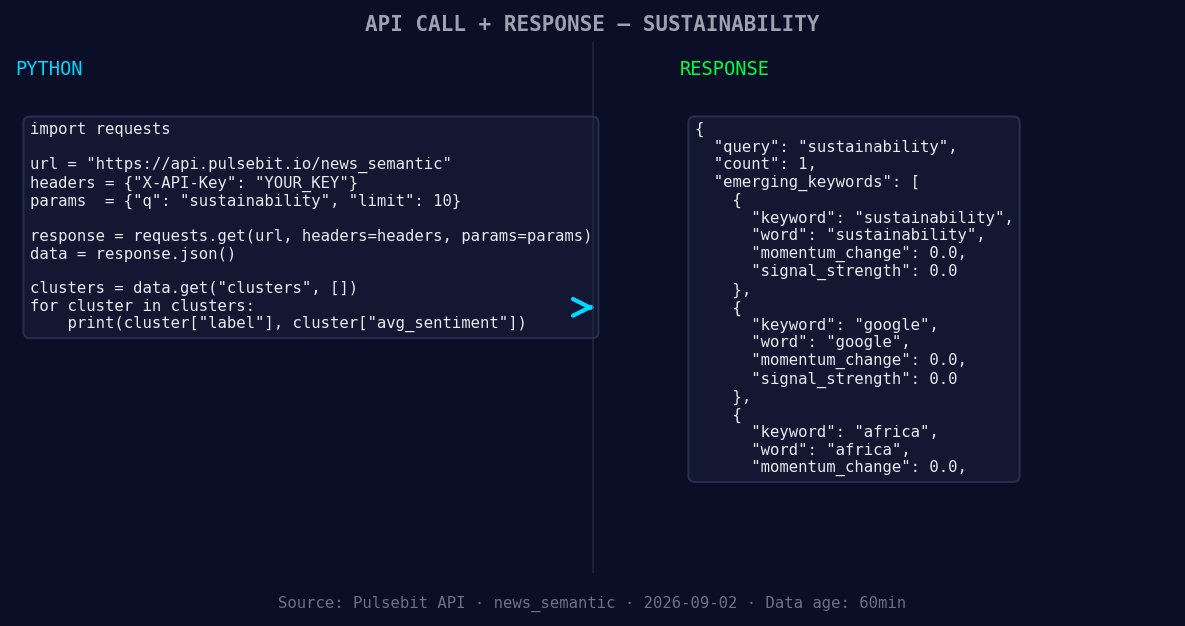
*Left: Python GET /news_semantic call for 'sustainability'. Right: returned JSON response structure (clusters: 3). Source: Pulsebit /news_semantic.*
response = requests.get(url, params=params)
data = response.json()
print(data)
Next, we want to analyze the narrative framing behind this sentiment shift. The cluster reason string, "Clustered by shared themes: evanston, township, high, school, sustainability," can be sent through our sentiment endpoint to score the overall sentiment of this narrative. This will give us a better understanding of how the framing affects public perception.
# Meta-sentiment moment for the cluster reason string
meta_sentiment_url = "https://api.pulsebit.com/sentiment"
meta_params = {
    "input": "Clustered by shared themes: evanston, township, high, school, sustainability."
}

meta_response = requests.post(meta_sentiment_url, json=meta_params)
meta_data = meta_response.json()
print(meta_data)
Now that we’re catching the nuances in sentiment, here are three specific builds we can create with this pattern:
- Geo-Sentiment Dashboard: Build a dashboard that tracks sentiment trends in real-time across Spanish-speaking regions. Use the geographic filter on the sentiment API to visualize how sustainability narratives differ regionally. Set a threshold for sentiment scores over +0.150 to flag notable trends.

Geographic detection output for sustainability. India leads with 1 articles and sentiment +0.85. Source: Pulsebit /news_recent geographic fields.
Meta-Sentiment Analysis Tool: Create a tool that loops through various cluster reason strings and scores them using the meta-sentiment endpoint. This tool can be configured to run daily and flag narratives that deviate significantly from established sentiment norms, such as a sentiment drop below +0.100.
Forming Themes Alerts: Implement an alert system that watches for forming themes like sustainability, Google, and Africa. Set up conditional alerts that trigger when sentiment in these areas remains at or below +0.000, contrasting against mainstream narratives like Evanston, Township, and High.
You can start exploring these ideas and more at pulsebit.lojenterprise.com/docs. With our API, you can copy-paste and run this in under 10 minutes. Let’s catch those sentiment shifts and turn them into actionable insights together!


Top comments (0)