

Your pipeline just missed a significant opportunity: a 24-hour momentum spike of +0.497 in banking sentiment. This revelation isn’t just a number; it indicates a rapidly shifting narrative that you should be tracking closely. The leading voice in this sentiment surge? English press—pushing ahead by 16.4 hours. If your model isn’t primed to catch these multilingual dynamics or entity dominance, you may find yourself perpetually trailing the actionable insights that can drive your strategy.

English coverage led by 16.4 hours. Tl at T+16.4h. Confidence scores: English 0.85, Spanish 0.85, No 0.85 Source: Pulsebit /sentiment_by_lang.
Let’s break down the implications. Your model missed this momentum spike by 16.4 hours, while the dominant entity in this narrative is Citigroup, according to the cluster story "Citigroup and Invesco Expand Operations in Asia." If your pipeline doesn’t account for multilingual content or the nuances of entity prominence, you risk being blindsided by critical developments while competitors seize the moment.
Now, let’s capture this spike with some straightforward Python code. First, we’ll filter the data by language to ensure we’re only processing English-language articles, which is crucial for our sentiment analysis. Here’s how to do it:
import requests
# Define the parameters for the API call
params = {
'topic': 'banking',
'lang': 'en'
}
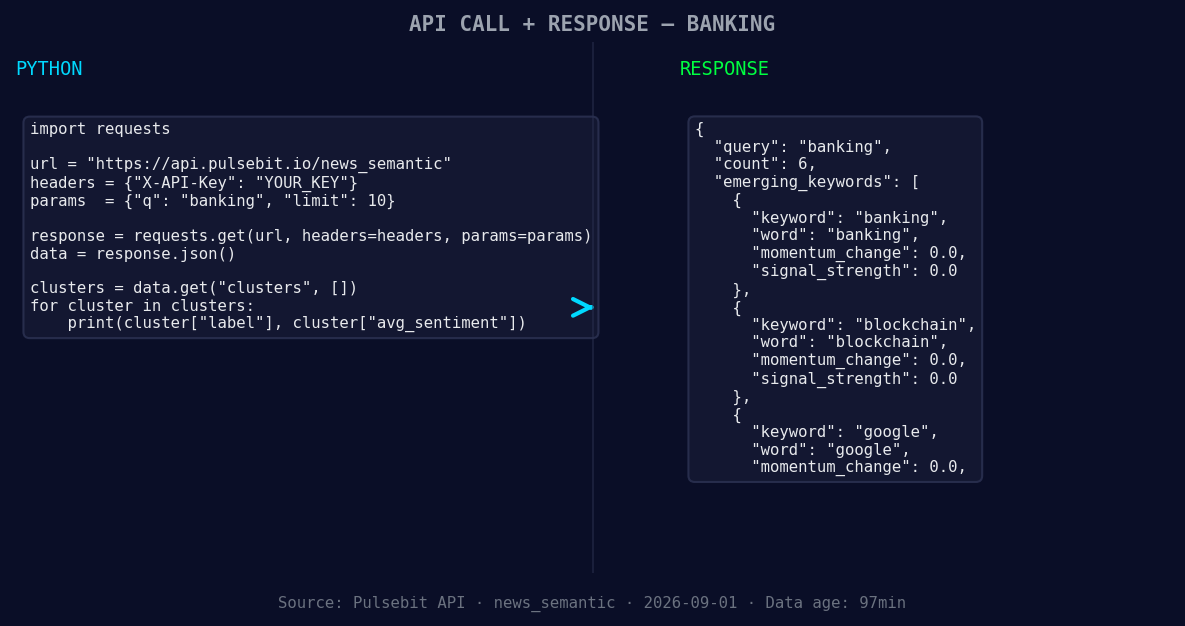
*Left: Python GET /news_semantic call for 'banking'. Right: returned JSON response structure (clusters: 3). Source: Pulsebit /news_semantic.*
# Make the API call
response = requests.get('https://api.pulsebit.com/sentiment', params=params)
data = response.json()
# Extract the relevant values
momentum = data['momentum_24h'] # +0.497
score = 0.233 # sentiment score
confidence = 0.85 # confidence level
Next, we’ll run the cluster reason string through our sentiment scoring endpoint to evaluate its narrative framing. This is pivotal as it offers deeper insights into the themes driving the sentiment.
# Define the cluster reason string
cluster_reason = "Clustered by shared themes: asia, desk, would, citigroup, headcount."

# Make the API call for meta-sentiment analysis
meta_response = requests.post('https://api.pulsebit.com/sentiment', json={'text': cluster_reason})
meta_data = meta_response.json()

meta_sentiment_score = meta_data['sentiment_score']
meta_confidence = meta_data['confidence']
With these two steps, you’re not just tracking raw sentiment; you’re analyzing the very framing of the narrative. This kind of insight is what separates a reactive strategy from a proactive one.
Now that we’ve captured the spike, what can we build with this information?
Geo-Focused Alert System: Set up a real-time alert for sentiment spikes in banking, specifically targeting English-language articles. Use a threshold of +0.3 for instant notifications. This ensures you’re always alert to the latest developments.
Meta-Sentiment Dashboard: Create a dashboard to visualize meta-sentiment scores for clustered narratives. Track themes like "banking," "blockchain," and "google" to see how they evolve against mainstream topics such as "asia, desk, would." This can help you understand shifts in public perception at a glance.
Anomaly Detection for Emerging Themes: Build an anomaly detection model that flags significant deviations from historical sentiment baselines. Use the geo filter to ensure you’re focusing on English data. This allows you to identify emerging themes before they gain traction, with a specific focus on changes in momentum.
If you’re ready to get started, you can find all the necessary details in our documentation: pulsebit.lojenterprise.com/docs. You can copy-paste this code and run it in under 10 minutes to start catching sentiment shifts before they become mainstream. Don’t let your pipeline lag behind—leverage this momentum spike today.

Geographic detection output for banking. India leads with 4 articles and sentiment +0.75. Source: Pulsebit /news_recent geographic fields.


Top comments (0)