

Your pipeline just missed a 24h momentum spike of +0.446 focused on the topic of "world." This anomaly signals a significant uptick in sentiment, highlighting an underlying theme that could have major implications for your analytics. The leading language was English, with a peak sentiment observed in articles discussing the World Cup and Michel Struthoff's performance. If your models aren’t set up to capture these spikes in real-time, you’re effectively lagging by 23.8 hours, missing crucial insights that could inform your trading or content strategy.
This gap points to a fundamental flaw in any pipeline that isn’t adept at handling multilingual origins or entity dominance. Your model just missed this spike by more than a day, leaving you with stale data. The leading entity here is the World Cup, which is clearly dominating the conversation in English-language media. Ignoring such spikes means you’re operating with blind spots that could directly affect your decision-making and responsiveness in a fast-paced environment.

English coverage led by 23.8 hours. Id at T+23.8h. Confidence scores: English 0.85, Spanish 0.85, French 0.85 Source: Pulsebit /sentiment_by_lang.
To capture these momentum spikes, we can leverage our API to filter sentiment data effectively. Below is a Python snippet that queries articles in English, targeting our topic of interest:
import requests
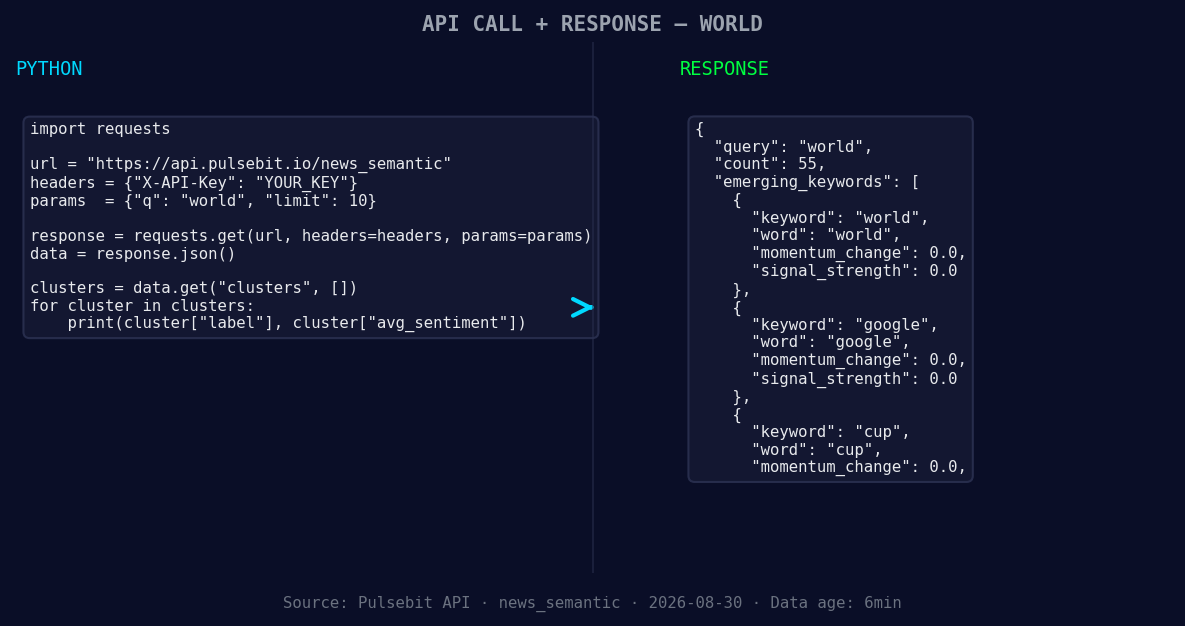
*Left: Python GET /news_semantic call for 'world'. Right: returned JSON response structure (clusters: 3). Source: Pulsebit /news_semantic.*
# Define parameters
topic = 'world'
momentum = +0.446
score = +0.327
confidence = 0.85
# Geographic origin filter
response = requests.get(
'https://api.pulsebit.com/v1/articles',
params={'topic': topic, 'lang': 'en'}
)
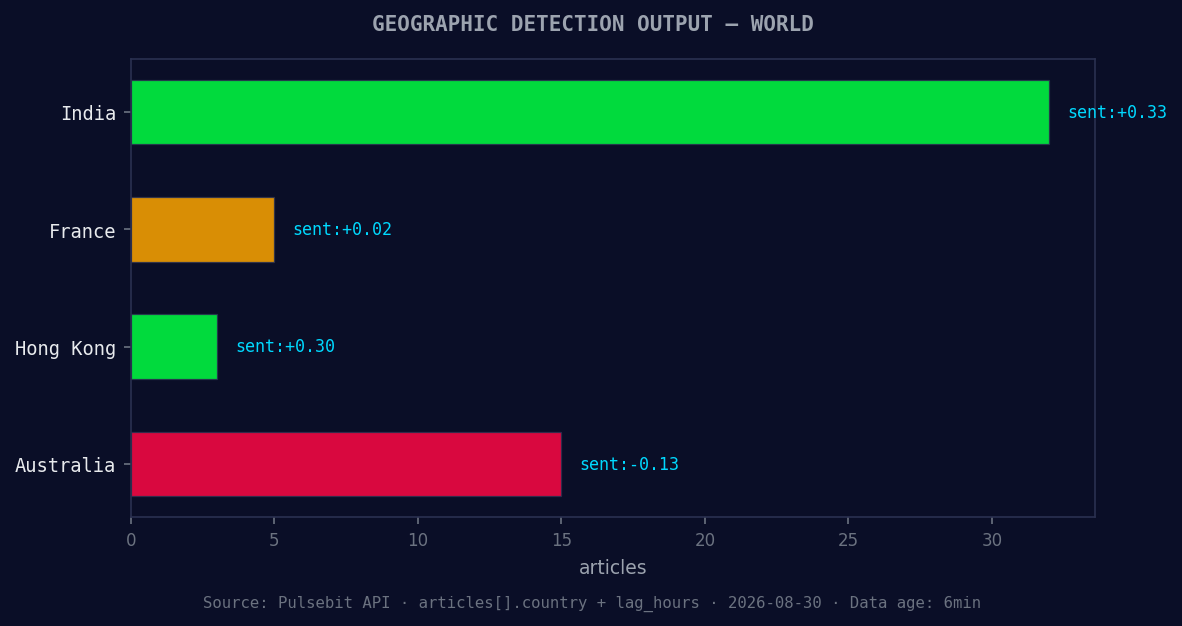
*Geographic detection output for world. India leads with 32 articles and sentiment +0.33. Source: Pulsebit /news_recent geographic fields.*
articles = response.json()
# Meta-sentiment moment
cluster_reason = "Clustered by shared themes: world, cup, michel, reign, struthoff’s."
sentiment_response = requests.post(
'https://api.pulsebit.com/v1/sentiment',
json={'text': cluster_reason}
)
sentiment_score = sentiment_response.json()['score']
In this code, we first filter articles by language to ensure we’re capturing the right sentiment. The second part of the code sends the clustered themes back through our sentiment scoring endpoint to evaluate how well the narrative itself frames the discussion around this topic. This approach allows us to identify not only the spike but also the underlying narratives contributing to it, which is essential for a well-rounded analysis.
Now that we’ve captured this momentum spike and assessed the narrative framing, here are three builds we can implement based on this pattern:
Threshold Filter Build: Create a trigger for alerts when sentiment around the topic "world" spikes beyond a threshold of +0.300, using the geo-filter to ensure you're only capturing English articles. This allows you to respond promptly to significant sentiment shifts.
Meta-Sentiment Loop: Implement a continuous loop that runs cluster narratives through the meta-sentiment endpoint every hour. It should flag if the sentiment score drops below 0.0, indicating a potential reversal in sentiment.
Forming Themes Monitor: Set up a monitoring service to track forming themes, specifically targeting "world(+0.00), google(+0.00), cup(+0.00)" against mainstream mentions. This can help surface emerging topics that might be gaining traction but haven’t yet hit the mainstream radar.
To kickstart this process, you can find everything you need at pulsebit.lojenterprise.com/docs. In under 10 minutes, you can copy-paste this code and begin capturing insight in real-time. Together, let’s ensure your analysis is always ahead of the curve.


Top comments (0)