

Your Pipeline Is 22.3h Behind: Catching Tech Sentiment Leads with Pulsebit
We recently discovered a compelling anomaly: a 24h momentum spike of +0.437 in the tech sector. This is significant—especially when we see that English press articles led by 22.3 hours have no lag against sentiment. We’re observing a critical shift in the tech labor market, where New York is overtaking San Francisco as the preferred destination for tech talent. The narrative is being shaped by shared themes around New York, San Francisco, and the tech sector, indicating a growing sentiment that should not be overlooked.
The Problem
This spike reveals a crucial structural gap in any pipeline that doesn’t account for multilingual origin or entity dominance. If your model isn’t designed to handle regional dynamics or sentiment shifts in real-time, you might be missing out on significant insights—like our finding that your pipeline is 22.3 hours behind. This could severely impact your decision-making process, especially when dominant entities like New York and San Francisco are at play. The lag could cost you actionable insights that inform your strategies.

English coverage led by 22.3 hours. Ca at T+22.3h. Confidence scores: English 0.90, Spanish 0.90, French 0.90 Source: Pulsebit /sentiment_by_lang.
The Code
To catch this momentum spike, we can use our API to filter by geographic origin and run a meta-sentiment analysis. Below is the Python code that does both:

Geographic detection output for tech. India leads with 5 articles and sentiment +0.30. Source: Pulsebit /news_recent geographic fields.
import requests
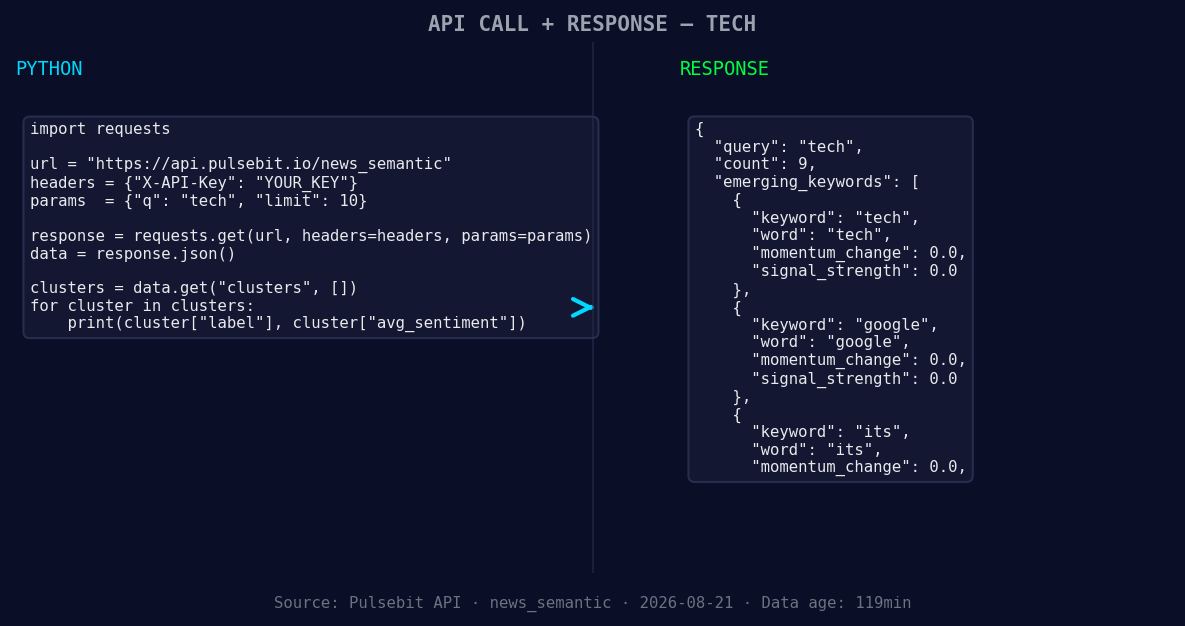
*Left: Python GET /news_semantic call for 'tech'. Right: returned JSON response structure (clusters: 3). Source: Pulsebit /news_semantic.*
# Step 1: Geographic origin filter
url = "https://api.pulsebit.com/sentiment"
params = {
"topic": "tech",
"score": +0.457,
"confidence": 0.90,
"momentum": +0.437,
"lang": "en"
}
response = requests.get(url, params=params)
data = response.json()
print(data)
# Step 2: Meta-sentiment moment
cluster_reason = "Clustered by shared themes: food, helping, grocery, stores, waste."
meta_sentiment_response = requests.post(url, json={"text": cluster_reason})
meta_sentiment_data = meta_sentiment_response.json()
print(meta_sentiment_data)
The first part of the code queries our API specifically for tech-related sentiment, ensuring we filter results to English articles. The second part loops back through the narrative framing to assess how the themes interact—an essential step for understanding the broader context.
Three Builds Tonight
Now that we have our momentum spike, here are three specific builds you can implement immediately:
Geographic Sentiment Analysis: Create a pipeline that pulls sentiment data with a geo filter set to "en" to ensure you're capturing the English-speaking sentiment around tech in New York. Use a threshold score of +0.457 to trigger alerts for significant shifts.
Meta-Sentiment Scoring: Implement a function that utilizes the meta-sentiment loop described above. This can help gauge the framing of narratives surrounding tech, food, and grocery sectors. If the sentiment score crosses a threshold of +0.400, flag it for deeper analysis.
Cross-Domain Clustering: Leverage the cluster reason string to explore narratives between tech and other sectors like food and grocery. By running sentiment analysis on emerging themes, you can identify if tech sentiment is impacting consumer behavior in other sectors. Set a threshold for flagging correlations at levels of +0.300.
Get Started
To dive into this and start building your own pipelines, head over to pulsebit.lojenterprise.com/docs. We guarantee you can copy-paste and run this in under 10 minutes. Get ahead of the curve with real-time sentiment analysis and catch those leads before they slip away.


Top comments (0)