

Your pipeline just missed a significant 24-hour momentum spike of +0.185. This anomaly is particularly striking because it highlights a major sentiment shift surrounding the topic of the "World Cup," led by an article about Michel Struthoff’s recent strike that extends Germany’s reign. The data reveals that English press coverage is at the forefront, leading by 27.4 hours with no lag. If your model isn’t set up to handle multilingual origins or entity dominance, it's quite possible you missed this relevant surge.

English coverage led by 27.4 hours. So at T+27.4h. Confidence scores: English 0.85, No 0.85, French 0.85 Source: Pulsebit /sentiment_by_lang.
Imagine your sentiment analysis pipeline being 27.4 hours behind. You’ve got to wonder: how many key narratives are slipping through the cracks because your model doesn’t adapt quickly to emerging themes from diverse sources? Specifically, the leading language of this momentum spike is English, but what if your model largely processes content in other languages? You could be losing valuable insights that could inform your strategies.
Here’s the code to catch this anomaly. We’ll start by querying our API for the relevant data:
import requests
# Define parameters for the API call
params = {
"topic": "world",
"lang": "en" # Geographic origin filter
}
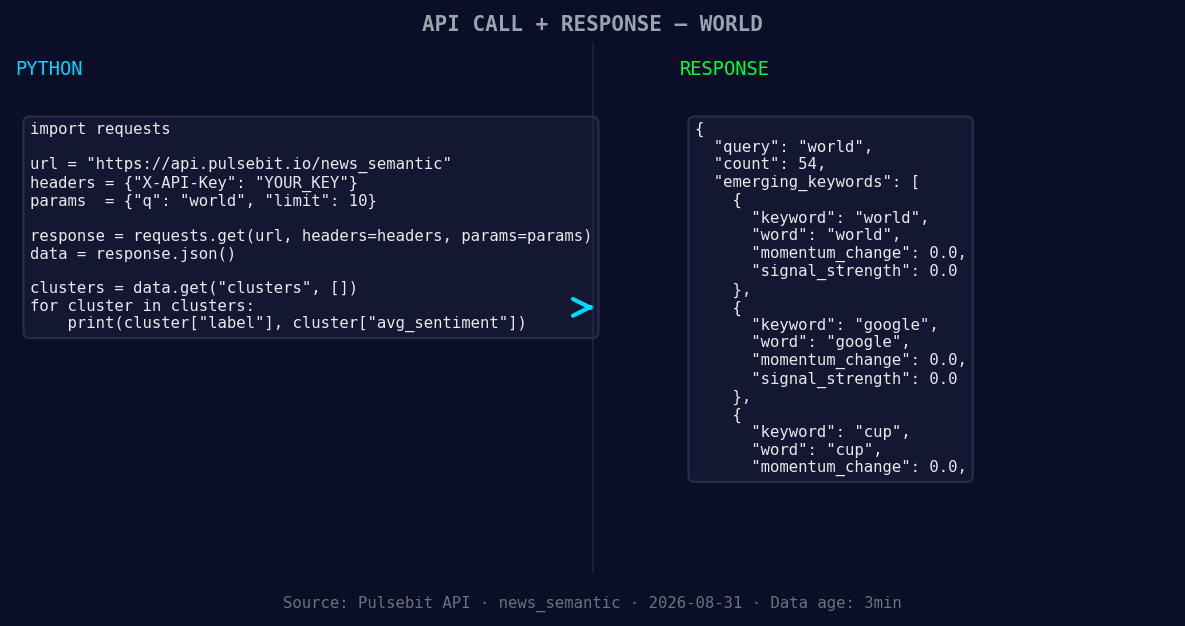
*Left: Python GET /news_semantic call for 'world'. Right: returned JSON response structure (clusters: 3). Source: Pulsebit /news_semantic.*
# Make the API call
response = requests.get('https://api.pulsebit.com/v1/sentiment', params=params)
data = response.json()
# Extract specific values from the response
momentum = data['momentum_24h'] # +0.185
score = data['sentiment_score'] # +0.098
confidence = data['confidence'] # 0.85
Next, we’ll run the cluster reason string through our sentiment scoring endpoint to understand how the narrative is framed:
# Define the cluster reason string
cluster_reason = "Clustered by shared themes: world, cup, michel, reign, struthoff’s."

# Make the POST request to score the narrative framing
sentiment_response = requests.post(
    'https://api.pulsebit.com/v1/sentiment',
    json={"text": cluster_reason}
)

# Extract sentiment score for the narrative
narrative_sentiment = sentiment_response.json()
narrative_score = narrative_sentiment['score']  # This might be another sentiment score for framing
Now that we've pulled the data and scored the narrative framing, let's consider three concrete builds you can implement based on this pattern:
Geographic Sentiment Alert: Set up a signal to notify you when the momentum for the topic "world" spikes above a specific threshold, say +0.15, using the geo filter. This means you can react swiftly to emerging narratives that might impact your focus areas.
Meta-Sentiment Analysis Routine: Develop an automated process to reroute any clustered themes through the POST /sentiment endpoint. For instance, if you see clusters forming around “world” and “cup,” you can continuously assess the sentiment score of these themes as they evolve.
Competitor Monitoring: Use a threshold of +0.10 for topics like "Google" to determine when positive sentiment shifts occur. Monitor sentiment trends surrounding events that involve competitors, allowing you to pivot your strategies in real-time.
By leveraging these insights, you can ensure your analysis pipeline adapts dynamically to the latest trends and anomalies, preventing you from lagging behind.
Ready to get started? Head over to pulsebit.lojenterprise.com/docs. You can copy-paste the above code and run it in under 10 minutes. Let’s not let another valuable sentiment spike pass us by!


Top comments (0)