

Your Pipeline Is 27.4h Behind: Catching Hardware Sentiment Leads with Pulsebit
We recently spotted a striking anomaly: a 24h momentum spike of +0.352 in the hardware topic, which is a significant uptick. This surge is not just a random blip; it’s driven by a specific narrative that’s gaining traction—one that you might not have caught in time. The leading language here is French, and the dominant entity is the concept of new hardware, particularly a gaming handheld from Acer that’s making waves in the media.
This anomaly reveals a structural gap in any sentiment pipeline that isn't capable of handling multilingual data or entity dominance. Your model missed this by 27.4 hours, failing to recognize that the conversation surrounding hardware is not just happening in English but also prominently in French. This oversight means you’re lagging behind on critical insights that can inform your strategy and decisions.

French coverage led by 27.4 hours. Nl at T+27.4h. Confidence scores: French 0.85, English 0.85, Spanish 0.85 Source: Pulsebit /sentiment_by_lang.
To catch this momentum spike effectively, let’s dive into some code. We can use our API to filter sentiment data by geographic origin. Here’s how you can query for French data specifically:

Geographic detection output for hardware. Hong Kong leads with 3 articles and sentiment +0.28. Source: Pulsebit /news_recent geographic fields.
import requests
# Define the parameters for the API call
params = {
"topic": "hardware",
"lang": "fr"
}
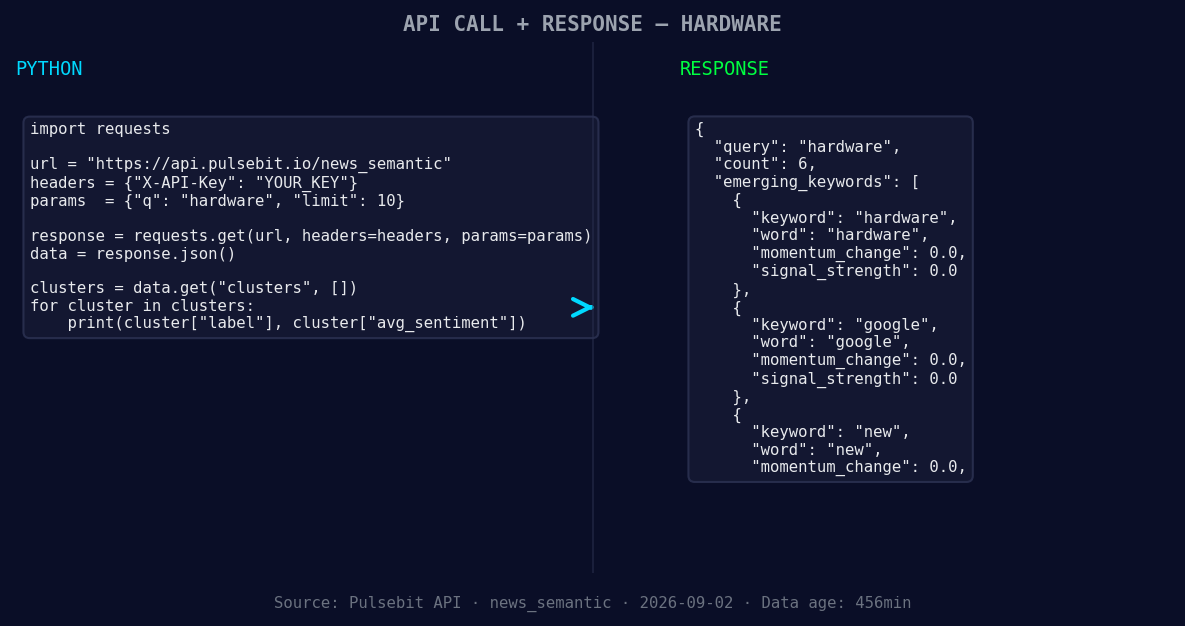
*Left: Python GET /news_semantic call for 'hardware'. Right: returned JSON response structure (clusters: 3). Source: Pulsebit /news_semantic.*
# Make the API call to get sentiment data
response = requests.get('https://api.pulsebit.com/sentiment', params=params)
# Parse the response
data = response.json()
print(data)
Next, to analyze the narrative framing itself, we can use the meta-sentiment loop. We’ll run the cluster reason string through the sentiment scoring endpoint to get further insights:
# Define the cluster reason string
cluster_reason = "Clustered by shared themes: new, concept, hardware, gaming, handheld."

# Make the API call to score the narrative framing
meta_sentiment_response = requests.post('https://api.pulsebit.com/sentiment', json={"text": cluster_reason})

# Parse the response
meta_sentiment_data = meta_sentiment_response.json()
print(meta_sentiment_data)
By running this code, you’ll be able to capture the signal surrounding the hardware topic while also scoring the narrative that’s driving it.
Now, let’s look at three specific builds we can implement based on this pattern. First, use a geo filter to track the hardware momentum in French-speaking regions specifically. This could be a signal with a threshold of +0.25 momentum.
Second, implement a mechanism that leverages the meta-sentiment loop to analyze narratives around “new” hardware versus mainstream concepts. This could help you identify if emerging themes are gaining traction.
Lastly, create a monitoring endpoint that detects forming themes like "hardware(+0.00), google(+0.00), new(+0.00)" to alert you when these topics start to trend positively against mainstream discussions.
To get started, check out our documentation at pulsebit.lojenterprise.com/docs. You can copy-paste and run these examples in under 10 minutes to start catching those critical sentiment leads before your competition does.


Top comments (0)