

Your pipeline is 17.4 hours behind: catching economy sentiment leads with Pulsebit
We recently uncovered a striking anomaly: a 24-hour momentum spike of +0.539 in sentiment around the topic of the economy. This spike is particularly notable given that the leading language driving this sentiment is Spanish, with a 17.4-hour lead time. The dominant entity in this conversation is the U.S., which holds a 17% share of voice and boasts a positive sentiment score of +0.333. What stands out here is how quickly themes can shift, especially when the conversation is led by different languages and entities.
The problem here is glaring. If your pipeline doesn’t accommodate for multilingual origins or recognize entity dominance, you might miss crucial insights like this by a staggering 17.4 hours. For example, our findings show that while your model was processing data primarily in English, the Spanish press had already identified a significant sentiment shift in the economy. Your model missed this by 17.4 hours, leaving you out of the loop on an important and emerging narrative.

Spanish coverage led by 17.4 hours. Sv at T+17.4h. Confidence scores: Spanish 0.90, English 0.90, French 0.90 Source: Pulsebit /sentiment_by_lang.
Here’s how we can catch this momentum and make use of it effectively. First, we’ll filter by geographic origin and language. The following Python code snippet demonstrates how to query our API to focus on the Spanish-language content surrounding the topic of "economy":

Geographic detection output for economy. India leads with 2 articles and sentiment +0.00. Source: Pulsebit /news_recent geographic fields.
import requests
# Define parameters
topic = 'economy'
score = +0.000
confidence = 0.90
momentum = +0.539
# API call to filter by language and topic
response = requests.get("https://api.pulsebit.com/v1/sentiment", params={
"topic": topic,
"lang": "sp",
"score": score,
"confidence": confidence,
"momentum": momentum
})
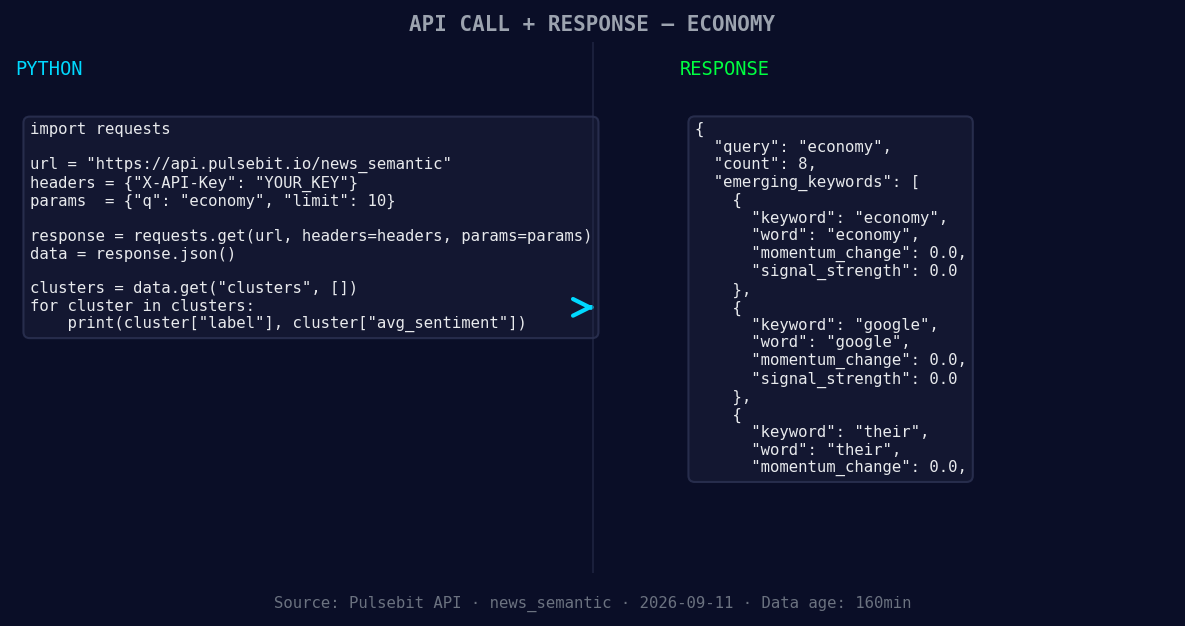
*Left: Python GET /news_semantic call for 'economy'. Right: returned JSON response structure (clusters: 3). Source: Pulsebit /news_semantic.*
data = response.json()
print(data)
Next, we need to assess the meta-sentiment of the clustered narrative itself. This is crucial for understanding the framing of our findings. We’ll run the string “Clustered by shared themes: what, creator, economy?, new, generation.” through our sentiment API:
# Meta-sentiment analysis
meta_sentiment_input = "Clustered by shared themes: what, creator, economy?, new, generation."
meta_response = requests.post("https://api.pulsebit.com/v1/sentiment", json={"text": meta_sentiment_input})
meta_data = meta_response.json()
print(meta_data)
By using this approach, you effectively bridge the gap between differing languages and gain a clearer picture of emerging trends.
Now, let’s build on this insight. Here are three specific implementations you can develop right away:
- Geo-Filtered Sentiment Alerts: Set up an endpoint that alerts you when sentiment spikes in specific regions. For example, if the economy sentiment in Spanish surpasses a threshold of +0.500, you receive an immediate notification. Use the geo filter as follows:
response = requests.get("https://api.pulsebit.com/v1/sentiment", params={"topic": topic, "lang": "sp", "threshold": 0.500})
Meta-Sentiment Dashboard: Create a dashboard that visualizes meta-sentiment scores over time for various themes. By capturing how narratives are framed, you can adjust your model to reflect emerging themes like “economy” or “creator”.
Dynamic Entity Tracking: Implement a system that dynamically tracks entity sentiment, focusing on dominant entities like the U.S. or China. Set a threshold where if the sentiment shifts positively or negatively by ±0.200, an alert is triggered.
By incorporating these builds, you’re not only catching up to the conversation but also staying ahead of it. Acknowledging the forming themes, such as economy(+0.00), google(+0.00), their(+0.00) versus mainstream topics, enables your models to adapt and respond to the evolving narrative landscape.
To get started, check out our documentation: pulsebit.lojenterprise.com/docs. You can copy-paste and run these examples in under 10 minutes.


Top comments (0)