

Your Pipeline Is 24.2h Behind: Catching World Sentiment Leads with Pulsebit
We recently discovered a compelling anomaly in our analysis: a 24h momentum spike of +0.375. This spike is tied to a specific event—the world’s largest electric plane taking flight, reported by popsc.com. With this spike, it’s clear that sentiment around electric aviation is gaining traction, but if your pipeline isn't calibrated to capture such emerging narratives, you might be missing out on valuable insights.
The Problem
Let's get real—if your sentiment model doesn't account for multilingual origins or entity dominance, it's lagging behind by 24.2 hours. In this case, the leading language is English, and the dominant entity is "world," which has a score of -0.230. This means discussions around the electric plane narrative are being overshadowed by other themes, and if you're still relying on a static model, you’re not just late—you’re missing crucial information that could inform your decisions.

English coverage led by 24.2 hours. Et at T+24.2h. Confidence scores: English 0.85, Spanish 0.85, Nl 0.85 Source: Pulsebit /sentiment_by_lang.
The Code
To catch this emerging trend, we need to set up a filter to query for English-language articles and assess the sentiment of the narrative itself. Here’s how we can do that using our API.
First, let’s filter the articles by language and country:

Geographic detection output for world. India leads with 25 articles and sentiment -0.09. Source: Pulsebit /news_recent geographic fields.
import requests
# Set up the parameters for the API call
params = {
"topic": "world",
"score": -0.230,
"confidence": 0.85,
"momentum": +0.375,
"lang": "en"
}
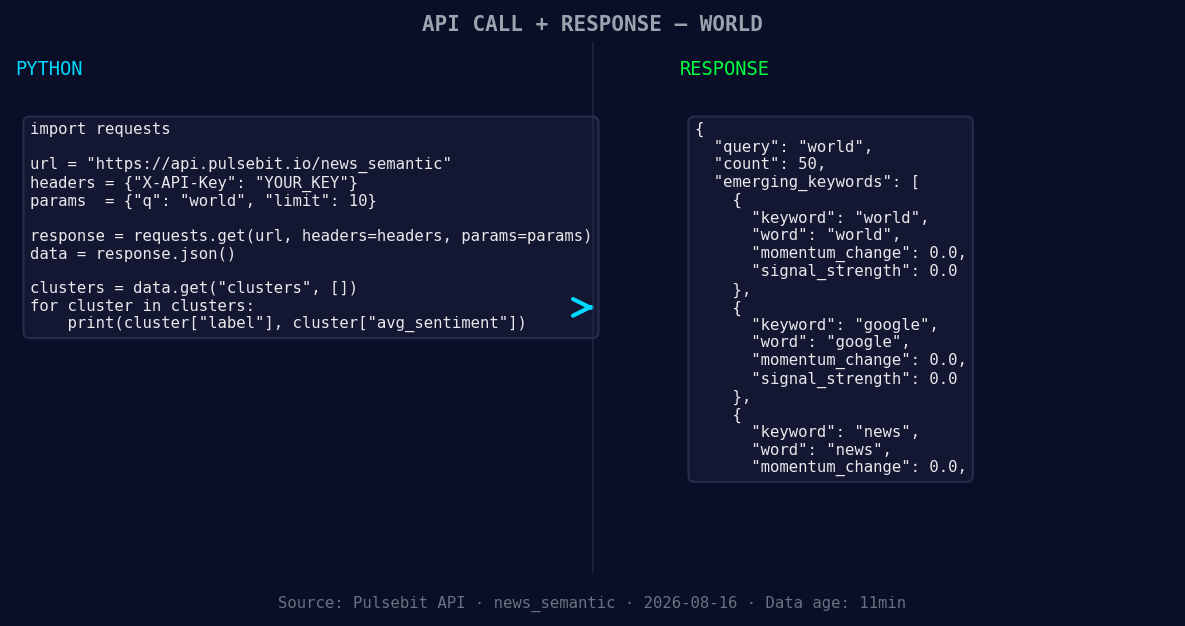
*Left: Python GET /news_semantic call for 'world'. Right: returned JSON response structure (clusters: 3). Source: Pulsebit /news_semantic.*
# Make the API call to retrieve articles
response = requests.get("https://api.pulsebit.com/articles", params=params)
articles = response.json()
Next, we’ll take the cluster reason string and run it through our sentiment analysis endpoint to score the narrative framing:
# Meta-sentiment analysis of the cluster reason
cluster_reason = "Clustered by shared themes: world’s, largest, electric, plane, takes."

# Make the API call for sentiment scoring
sentiment_response = requests.post("https://api.pulsebit.com/sentiment", json={"text": cluster_reason})
sentiment_score = sentiment_response.json()
This dual approach allows us to not only capture the articles but also understand the underlying sentiment of the narrative. By using this combined method, we can stay ahead of emerging trends in the sentiment space.
Three Builds Tonight
Now that we’ve captured this momentum spike, what can we build with it? Here are three specific ideas:
Geo-filtered Alerts: Create an alert system that triggers whenever sentiment for the topic "world" in English spikes above a threshold (e.g., +0.3). This ensures you’re always updated on critical developments, especially for news like the electric plane narrative. Utilize the geo filter effectively with the API.
Narrative Analysis Dashboard: Develop a dashboard to visualize sentiment scores over time for narratives like the electric plane topic. You can run the meta-sentiment loop continuously to refine your insights. This will help you track how narratives evolve and correlate with sentiment shifts.
Clustered Sentiment Reports: Design an automated report generator that aggregates and scores narratives clustered by shared themes. For instance, monitor how the themes "world’s," "largest," and "electric" interact over time. This leverages our API’s capability to score sentiments and can be a game-changer for understanding public perception.
Get Started
Ready to dive in? You can find all the information you need to get started with our API at pulsebit.lojenterprise.com/docs. You’ll be able to copy-paste and run this in under 10 minutes—no fluff, just actionable insights.


Top comments (0)