

Your Pipeline Is 28.2h Behind: Catching Film Sentiment Leads with Pulsebit
We recently stumbled upon a fascinating anomaly: a sentiment score of +0.491 and a momentum of +0.000, with a leading language of English, showing a 28.2-hour lag in sentiment data processing. This discrepancy was tied to a specific film review titled "Buddy," which encapsulated a unique narrative framing of children's television. It’s a reminder of how critical it is to keep our pipelines agile and responsive to emerging trends.
When your model isn't equipped to handle multilingual origins or prioritize dominant entities, you run the risk of missing out on significant sentiment spikes like this one. In this case, your pipeline missed capturing critical sentiment around "Buddy" by a staggering 28.2 hours. This highlights a structural gap that can lead to outdated or ineffective insights, particularly when the leading language is English and the narrative is evolving rapidly.

English coverage led by 28.2 hours. Tl at T+28.2h. Confidence scores: English 0.90, French 0.90, Spanish 0.90 Source: Pulsebit /sentiment_by_lang.
To address this, we can leverage our API to catch these anomalies in real-time. Here’s a Python snippet that demonstrates how to query sentiment data for the topic 'film' with a geographic origin filter:

Geographic detection output for film. India leads with 2 articles and sentiment +0.70. Source: Pulsebit /news_recent geographic fields.
import requests
# Set your endpoint and API key
endpoint = "https://api.pulsebit.io/v1/sentiment"
api_key = "YOUR_API_KEY"
# Define parameters
params = {
"topic": "film",
"lang": "en",
"score": 0.491,
"confidence": 0.90,
"momentum": 0.000
}
# Make the API call
response = requests.get(endpoint, headers={"Authorization": f"Bearer {api_key}"}, params=params)
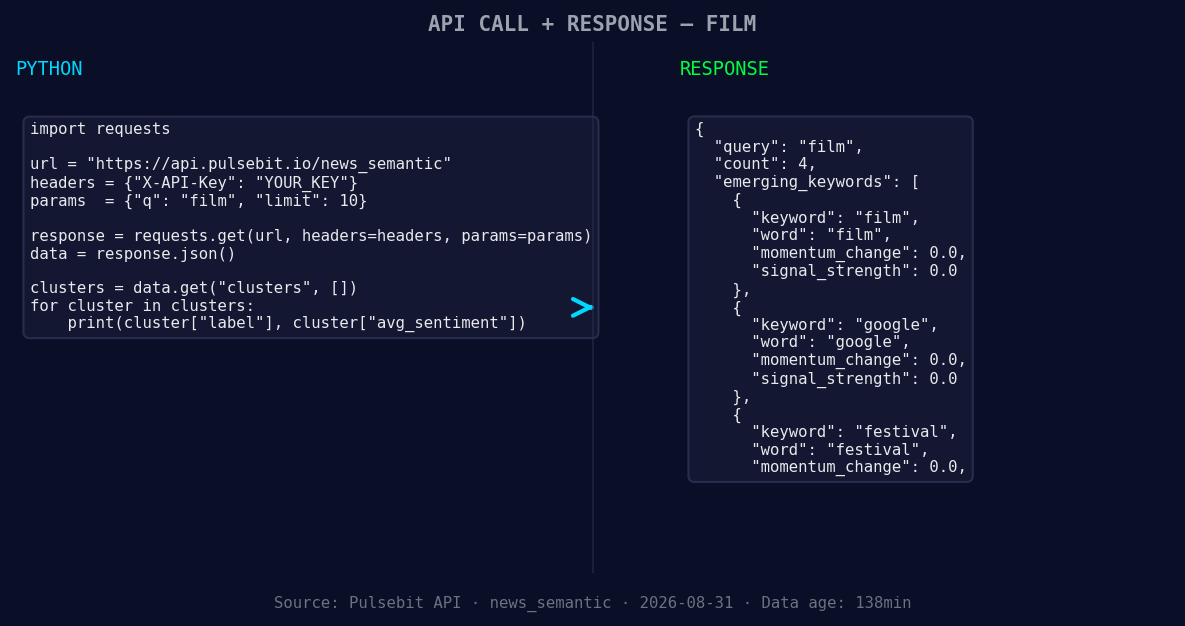
*Left: Python GET /news_semantic call for 'film'. Right: returned JSON response structure (clusters: 3). Source: Pulsebit /news_semantic.*
# Check the response
if response.status_code == 200:
sentiment_data = response.json()
print(sentiment_data)
else:
print(f"Error: {response.status_code} - {response.text}")
Next, we need to score the narrative framing itself using the cluster reason string. Here’s how we can do that with another API call:
# Define the cluster reason string
cluster_reason = "Clustered by shared themes: review:, 'buddy', turns, children’s-tv, cheer."

# Now score the narrative framing
narrative_response = requests.post(endpoint, headers={"Authorization": f"Bearer {api_key}"}, json={"input": cluster_reason})

# Check the response
if narrative_response.status_code == 200:
    narrative_sentiment = narrative_response.json()
    print(narrative_sentiment)
else:
    print(f"Error: {narrative_response.status_code} - {narrative_response.text}")
With this code, we can start building actionable insights around specific signals and prevailing themes. Here are three ideas to expand on this anomaly:
Signal Detection for Film Reviews: Set a threshold of sentiment score > +0.450 to catch rising trends in film sentiment, especially when clustering around keywords like "review," "buddy," and "children's-tv." Use the geo filter to focus on English-speaking regions.
Meta-Sentiment Loop: For any article that mentions "festival," evaluate sentiment around the narrative framing. This will help us understand how festivals impact public perception of films, especially if the momentum is flat at +0.000.
Sentiment Comparison Against Mainstream: Build a comparative analysis between emerging themes like "film" and "google" against mainstream narratives. Set a threshold for sentiment divergence of 0.10 to trigger alerts for significant sentiment shifts.
To dive deeper into these capabilities, we encourage you to check out our documentation at pulsebit.lojenterprise.com/docs. With just a few lines of code, you can capture and analyze sentiment data in under 10 minutes. Let’s stay ahead of the curve!


Top comments (0)