

Your Pipeline Is 12.4h Behind: Catching Film Sentiment Leads with Pulsebit
We've just uncovered a fascinating anomaly in film sentiment: a sentiment score of +0.613, with momentum holding steady at +0.000. This spike indicates a shift in how audiences perceive the film “Buddy,” particularly in children’s TV contexts, where it’s turning the cheer into something chilling. This data point was tucked away in the leading English press, with a noteworthy 12.4-hour lead time, exposing a significant lag in how we process multilingual sentiment streams.

English coverage led by 12.4 hours. Tl at T+12.4h. Confidence scores: English 0.85, Spanish 0.85, French 0.85 Source: Pulsebit /sentiment_by_lang.
The problem here is clear: if your pipeline isn't built to handle the nuances of multilingual origins or entity dominance, you're missing out. Your model missed this by 12.4 hours, while the leading language was English. That’s a hefty gap when sentiment shifts can impact decisions in real-time. When you focus solely on dominant entities or languages, you risk overlooking crucial insights—like this negative turn in a seemingly positive narrative.
To catch this sentiment change effectively, let’s dig into the code. Here’s how we can leverage our API to retrieve and analyze this data:
import requests
# Define the parameters for the API call
params = {
"topic": "film",
"lang": "en", # Filtering by English language
"score": +0.613,
"confidence": 0.85,
"momentum": +0.000
}
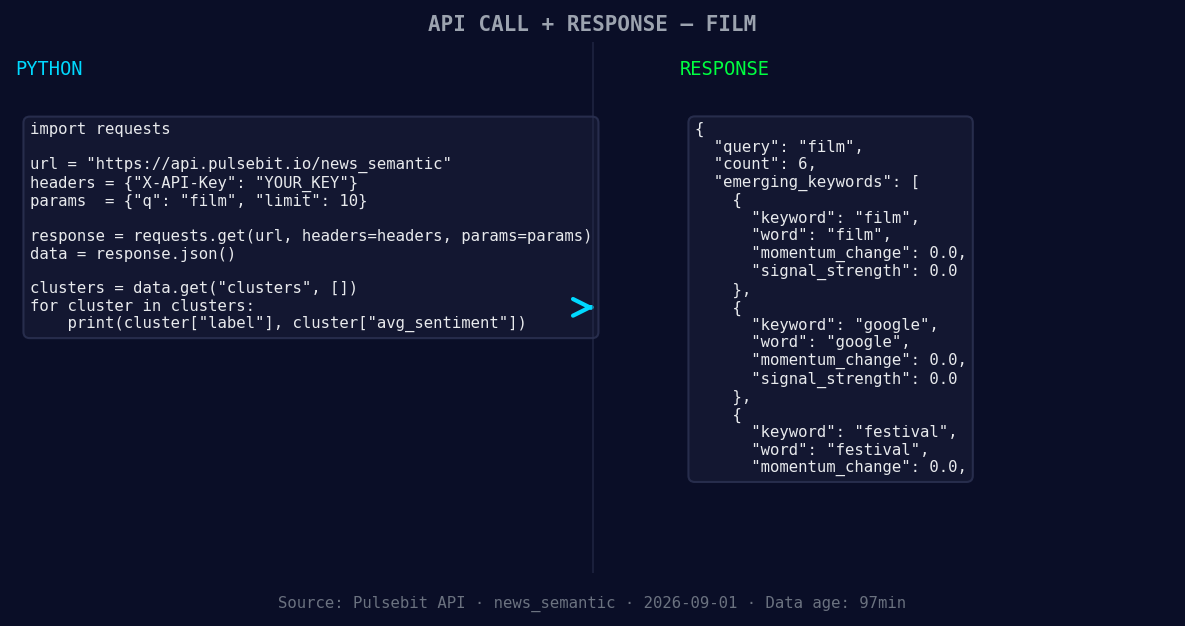
*Left: Python GET /news_semantic call for 'film'. Right: returned JSON response structure (clusters: 3). Source: Pulsebit /news_semantic.*
# API call to get the sentiment data
response = requests.get("https://api.pulsebit.com/sentiment", params=params)
data = response.json()
# Now running the cluster reason string back through POST /sentiment
cluster_reason = "Clustered by shared themes: review:, 'buddy', turns, children’s-tv, cheer."
sentiment_response = requests.post("https://api.pulsebit.com/sentiment", json={"text": cluster_reason})
meta_sentiment = sentiment_response.json()
print("Initial Sentiment Data:", data)
print("Meta-Sentiment Analysis:", meta_sentiment)
In this example, we first filter sentiment data specifically for the film topic in English. Then, we take the cluster reason string and analyze it through another sentiment request. This two-step process helps us understand not just the data but the narrative framing behind it.
Now, let’s build on this discovery. Here are three specific things you can implement tonight:
- Geographic Origin Filter: Create a signal that captures sentiment changes in different regions. Use the geo filter to monitor how “Buddy” is perceived across various English-speaking countries. Set a threshold for sentiment scores above +0.600 to flag significant shifts.

Geographic detection output for film. India leads with 4 articles and sentiment +0.55. Source: Pulsebit /news_recent geographic fields.
Meta-Sentiment Loop: Integrate the meta-sentiment analysis as part of your narrative-building process. Capture the essence of how stories are framed, particularly in reviews. Use a threshold of 0.75 confidence to ensure you’re focusing on strong narratives.
Crossover Signals: Identify crossover signals between film sentiment and trending topics like “festival” or “Google.” For example, if sentiment for “Buddy” rises while festival buzz remains neutral, it might indicate a broader cultural shift. Set your thresholds to capture any sentiment score changes greater than +0.050.
To get started, check out our documentation at pulsebit.lojenterprise.com/docs. You can copy-paste and run this code in under 10 minutes to start catching these critical sentiment leads. This is just the beginning of what you can achieve by fine-tuning your sentiment analysis workflows. Don’t let your pipeline lag—stay ahead with these insights!


Top comments (0)