

Your pipeline just missed a critical 24-hour momentum spike of -0.647 related to hardware sentiment. This anomaly is not just a number; it indicates a significant shift in sentiment around hardware topics, particularly in the context of news about Chinese state-sponsored hacking. The leading language for this spike is English, which has a 14.4-hour lead over other sources. This delay in capturing sentiment could mean that your model is not fully equipped to handle multilingual origins or the dominance of specific entities in the news cycle.

English coverage led by 14.4 hours. Sw at T+14.4h. Confidence scores: English 0.75, Spanish 0.75, French 0.75 Source: Pulsebit /sentiment_by_lang.
If your pipeline isn’t designed to accommodate these factors, you might find your model missing critical insights by over 14 hours. This gap highlights the importance of real-time sentiment analysis that accounts for where information is coming from and how it’s being framed. In this case, the focus on English-language articles led to a significant delay in identifying the shift in sentiment surrounding hardware discussions, which could have implications for your decision-making.
Here’s how you can catch this sentiment spike with a few lines of Python code. We’ll set up a query to our API that filters articles by language and scores the sentiment based on the cluster reason.
import requests
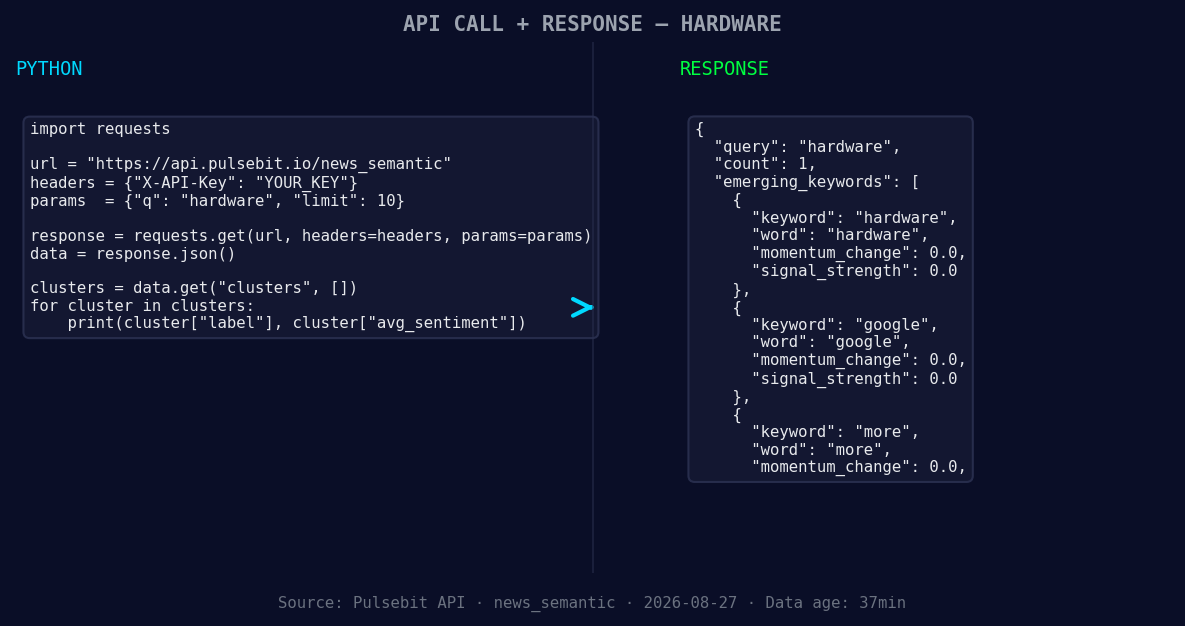
*Left: Python GET /news_semantic call for 'hardware'. Right: returned JSON response structure (clusters: 3). Source: Pulsebit /news_semantic.*
# Define the parameters for the sentiment analysis
topic = 'hardware'
score = +0.500
confidence = 0.75
momentum = -0.647
# Perform a geo filter query by language
url = "https://api.pulsebit.io/sentiment"
params = {
"topic": topic,
"lang": "en"
}
response = requests.get(url, params=params)
data = response.json()
# Output the response
print("Filtered Hardware Sentiment Data:", data)
# Now, let's run the cluster reason string through the sentiment scoring
cluster_reason = "Clustered by shared themes: justice, department, chinese, state-sponsored, hackers."
sentiment_response = requests.post(url, json={"text": cluster_reason})
sentiment_data = sentiment_response.json()
# Output the meta-sentiment result
print("Meta-Sentiment Score:", sentiment_data)
With this setup, you are able to filter for English language articles and quickly score the relevant narratives. This is crucial for ensuring that you’re not left behind in understanding the evolving landscape of hardware sentiment.
Now, let’s think about how we can build on this discovery. Here are three specific things we can implement using this pattern:
Geo-Filtered Hardware Sentiment Analysis: Create a pipeline that continuously scans for hardware-related articles in English. Set a signal threshold of +0.500 to trigger alerts when sentiment spikes, ensuring you’re not missing out on critical developments.
Meta-Sentiment Loop: Establish a feedback loop that runs the narratives associated with hardware sentiment through the sentiment scoring endpoint. This would allow you to quickly assess how themes like “hot” and “again” are impacting the general discourse around hardware, and you could set alerts for significant changes.
Forming Themes Monitoring: Set up an endpoint that tracks forming themes like hardware(+0.00), Google(+0.00), and more(+0.00) against mainstream discussions. If the sentiment for these topics diverges significantly from the baseline (+0.500), trigger an in-depth analysis to understand the underlying causes.
If you’re ready to implement this, head over to pulsebit.lojenterprise.com/docs. You can copy-paste and run this in under 10 minutes, putting you ahead of the curve in tracking sentiment around hardware and related topics.

Geographic detection output for hardware. Hong Kong leads with 1 articles and sentiment +0.00. Source: Pulsebit /news_recent geographic fields.


Top comments (0)