

Your Pipeline Is 18.4h Behind: Catching Artificial Intelligence Sentiment Leads with Pulsebit
We recently discovered a notable anomaly: a 24-hour momentum spike of -0.850 in sentiment surrounding artificial intelligence. This significant drop points to a critical shift in the sentiment landscape, particularly in French press articles that lead by 18.4 hours, with no lag time against the sentiment weight. It’s essential to act quickly on these insights, and understanding the source of this anomaly could help you stay ahead in your sentiment tracking.
Unfortunately, many sentiment analysis pipelines struggle with multilingual origins and entity dominance, leading to missed opportunities. Your model may have missed this crucial shift by a staggering 18.4 hours, as the French articles gained traction. This oversight indicates a fundamental gap—if you aren’t accounting for linguistic nuances and regional sentiment, you’re potentially blind to critical trends that could inform your strategy.

French coverage led by 18.4 hours. Sw at T+18.4h. Confidence scores: French 0.85, English 0.85, Spanish 0.85 Source: Pulsebit /sentiment_by_lang.
To catch these insights, we can leverage our API effectively. Here’s a straightforward example in Python that highlights how to filter sentiment based on geographic origin and analyze the narrative framing.

Geographic detection output for artificial intelligence. Hong Kong leads with 4 articles and sentiment +0.36. Source: Pulsebit /news_recent geographic fields.
import requests
# Define parameters for the API call
topic = 'artificial intelligence'
score = -0.233
confidence = 0.85
momentum = -0.850
lang = 'fr'
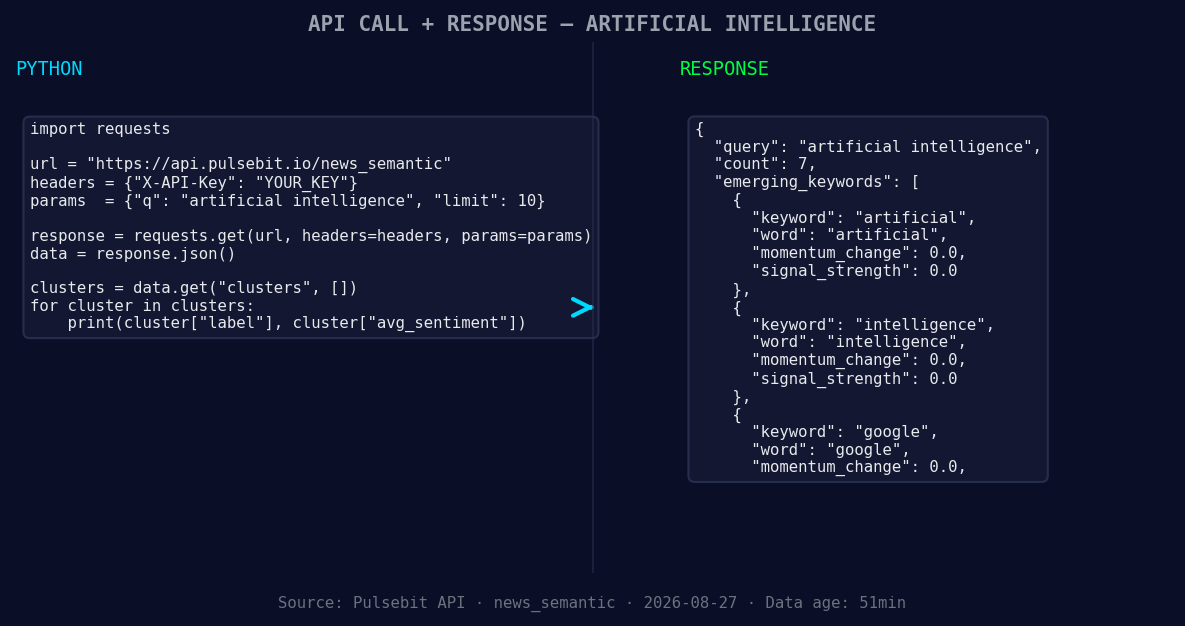
*Left: Python GET /news_semantic call for 'artificial intelligence'. Right: returned JSON response structure (clusters: 3). Source: Pulsebit /news_semantic.*
# Geographic origin filter: Query by language
response = requests.get(
f'https://api.pulsebit.com/sentiment',
params={
'topic': topic,
'lang': lang,
'score': score,
'confidence': confidence,
'momentum': momentum
}
)
data = response.json()
print(data)
# Meta-sentiment moment: Analyze the cluster reason
cluster_reason = "Clustered by shared themes: intelligence, college, artificial, applications, ktv."
sentiment_response = requests.post(
'https://api.pulsebit.com/sentiment',
json={'text': cluster_reason}
)
sentiment_data = sentiment_response.json()
print(sentiment_data)
In this code, we first filter sentiment data by specifying the language parameter as French. This allows us to catch the momentum spike specific to that demographic, which is critical given the leading language’s influence. Next, we run a meta-sentiment analysis on the cluster narrative itself, enabling us to score the underlying themes driving this sentiment shift.
Based on this pattern, here are three specific builds we can implement tonight:
Geographic Sentiment Dashboard: Create a real-time dashboard that displays sentiment changes over time, specifically filtering by language. Use the parameter
lang: "fr"to track French sentiment trends in AI discussions.Meta-Sentiment Alerts: Build a notification system that triggers alerts when specific themes, such as "artificial intelligence" and "college", show a significant sentiment score change. Leverage the meta-sentiment loop to score the narratives for these themes periodically.
Anomaly Detection System: Implement a threshold-based anomaly detection system that flags significant sentiment drops (e.g., below -0.5) and alerts you to the forming gap in narratives. Use both the momentum data and cluster insights to inform your strategy.
These builds will help you proactively manage and respond to sentiment trends, ensuring you’re not left behind in a fast-moving landscape, especially with topics as critical as artificial intelligence.
For more details on how to get started, please visit our documentation. With just a few lines of code, you’ll be up and running in under 10 minutes, harnessing the power of sentiment analysis to keep your pipeline sharp.


Top comments (0)