

Your Pipeline Is 18.8h Behind: Catching Human Rights Sentiment Leads with Pulsebit
On August 21, 2026, we observed a notable anomaly: a 24-hour momentum spike of +0.714 in sentiment surrounding "Deteriorating Human Rights in Myanmar." This spike, driven by just two articles, indicates a rising narrative that we need to pay attention to. Notably, the English press is leading the charge, coming in at 18.8 hours ahead of the Spanish press. It’s a clear reminder that the dynamics of multilingual content can significantly impact the timeliness of our insights.

English coverage led by 18.8 hours. Spanish at T+18.8h. Confidence scores: English 0.85, French 0.85, Spanish 0.85 Source: Pulsebit /sentiment_by_lang.
The Problem
This scenario exemplifies a structural gap in any pipeline not designed to handle multilingual origins or entity dominance. Your model missed this by 18.8 hours—an eternity when reacting to fast-evolving sentiment. In this case, the English press's early coverage could have put you ahead of the curve, allowing you to act on emerging human rights concerns before they hit the mainstream narrative. When your pipeline lacks the capacity to filter or prioritize content based on language, you risk being late to critical developments that impact your strategy.
The Code
To catch these momentum spikes, we can leverage our API to filter the right content and analyze sentiment. Here’s how you can do it:
First, we’ll set up a geographic origin filter to focus on English articles discussing human rights.

Geographic detection output for human rights. India leads with 2 articles and sentiment -0.60. Source: Pulsebit /news_recent geographic fields.
import requests
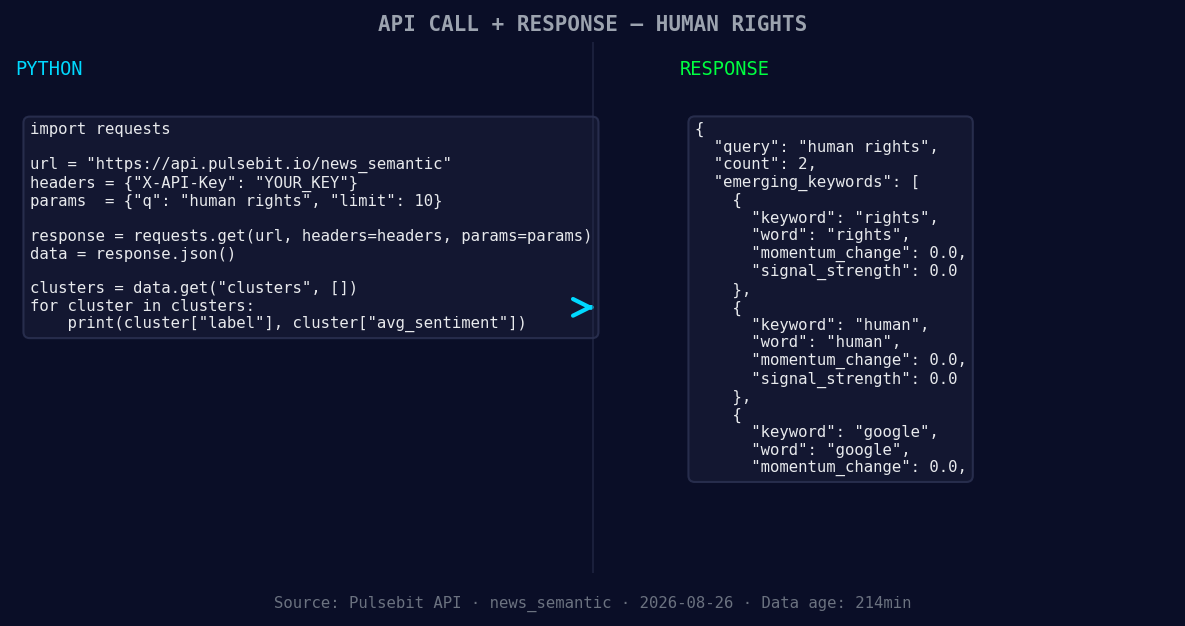
*Left: Python GET /news_semantic call for 'human rights'. Right: returned JSON response structure (clusters: 3). Source: Pulsebit /news_semantic.*
url = "https://api.pulsebit.com/v1/articles"
params = {
"topic": "human rights",
"lang": "en",
}
response = requests.get(url, params=params)
articles = response.json()
Next, we need to analyze the meta-sentiment of the narrative framing itself. We’ll take the cluster reason string and score it to understand its sentiment in more depth.
meta_sentiment_url = "https://api.pulsebit.com/v1/sentiment"
meta_sentiment_input = {
    "text": "Clustered by shared themes: business, case, human, rights, more."
}

meta_sentiment_response = requests.post(meta_sentiment_url, json=meta_sentiment_input)
meta_sentiment = meta_sentiment_response.json()
Using the above code, you can dynamically filter and analyze the sentiment surrounding critical topics, giving you real-time insights.
Three Builds Tonight
Signal Detection: Build a signal detection endpoint that triggers alerts when momentum exceeds a threshold of +0.700 in the human rights domain. This allows you to catch emerging stories before they become mainstream.
Geo-Filtered News Aggregator: Create a function that pulls articles based on geographic origin, specifically filtering for English-language content. This will ensure you have the most timely insights on human rights issues as they develop.
Meta-Sentiment Dashboard: Develop a dashboard that visualizes sentiment scores and confidence levels based on the meta-sentiment analysis you run. This would give your team a clearer view of how narratives are evolving and which themes are forming: rights(+0.00), human(+0.00), and the contrast with mainstream topics like business and case.
Get Started
Dive into our documentation at pulsebit.lojenterprise.com/docs and replicate this in under 10 minutes. The power of sentiment analysis is at your fingertips—don’t let your pipeline fall behind.


Top comments (0)