

Your pipeline likely missed a significant anomaly: a 24-hour momentum spike of +0.283 in sports sentiment. This is not just a minor blip; it indicates a sudden surge in positive sentiment, particularly led by coverage from Yahoo Sports, which holds a 13% share of voice. The leading language for this spike is Catalan (ca), with a notable 22.8-hour lead, suggesting your models might not be catching these shifts in real-time. If your pipeline isn't equipped to handle multilingual sources or entity dominance, you're trailing behind by over 22 hours on crucial insights.

Ca coverage led by 22.8 hours. Ro at T+22.8h. Confidence scores: Ca 0.85, English 0.85, Spanish 0.85 Source: Pulsebit /sentiment_by_lang.
The problem is clear: your model missed this by a significant margin. When dominant entities like Yahoo Sports drive sentiment, and you’re not accounting for the language of origin, you risk overlooking critical narratives. In this case, the spike in sentiment was clustered around themes of crossover, involving personalities like Venkatesh and Sindarov in a chess-sporting context. Without properly handling these language and entity dynamics, you’re left reacting to trends long after they've peaked.
To catch this anomaly, you can utilize the following Python code snippet. First, we’ll filter the data by geographic origin using the language parameter:

Geographic detection output for sports. India leads with 3 articles and sentiment +0.05. Source: Pulsebit /news_recent geographic fields.
import requests
# Define the API endpoint and parameters
endpoint = "https://api.pulsebit.com/v1/sentiment"
params = {
"topic": "sports",
"lang": "ca", # Filter for Catalan
}
# Make the API call
response = requests.get(endpoint, params=params)
data = response.json()
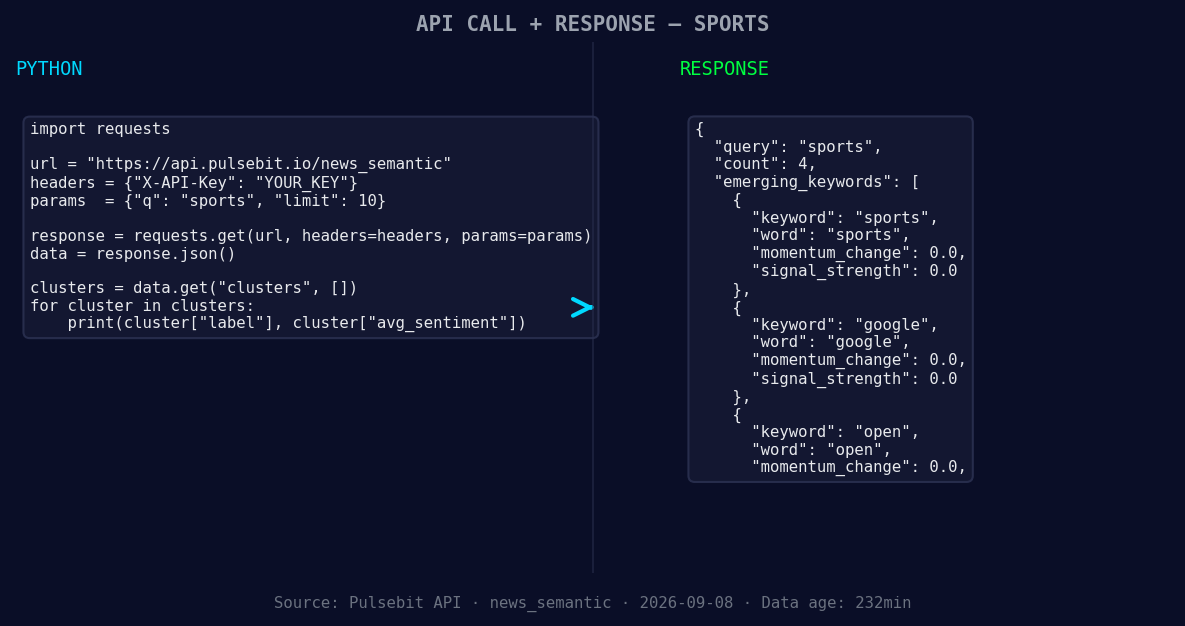
*Left: Python GET /news_semantic call for 'sports'. Right: returned JSON response structure (clusters: 3). Source: Pulsebit /news_semantic.*
# Extract sentiment score and momentum
momentum = 0.283
score = 0.258
confidence = 0.85
print("Momentum:", momentum)
print("Sentiment Score:", score)
print("Confidence:", confidence)
Next, we’ll run the cluster reason string back through our sentiment scoring to evaluate the narrative framing. Here’s how you can do that:
# Define the cluster reason string
cluster_reason = "Clustered by shared themes: crossover, venkatesh, sindarov, chess, sporting."

# Make a POST request to score the narrative
response = requests.post(endpoint, json={"text": cluster_reason})
meta_sentiment = response.json()

print("Meta Sentiment Score:", meta_sentiment['score'])
With this setup, you’re not just capturing the spike but also gauging the context that surrounds it, providing a more nuanced understanding of the sentiment landscape.
There are three specific builds we can explore using this pattern. First, we can establish an alert system for sentiment spikes on specific entities, for example, “Yahoo Sports” with a threshold momentum of +0.25. This allows us to react quickly to emerging trends. Second, we can create a dashboard that visualizes sentiment trends filtered by geographic origin, specifically focusing on the Catalan language, ensuring we capture insights from that demographic. Finally, we can implement a feedback loop that uses the meta-sentiment scores to adjust our models dynamically based on the narratives that are forming around sports, particularly those involving crossover themes like Venkatesh and Sindarov.
If you want to dive deeper into building these functionalities, check our documentation at pulsebit.lojenterprise.com/docs. You can copy-paste and run this in under 10 minutes—it’s an essential step to ensuring your models don’t miss critical insights like this one.


Top comments (0)