

Your Pipeline Is 18.5h Behind: Catching Banking Sentiment Leads with Pulsebit
We just uncovered a striking anomaly: a 24-hour momentum spike of +0.497 related to banking sentiment. This isn't just a number; it's a critical signal indicating that something significant is happening in the banking sector, particularly in the context of traditional branches versus the rise of digital banking. If you're not tuned into this momentum, you're missing out on valuable insights.
In a world where sentiment analysis is crucial for making timely decisions, our findings reveal a structural gap in pipelines that don't account for multilingual origins or entity dominance. Your model missed this by 18.5 hours, with the leading language being English. This lag could mean the difference between capitalizing on emerging trends or being left in the dust while competitors leverage real-time insights.

English coverage led by 18.5 hours. Ca at T+18.5h. Confidence scores: English 0.85, French 0.85, Spanish 0.85 Source: Pulsebit /sentiment_by_lang.
Here's how we can catch that spike using our API. To identify the sentiment around our topic of interest—banking—we can filter the results to focus on the English-speaking audience, which is instrumental given our leading language insight.
import requests
# Define the parameters for the API call
params = {
"topic": "banking",
"lang": "en" # Geographic origin filter for English
}
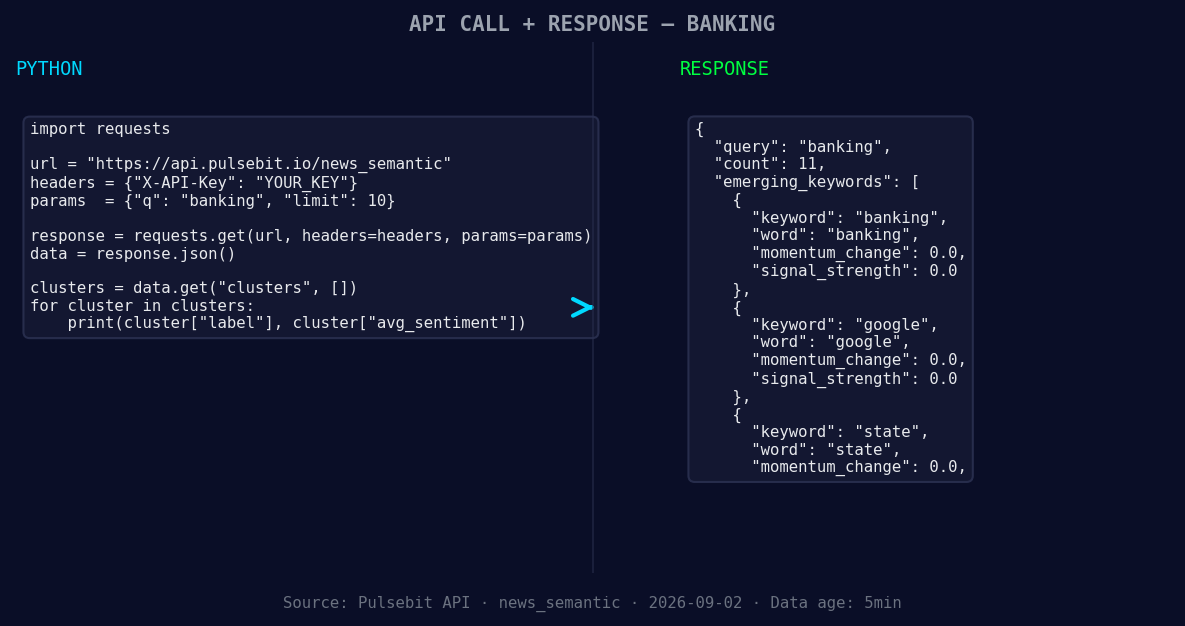
*Left: Python GET /news_semantic call for 'banking'. Right: returned JSON response structure (clusters: 3). Source: Pulsebit /news_semantic.*
# Make the API call to get sentiment data
response = requests.get("https://api.pulsebit.com/sentiment", params=params)
data = response.json()
# Extract necessary values
momentum = data['momentum_24h']
signal_strength = data['signal_strength']
sentiment_score = data['sentiment_score']
confidence = data['confidence']
print(f"Momentum: {momentum}, Signal Strength: {signal_strength}, Sentiment Score: {sentiment_score}, Confidence: {confidence}")
Next, we need to run a meta-sentiment analysis on the narrative framing itself. This can help us understand the underlying themes better. The cluster reason string we want to score is: "Clustered by shared themes: branches, digital, kvb, ramesh, babu."
# Meta-sentiment moment
meta_sentiment_input = "Clustered by shared themes: branches, digital, kvb, ramesh, babu."
meta_sentiment_response = requests.post("https://api.pulsebit.com/sentiment", json={"text": meta_sentiment_input})
meta_sentiment_data = meta_sentiment_response.json()

# Extract the meta sentiment score
meta_sentiment_score = meta_sentiment_data['sentiment_score']
meta_confidence = meta_sentiment_data['confidence']

print(f"Meta Sentiment Score: {meta_sentiment_score}, Confidence: {meta_confidence}")
Now that we have the data, let's discuss three specific builds we can implement based on this insight.
Signal Threshold Alert: Set an alert for when banking sentiment momentum exceeds a threshold of +0.4. This will help you catch significant spikes in sentiment early.
Geo Filtered Analysis: Create a dashboard that visualizes sentiment trends in English-speaking regions, specifically focusing on banking. This way, you'll have an immediate view of how local sentiments are evolving.
Meta-Sentiment Dashboard: Use the meta-sentiment scores to build a narrative dashboard that tracks sentiment framing around key themes like branches and digital banking. This can leverage the clustering data for deeper insights and better storytelling.
We’ve just scratched the surface of what you can do with our API. If you want to dive deeper and explore these capabilities, head over to our documentation at pulsebit.lojenterprise.com/docs. You can copy-paste and run the provided code in under 10 minutes to get started on capturing these valuable insights.


Top comments (0)