

Your Pipeline Is 14.5h Behind: Catching Finance Sentiment Leads with Pulsebit
We just uncovered a critical insight: the sentiment score for finance is currently at +0.032, with a momentum of +0.001. This spike comes at a time when the leading language is English, showing a 14.5-hour head start over Spanish coverage. If you’re not tuned in to the nuances of multilingual sentiment, you may be missing out on essential signals that could impact your financial models.

English coverage led by 14.5 hours. Spanish at T+14.5h. Confidence scores: English 0.95, French 0.95, Spanish 0.95 Source: Pulsebit /sentiment_by_lang.
But here's the catch: your model missed this by 14.5 hours. While English content is surging in sentiment, potentially leading the conversation, any pipeline not designed to handle multilingual data or entity dominance is at risk of lagging behind. The dominant entity in this case is finance, with its themes clustering around wealth and growth. If you’re relying on a single language or a narrow scope, you’re already trailing the narrative.
Let’s dive into how we can catch up with this spike. First, we’ll filter the relevant content by language and country using our API. Here’s how you can do that using Python:

Geographic detection output for finance. India leads with 1 articles and sentiment -0.70. Source: Pulsebit /news_recent geographic fields.
import requests
# Define the API endpoint and parameters
url = "https://api.pulsebit.com/v1/articles"
params = {
"topic": "finance",
"lang": "en"
}
# Make the API call
response = requests.get(url, params=params)
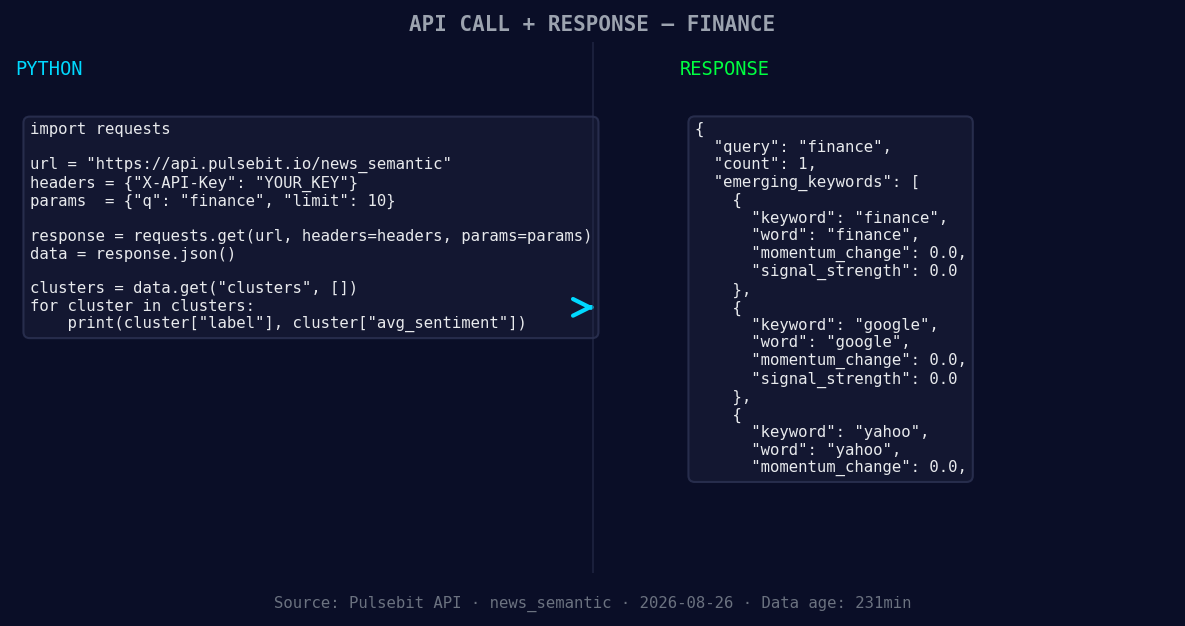
*Left: Python GET /news_semantic call for 'finance'. Right: returned JSON response structure (clusters: 3). Source: Pulsebit /news_semantic.*
# Check if the request was successful
if response.status_code == 200:
articles = response.json()
print(articles)
else:
print("Error fetching data:", response.status_code)
Next, we’ll run the sentiment of the narrative framing itself, based on the clustered themes. This is the meta-sentiment loop that gives us an additional layer of insight. Here’s how to score the narrative:
# Define the cluster reason string
cluster_reason = "Clustered by shared themes: rising, wealth, propel, finance, industry."

# Set up the POST request for sentiment scoring
sentiment_url = "https://api.pulsebit.com/v1/sentiment"
sentiment_data = {
    "text": cluster_reason,
    "confidence": 0.95
}

# Post the sentiment analysis
sentiment_response = requests.post(sentiment_url, json=sentiment_data)

# Check if the request was successful
if sentiment_response.status_code == 200:
    sentiment_result = sentiment_response.json()
    print(sentiment_result)
else:
    print("Error scoring sentiment:", sentiment_response.status_code)
With this data, you can build several useful applications. Here are three specific builds to consider:
Geo-Filtered Insights: Use the geographic origin filter to pull insights specifically from English-speaking regions. Set your threshold for sentiment score at +0.030 to catch only the most relevant articles.
Meta-Sentiment Alerts: Implement a monitoring system that triggers alerts when the meta-sentiment of clustered themes scores above a certain threshold, say +0.025. This helps you stay ahead of emerging narratives.
Comparative Analysis: Build a comparative dashboard that pits financial sentiment against mainstream themes like "rising," "wealth," and "propel." Set up alerts for when these themes intersect with finance, ensuring you catch shifts as they happen.
Ready to get started? Check out our documentation: pulsebit.lojenterprise.com/docs. You can have this running in under 10 minutes. Let's ensure you're not left behind on the next big sentiment shift in finance!


Top comments (0)