

Your Pipeline Is 24.4h Behind: Catching Film Sentiment Leads with Pulsebit
We recently uncovered an intriguing anomaly in sentiment data: a spike in film sentiment with a score of +0.470 and momentum of +0.000. The leading language for this sentiment was English, with a lag of 24.4 hours. This delay in capturing sentiment can significantly impact decision-making in our projects, especially when dealing with rapidly evolving topics like film reviews.
A 24.4-hour lag means your model missed this crucial sentiment shift by nearly a full day. This is particularly concerning when the dominant entity, in this case, the film "Buddy," is making waves in children's TV content. If your pipeline doesn't account for multilingual origins or entity dominance, you might find yourself out of sync with the latest narratives shaping public perception.

English coverage led by 24.4 hours. Tl at T+24.4h. Confidence scores: English 0.85, Da 0.85, French 0.85 Source: Pulsebit /sentiment_by_lang.
To catch this sentiment spike effectively, we can leverage our API. Below is a Python snippet that demonstrates how to query for sentiment data while filtering for the English language.
import requests
# Define the API endpoint and parameters
url = "https://api.pulsebit.com/sentiment"
params = {
"topic": "film",
"lang": "en", # Geographic origin filter
"score": +0.470,
"confidence": 0.85,
"momentum": +0.000
}
# Make the API call
response = requests.get(url, params=params)
data = response.json()
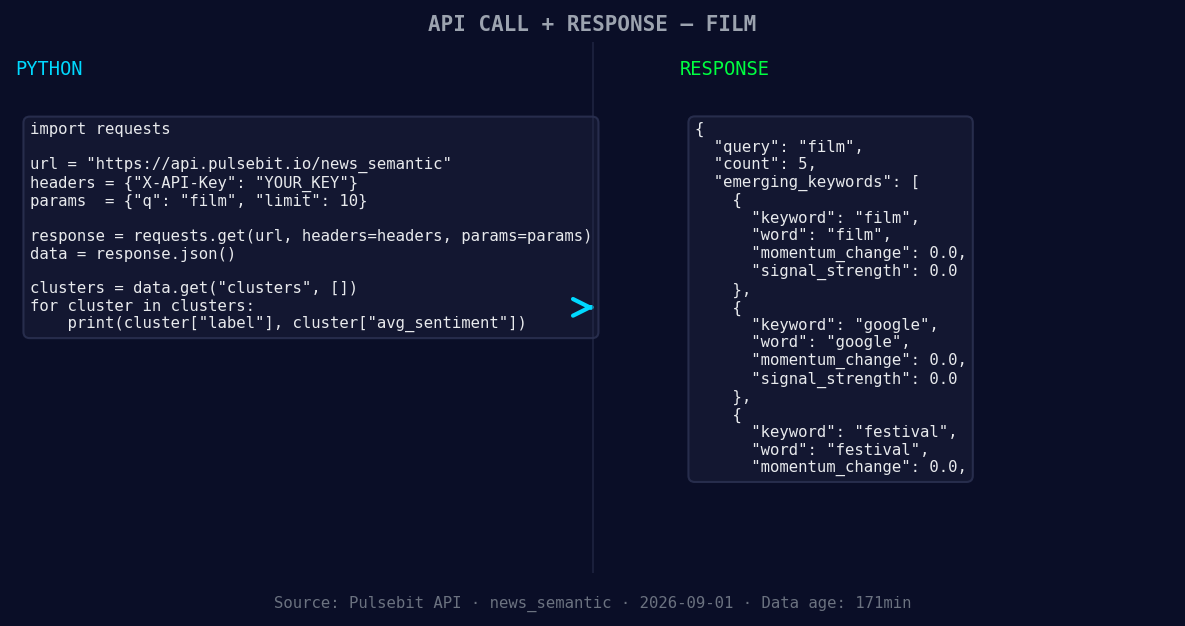
*Left: Python GET /news_semantic call for 'film'. Right: returned JSON response structure (clusters: 3). Source: Pulsebit /news_semantic.*
print(data)
Next, we need to assess the narrative framing of this sentiment spike. We can run the cluster reason string through our sentiment API to evaluate its context further. Here’s how to do that:
# Meta-sentiment moment: Analyze cluster reason string
meta_url = "https://api.pulsebit.com/sentiment"
cluster_reason = "Clustered by shared themes: review:, 'buddy', turns, children’s-tv, cheer."

meta_params = {
    "text": cluster_reason
}

# Make the POST request to score the narrative
meta_response = requests.post(meta_url, json=meta_params)
meta_data = meta_response.json()

print(meta_data)
With this setup, you can extract valuable insights from both the sentiment data and the narrative framing, ensuring you stay ahead of the curve.
Here are three specific builds we can create using this pattern:
- Geo-Filtered Sentiment Analysis: Create a signal that identifies sentiment shifts when the score exceeds +0.400 for English-language film reviews. Use the geographic filter to ensure you're capturing the right audience-driven insights.

Geographic detection output for film. Hong Kong leads with 2 articles and sentiment +0.35. Source: Pulsebit /news_recent geographic fields.
Meta-Sentiment Loop: Build a function that triggers alerts when the narrative framing on children's TV shows like "Buddy" has a sentiment score greater than +0.400. This will help us understand how public discourse is evolving around such themes.
Festival Relevance Checker: Develop an endpoint that monitors sentiment around film festivals. It should trigger when sentiment scores for related topics (e.g., festival, film) rise above +0.200. This way, you can stay informed on emerging trends and audience reactions.
To get started with these implementations, check out our documentation at pulsebit.lojenterprise.com/docs. You can copy-paste the provided code snippets and run them in under ten minutes. Let's ensure we don't miss any more sentiment spikes like this one!


Top comments (0)