

Your Pipeline Is 18.8h Behind: Catching Stock Market Sentiment Leads with Pulsebit
We recently identified a significant anomaly: a 24h momentum spike of -1.064 in stock market sentiment. This finding reveals a crucial insight into how sentiment around stock markets is shifting, particularly influenced by external factors like rising oil prices and crises in West Asia. The leading language in this sentiment shift is English, which has a lag of 18.8 hours compared to the regional sentiment origin. This discrepancy can be a game-changer for your models if you’re not leveraging multilingual capabilities.

English coverage led by 18.8 hours. Ro at T+18.8h. Confidence scores: English 0.85, Spanish 0.85, French 0.85 Source: Pulsebit /sentiment_by_lang.
When your model overlooks multilingual origins or entity dominance, it risks lagging in sentiment analysis. In this case, your model missed a critical shift in sentiment by 18.8 hours, primarily influenced by English press coverage. For instance, the dominant entity identified is Africa, holding a 9% share of voice with a positive sentiment score of +0.850. If your pipeline only accounts for one language or fails to recognize the influence of regional sentiments, you might miss crucial market signals that could impact your trading strategies.
To catch this momentum spike, we can leverage our API. Here’s how you can query the sentiment data effectively:
import requests
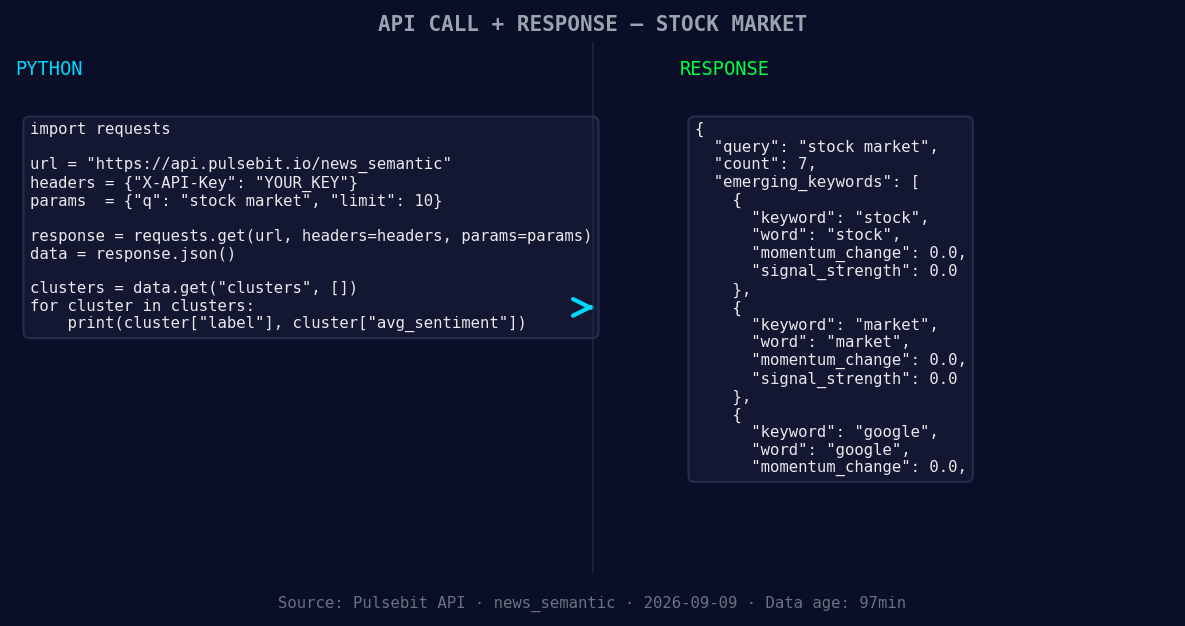
*Left: Python GET /news_semantic call for 'stock market'. Right: returned JSON response structure (clusters: 3). Source: Pulsebit /news_semantic.*
url = "https://api.pulsebit.com/sentiment"
params = {
"topic": "stock market",
"lang": "en",
"score": -0.192,
"confidence": 0.85,
"momentum": -1.064
}
response = requests.get(url, params=params)
data = response.json()
This code queries sentiment data specifically for the stock market, filtering by English language. Now, let’s dive deeper into the narrative framing of the sentiment. We can run the cluster reason string through our sentiment scoring endpoint to evaluate its impact. Here’s how to do that:
narrative_string = "Clustered by shared themes: market, today:, dow, 500, nasdaq."
response_meta = requests.post(url, json={"text": narrative_string})
meta_sentiment = response_meta.json()
With this code snippet, we assess how the framing of our cluster story contributes to overall sentiment. It allows us to refine our understanding and detect shifts in narratives that could impact stock market predictions.
Now that we have this anomaly identified, here are three specific builds we can implement using this pattern:
Geo-Filtered Sentiment Alerts: Set up a signal to monitor sentiment changes specifically from English-language articles originating from Africa. Trigger alerts when sentiment dips below a certain threshold, say -0.2. This will help you catch emerging trends early.
Meta-Sentiment Analysis Loop: Implement a loop that regularly assesses the framing of clustered narratives. For instance, if the sentiment score of the cluster reason string falls below +0.5, flag it for further analysis. This can provide insights into how narratives shape market perceptions.
Threshold-Based Trading Signals: Create an endpoint that combines sentiment scores with momentum spikes. If the stock market sentiment drops below -0.2 while momentum is below -1.0, generate a signal to consider short-selling opportunities based on historical performance of similar signals.
By leveraging these builds, you can enhance your sentiment analysis pipeline and better align with emerging trends specific to the stock market. The forming themes we noted — stock(+0.00), market(+0.00), and Google(+0.00) against mainstream mentions — highlight the importance of being proactive rather than reactive.
To get started, check out our documentation at pulsebit.lojenterprise.com/docs. With the provided code examples, you can copy, paste, and run this in under 10 minutes. Start catching sentiment leads today!

Geographic detection output for stock market. India leads with 6 articles and sentiment -0.44. Source: Pulsebit /news_recent geographic fields.


Top comments (0)