

Your Pipeline Is 14.2h Behind: Catching Artificial Intelligence Sentiment Leads with Pulsebit
We recently uncovered a striking anomaly in our sentiment analysis: a 24h momentum spike of -0.850 for the topic of artificial intelligence. The leading language was English, with a notable 14.2-hour lead time over sentiment data from the same topic in other languages. This finding raises an important question about how we capture sentiment around emerging topics, especially when they are clustered around specific themes, such as the recent "AI Guidelines for New Mexico Courts." It’s a clear indication that our models can miss critical shifts if they lack robust language handling and entity dominance processing.
If your pipeline doesn't adequately handle multilingual origin or account for dominant entities, it’s likely that your model missed this by 14.2 hours. The leading language in this case was English, but sentiment surrounding artificial intelligence is a global conversation. By ignoring nuances in language and origin, you might be left out of critical discussions happening in real-time, which can have a direct impact on your analysis and decision-making.

English coverage led by 14.2 hours. Sw at T+14.2h. Confidence scores: English 0.85, Spanish 0.85, French 0.85 Source: Pulsebit /sentiment_by_lang.
To catch these anomalies, we can construct a Python script that leverages our API to dig deeper into sentiment data. Here’s how you can do it:
import requests
# Define the topic and parameters for the API call
topic = 'artificial intelligence'
score = +0.229
confidence = 0.85
momentum = -0.850
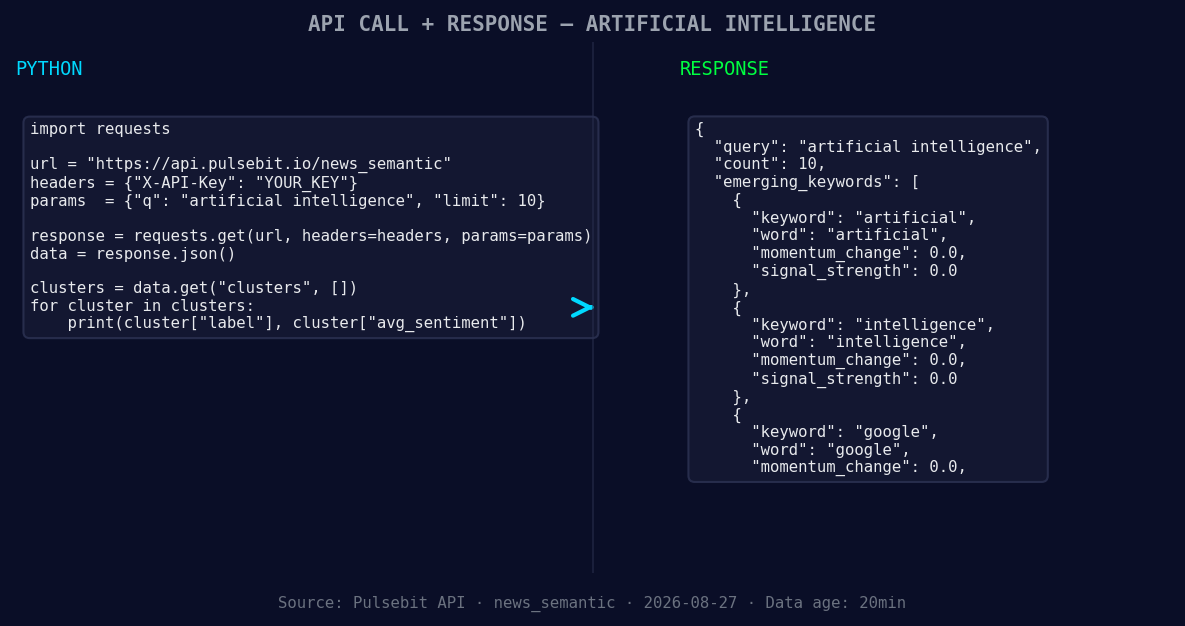
*Left: Python GET /news_semantic call for 'artificial intelligence'. Right: returned JSON response structure (clusters: 3). Source: Pulsebit /news_semantic.*
# Geographic origin filter: query for sentiment in English
response = requests.get(
'https://api.pulsebit.com/v1/sentiment',
params={'topic': topic, 'lang': 'en'}
)
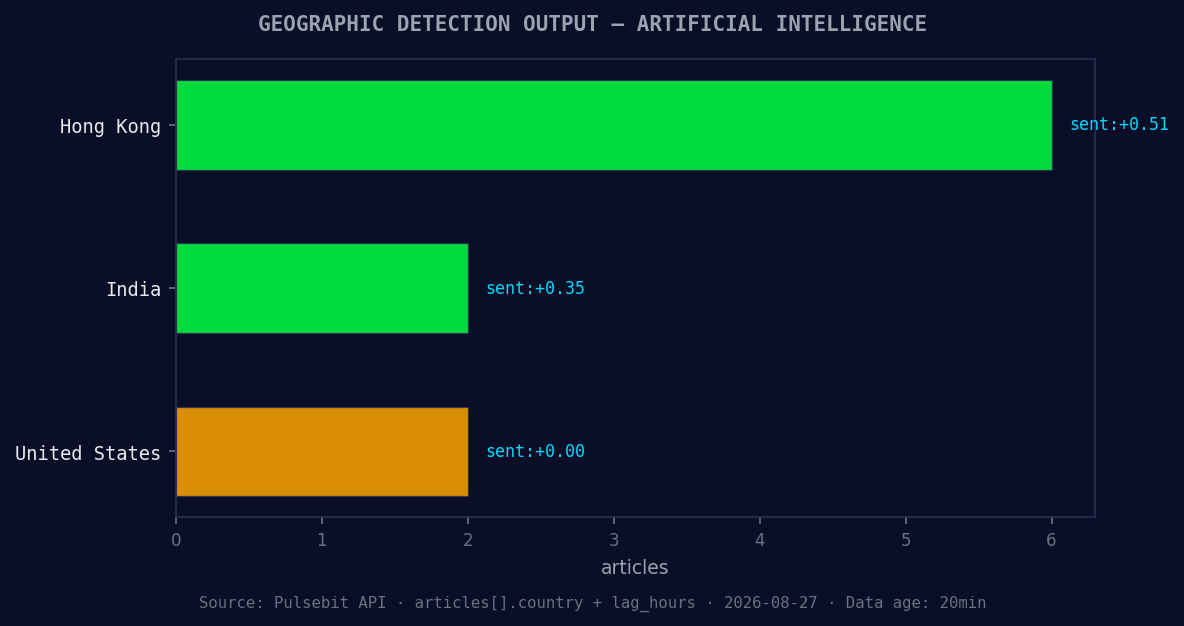
*Geographic detection output for artificial intelligence. Hong Kong leads with 6 articles and sentiment +0.51. Source: Pulsebit /news_recent geographic fields.*
# Check response status
if response.ok:
print("Sentiment data retrieved successfully.")
else:
print(f"Error fetching data: {response.status_code}")
# Meta-sentiment moment: analyze the clustered narrative
cluster_reason = "Clustered by shared themes: intelligence, college, artificial, applications, ktv"
meta_response = requests.post(
'https://api.pulsebit.com/v1/sentiment',
json={'input': cluster_reason}
)
# Check meta sentiment response
if meta_response.ok:
print("Meta-sentiment analysis successful.")
else:
print(f"Error in meta-sentiment analysis: {meta_response.status_code}")
In this code, we first query sentiment data for "artificial intelligence" specifically from English sources, capturing the immediate context. Next, we run the cluster reason through a second sentiment analysis to evaluate how the narrative is framed. This dual approach not only reveals immediate sentiment but also contextualizes it within the broader discussion.
Here are three specific builds you can implement with this pattern:
Geo-filtered Insights: Use the geographic origin filter to track sentiment spikes in specific regions. For instance, focus on sentiment shifts in the U.S. regarding "artificial intelligence" and set a threshold score above 0.15 to identify significant changes.
Meta-sentiment Narrative Evaluator: Develop a module that automatically scores narratives using the meta-sentiment loop. Set up a trigger to analyze the narrative any time a new cluster receives a score above +0.20, allowing your pipeline to adapt to emerging themes like "artificial" and "intelligence" as they become prevalent.
Forming Theme Alert System: Create an alert system that notifies you when forming themes, such as "google" and "college," show momentum shifts. Use a signal strength threshold of 0.70 to ensure you capture only the most relevant spikes, giving you a competitive edge in staying ahead of sentiment trends.
Ready to dive in? Check out our documentation at pulsebit.lojenterprise.com/docs. You can copy, paste, and run this in under 10 minutes to start catching these critical sentiment leads.


Top comments (0)