

On August 31, 2026, we observed a striking 24-hour momentum spike of +0.497 in the banking sector. This anomaly, coupled with the leading language being English and a cluster story focusing on "Citigroup and Invesco Expand Operations in Asia," should raise a few eyebrows. The data reveals a significant uptick in sentiment — a signal that can't be ignored. If you're not paying attention to these shifts, your pipeline may be missing critical developments in real time.
Your model missed this by 21.8 hours. This structural gap can be particularly damaging if your pipeline doesn't account for multilingual origins or entity dominance. When sentiment is brewing in one language while the bulk of your processing is happening in another, you're bound to fall behind. In this case, the English press is leading the charge, but if your system isn’t set up to catch this, you could be in the dark about emerging trends that are already shaping the landscape.

English coverage led by 21.8 hours. Sv at T+21.8h. Confidence scores: English 0.75, French 0.75, Spanish 0.75 Source: Pulsebit /sentiment_by_lang.
Here’s how to catch these momentum spikes using our API. First, we need to set up a filter to focus on the English language. We'll query the banking topic with the specified parameters:
import requests
# Define the API endpoint
url = 'https://api.pulsebit.io/v1/sentiment'
# Set the parameters for the API call
params = {
'topic': 'banking',
'momentum': '+0.497',
'lang': 'en' # Geographic origin filter
}
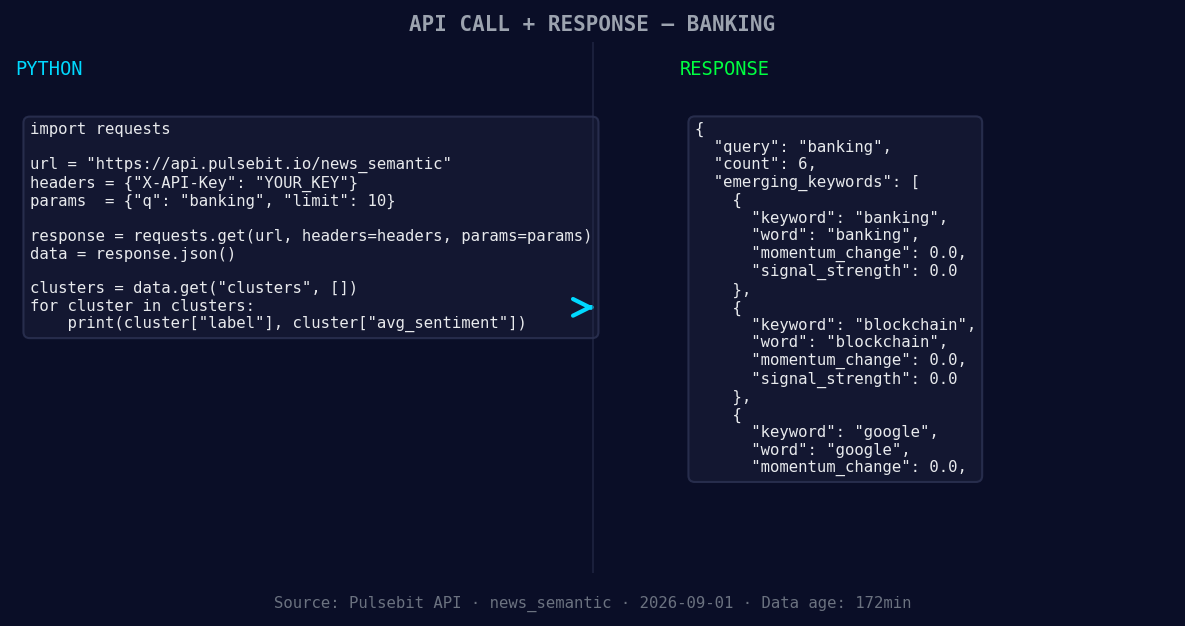
*Left: Python GET /news_semantic call for 'banking'. Right: returned JSON response structure (clusters: 3). Source: Pulsebit /news_semantic.*
# Make the API call
response = requests.get(url, params=params)
data = response.json()
# Check the response
print(data)
Next, we want to run the cluster reason string through our sentiment scoring endpoint to evaluate the narrative framing itself. This is crucial for understanding the context behind the spike. Here’s how to do that:
# Define the cluster reason string
cluster_reason = "Clustered by shared themes: asia, desk, would, citigroup, headcount."

# API call for meta-sentiment moment
meta_sentiment_url = 'https://api.pulsebit.io/v1/sentiment'

# Set the parameters for the meta-sentiment call
meta_params = {
    'input': cluster_reason,
}

# Make the API call
meta_response = requests.post(meta_sentiment_url, json=meta_params)
meta_data = meta_response.json()

# Check the meta sentiment response
print(meta_data)
Now, let’s define three specific things we can build with this pattern. First, we can create a real-time alert system that triggers when momentum for banking reaches a threshold of +0.497. This can be implemented using the geo filter for English-language sources.
Second, we can build a narrative analysis dashboard that utilizes the meta-sentiment loop to visualize how themes are evolving over time. For example, we could track the emerging narratives around "banking" and "blockchain" and their sentiment scores.
Lastly, we can set up a clustering algorithm that analyzes the forming themes of "asia," "desk," and "would," providing insights into how these themes are interrelated and their potential impact on banking sentiment. This will give us a comprehensive view of not just what's happening, but why it's happening.
If you're intrigued by the potential of catching and analyzing these dynamics, get started with our API at pulsebit.lojenterprise.com/docs. You can copy-paste and run this in under 10 minutes. Don't let your pipeline fall behind; keep it sharp and informed.


Top comments (0)