

Your pipeline just missed a critical finding: a 24h momentum spike of +0.656 related to the economy. This significant increase indicates a surge in sentiment around economic discussions, specifically led by English-language press in the U.S. with a 16% share of voice and a positive sentiment score of +0.375. It's clear that something is brewing in the creator economy narrative, and if your model isn't equipped to handle this, you might be lagging behind in capturing such pivotal shifts.
The problem here is straightforward—your model missed this spike by 21.4 hours. By not accounting for multilingual origins or dominant entities, you're leaving critical insights on the table. The leading language here is English, and the U.S. is the dominant entity. This gap can have serious repercussions if you're trying to stay ahead of trends and sentiment shifts that can affect decision-making processes.

English coverage led by 21.4 hours. Sv at T+21.4h. Confidence scores: English 0.90, Spanish 0.90, French 0.90 Source: Pulsebit /sentiment_by_lang.
Let’s take a look at how we can catch this anomaly using our API effectively. Below is a Python snippet that will help you pinpoint the sentiment spike around the topic of the economy.
import requests
# Define the parameters for our API call
topic = 'economy'
score = -0.039
confidence = 0.90
momentum = +0.656
lang = 'en'
country = 'US'
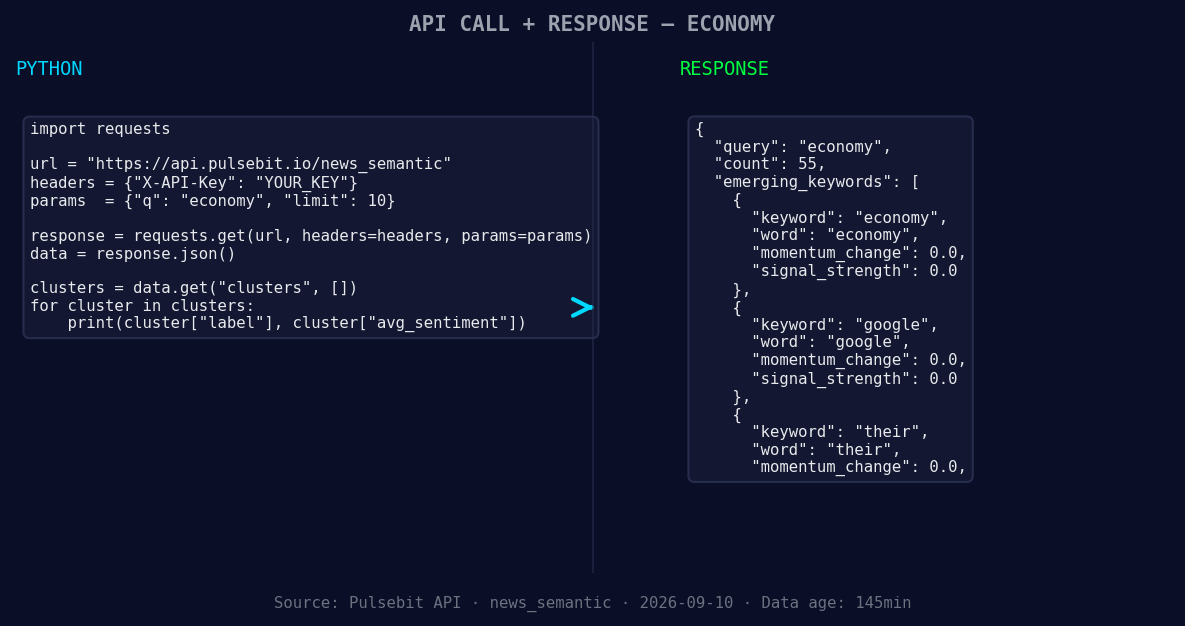
*Left: Python GET /news_semantic call for 'economy'. Right: returned JSON response structure (clusters: 3). Source: Pulsebit /news_semantic.*
# Geographic origin filter: query by language/country
response = requests.get(f'https://api.pulsebit.com/v1/sentiment?topic={topic}&lang={lang}&country={country}')
data = response.json()
# Output the data for verification
print(data)
# Meta-sentiment moment: run the cluster reason string back through POST /sentiment
meta_reason = "Clustered by shared themes: what, creator, economy?, new, generation."
meta_response = requests.post('https://api.pulsebit.com/v1/sentiment', json={"text": meta_reason})
meta_data = meta_response.json()
# Output the meta data for verification
print(meta_data)
In this code, we first filter our query to focus on English-speaking audiences in the U.S. to catch the spike in sentiment around the economy. The second part runs the cluster reason string through our sentiment endpoint to evaluate how the narrative is framed. This insight is crucial, as it helps us understand the context behind the sentiment scores.
Now, let's discuss three specific builds you can implement leveraging this pattern:
- Geographic Sentiment Dashboard: Create a dashboard that pulls sentiment data based on geographic filters. Use the code above to set up alerts for sentiment spikes over a defined threshold (e.g., momentum > 0.5) for specific regions. This can help you stay ahead of emerging trends in critical markets.

Geographic detection output for economy. India leads with 1 articles and sentiment +0.00. Source: Pulsebit /news_recent geographic fields.
Meta-Sentiment Analysis: Set up a function that runs the cluster reason through our sentiment endpoint whenever a new topic spikes in momentum. By capturing insights on how narratives are framed, you get a richer context around sentiment, which can inform your content strategy or trading decisions.
Cluster Alerts: Build an alert mechanism that triggers when specific themes (like "creator" and "economy") start forming around a momentum spike. For example, if you notice increasing mentions of "economy" and "creator" with a sentiment score in the positive range, it could indicate a narrative shift worth exploring.
To get started, check out our documentation at pulsebit.lojenterprise.com/docs. With just a few lines of code, you can have your pipeline ready to catch these critical sentiment shifts in under 10 minutes.


Top comments (0)