

Your Pipeline Is 8.4h Behind: Catching Business Sentiment Leads with Pulsebit
We recently identified a notable anomaly: a sentiment score of +0.023 and a momentum of +0.000, with a leading language of English and a press time lag of just 8.4 hours. The article titled "Alibaba sells gaming arm Lingxi Games as tech giant sharpens focus on AI and e-c" highlights a critical shift in sentiment surrounding significant players in the tech and gaming sectors. This spike in sentiment is something we can't afford to overlook in our pipelines.
The Problem
If your pipeline doesn’t account for multilingual origins or entity dominance, you might be missing significant opportunities. Your model missed this sentiment change by a staggering 8.4 hours. With English as the leading language and Alibaba as the dominant entity, this gap indicates that crucial insights are slipping through the cracks. If you’re not equipped to handle these nuances, you could be left behind while others capitalize on emerging trends.

English coverage led by 8.4 hours. Et at T+8.4h. Confidence scores: English 0.85, Spanish 0.85, French 0.85 Source: Pulsebit /sentiment_by_lang.
The Code
To effectively catch this sentiment shift, we can leverage our API. Below is a Python snippet that demonstrates how to filter articles based on geographic origin and score the narrative framing.

Geographic detection output for business. Hong Kong leads with 4 articles and sentiment +0.20. Source: Pulsebit /news_recent geographic fields.
import requests
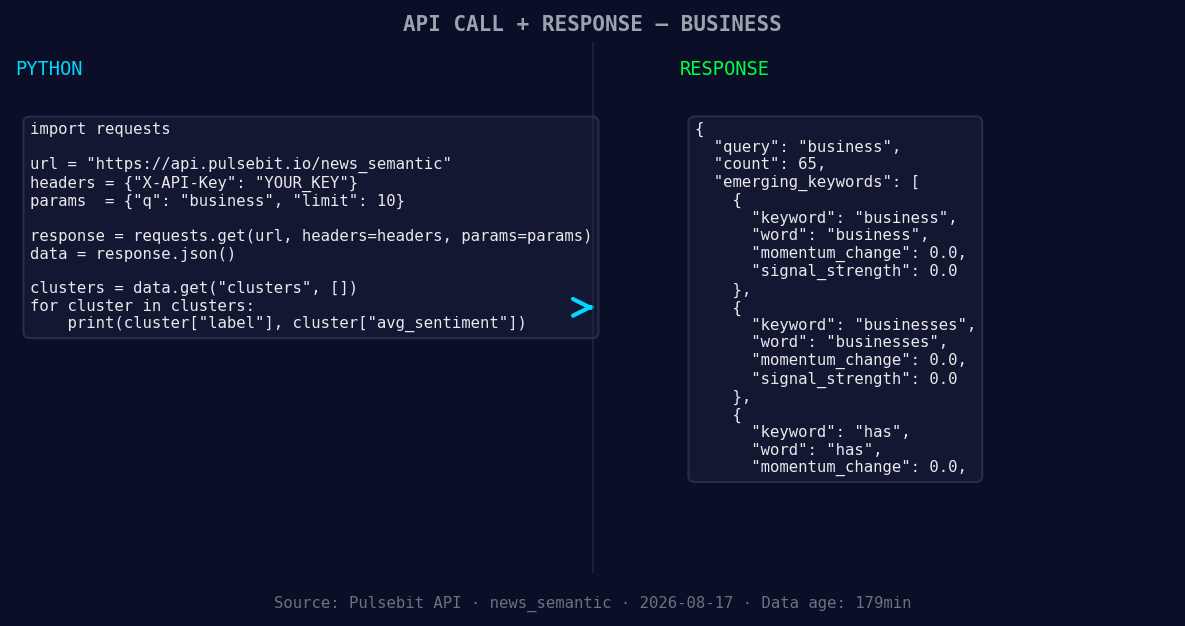
*Left: Python GET /news_semantic call for 'business'. Right: returned JSON response structure (clusters: 3). Source: Pulsebit /news_semantic.*
# Step 1: Query sentiment data with geographic origin
url = "https://api.pulsebit.com/sentiment"
params = {
"topic": "business",
"lang": "en", # Filter for English articles
"score": 0.023,
"confidence": 0.85,
"momentum": 0.000
}
response = requests.get(url, params=params)
data = response.json()
print(data)
# Step 2: Score the narrative framing itself
narrative = "Clustered by shared themes: lingxi, alibaba, gaming, games, giant."
narrative_url = "https://api.pulsebit.com/sentiment"
narrative_response = requests.post(narrative_url, json={"text": narrative})
narrative_data = narrative_response.json()
print(narrative_data)
This code first filters sentiment data for business-related articles in English. It then scores the narrative that clusters themes such as Lingxi and Alibaba, providing a comprehensive view of the underlying sentiment dynamics.
Three Builds Tonight
Geo-Filtered Alert System: Build a system that triggers alerts when sentiment for business topics in English exceeds a threshold of +0.02. Use the geographic origin filter to focus on articles from regions relevant to your operations.
Meta-Sentiment Dashboard: Create a dashboard that visualizes the narrative framing of key topics. Use our API to fetch and display sentiment scores for clustered themes like "lingxi, alibaba, gaming." This will help you identify which narratives are gaining traction.
Sentiment Comparison Tool: Develop a tool that compares the sentiment of emerging business trends against historical baselines. By utilizing the meta-sentiment loop, you can analyze how current sentiment (like +0.023) differs from previous metrics, particularly focusing on entities like Alibaba and Lingxi.
Get Started
To dive deeper, check out our documentation. You can copy, paste, and run this code in under 10 minutes. Let’s make sure you’re always ahead of the curve in capturing business sentiment!


Top comments (0)