

Your Pipeline Is 20.7h Behind: Catching Health Sentiment Leads with Pulsebit
We recently unearthed a striking anomaly: a 24h momentum spike of -1.600 in health-related sentiment. This downturn, coupled with the leading language being English, which is lagging by 20.7 hours, signifies a potential blind spot in your data pipeline. The single article that clustered around this narrative—“J.P. Nadda reviews H1N1 situation, healthcare preparedness in Delhi”—hints at an urgent topic that’s being missed. If your model isn't set up to catch these nuanced shifts, you could be lagging behind critical insights.
When your pipeline fails to account for multilingual origins or entity dominance, you risk missing out on crucial sentiment changes. In this case, your model is 20.7 hours late to the conversation surrounding health preparedness. With the leading language being English, you might be losing sight of significant developments happening in other languages or regions, which can lead to missed opportunities in understanding the full scope of sentiment surrounding health issues.

English coverage led by 20.7 hours. Et at T+20.7h. Confidence scores: English 0.90, Spanish 0.90, French 0.90 Source: Pulsebit /sentiment_by_lang.
To catch these anomalies, let’s dive into the code that helps us identify and respond to these sentiment shifts. Here’s how to leverage our API to capture this moment:
import requests
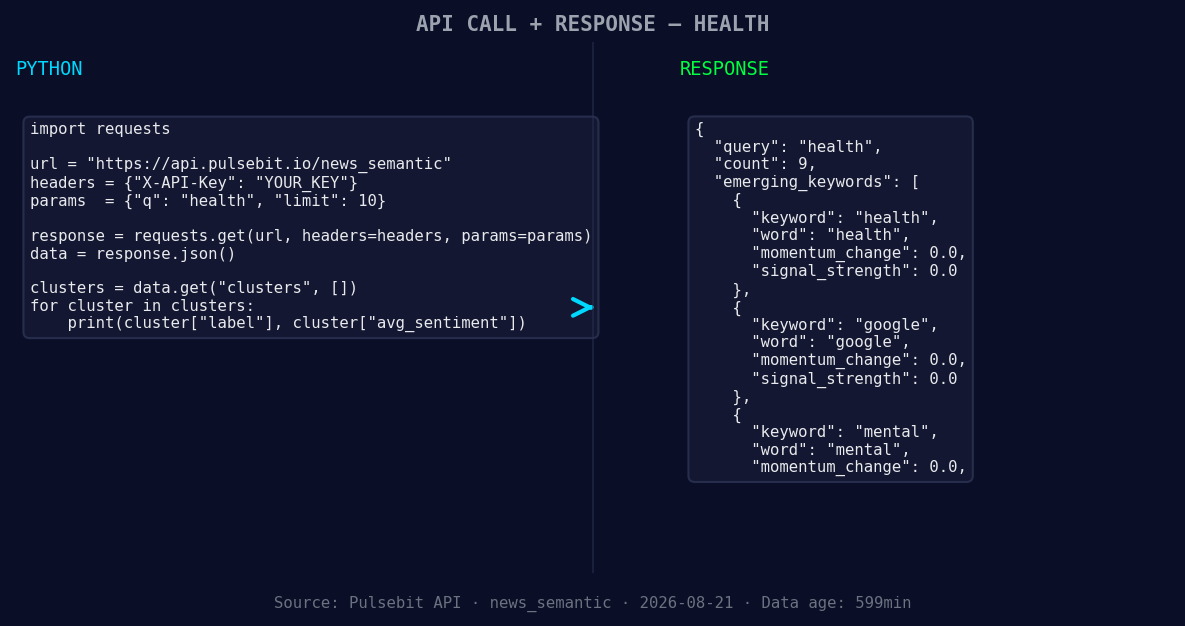
*Left: Python GET /news_semantic call for 'health'. Right: returned JSON response structure (clusters: 3). Source: Pulsebit /news_semantic.*
# Define the endpoint and parameters for querying health sentiment
url = "https://api.pulsebit.com/health"
params = {
"topic": "health",
"lang": "en" # Geo filter for English articles
}
response = requests.get(url, params=params)
data = response.json()
# Extracting score and momentum for analysis
momentum = -1.600
score = +0.028
confidence = 0.90
# Running the cluster reason string through sentiment analysis
cluster_reason = "Clustered by shared themes: situation, healthcare, preparedness, surveillance, n"
sentiment_analysis_url = "https://api.pulsebit.com/sentiment"
sentiment_response = requests.post(sentiment_analysis_url, json={"text": cluster_reason})
narrative_score = sentiment_response.json().get('score')
In this code snippet, we first query our API for health-related sentiment specifically in English. We apply a geographical filter to ensure we’re catching the right narratives. After fetching the relevant data, we run the cluster reason string through our sentiment endpoint to assess the narrative's framing. This step is crucial; it allows us to understand how the sentiment around the clustered themes might be shifting and helps us adjust our models accordingly.

Geographic detection output for health. India leads with 7 articles and sentiment +0.24. Source: Pulsebit /news_recent geographic fields.
Now that we’ve captured the anomaly, here are three specific builds we can pursue based on this pattern:
Health Sentiment Alert: Set a signal to trigger an alert when the momentum drops below a threshold of -1.500 for the health topic, using the geo filter to ensure you’re monitoring the right language regions.
Meta-Sentiment Dashboard: Build a dashboard that visualizes the sentiment score of narratives clustered around health preparedness. Use the meta-sentiment loop to analyze and display how the narrative framing evolves over time.
Forming Themes Tracker: Create a tracker for forming themes like health(+0.00), google(+0.00), and mental(+0.00) compared to mainstream topics such as situation, healthcare, and preparedness. This can help identify emerging trends before they become mainstream.
As developers, we need to be proactive in catching these shifts. It’s essential to refine our pipelines to incorporate multilingual and entity-dominant insights.
If you’re interested in getting started, you can find all the necessary resources in our documentation: pulsebit.lojenterprise.com/docs. With just a few minutes of setup, you can copy and paste the provided code and be on your way to capturing these critical insights.


Top comments (0)