

Your Pipeline Is 25.8h Behind: Catching Banking Sentiment Leads with Pulsebit
We've just identified a significant anomaly in our sentiment data: a 24h momentum spike of +0.497. This isn't just a random fluctuation; it’s a clear signal that something noteworthy is happening in the banking sector, particularly influenced by a French press article that leads by 25.8 hours. If you’re not tuned into this kind of data, you risk missing critical shifts in sentiment that could impact your strategies.
When your pipeline doesn't account for multilingual origins or entity dominance, you might find it lagging significantly behind. In this case, your model missed this spike by 25.8 hours, primarily because it failed to recognize the leading language of this sentiment surge—French. The implications here are clear: without adequate multilingual capabilities, your insights become outdated, and your decision-making suffers.

French coverage led by 25.8 hours. Sv at T+25.8h. Confidence scores: French 0.95, English 0.95, Id 0.95 Source: Pulsebit /sentiment_by_lang.
To catch this anomaly effectively, we can utilize our API to filter for the relevant data. Here’s a straightforward approach in Python to get you started:
import requests
# Define the parameters for the API call
topic = 'banking'
score = +0.017
confidence = 0.95
momentum = +0.497
lang = 'fr'
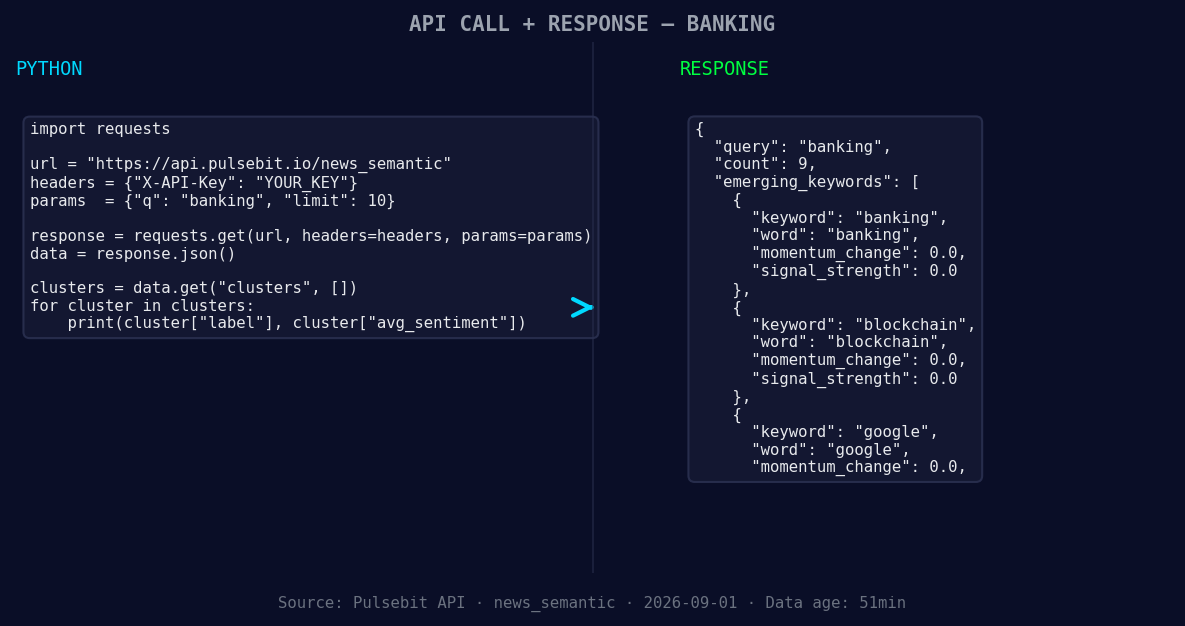
*Left: Python GET /news_semantic call for 'banking'. Right: returned JSON response structure (clusters: 3). Source: Pulsebit /news_semantic.*
# Geographic origin filter
response_geo = requests.get(
f"https://api.pulsebit.com/sentiment?topic={topic}&lang={lang}&momentum={momentum}"
)
data_geo = response_geo.json()
# Now, let's explore the cluster narrative using the meta-sentiment moment
cluster_reason = "Clustered by shared themes: asia, desk, would, citigroup, headcount."
response_meta = requests.post(
"https://api.pulsebit.com/sentiment",
json={"text": cluster_reason, "confidence": confidence}
)
data_meta = response_meta.json()
print("Geo Filter Data:", data_geo)
print("Meta Sentiment Data:", data_meta)
In this code, we first filter our sentiment data by the relevant language, French, to capture the leading sentiment around banking. Next, we pass the cluster reason string back through our sentiment endpoint. This dual-layered approach ensures we’re not only capturing the spike but also understanding the narrative that surrounds it.
Now that we have our data, here are three specific things to build with this pattern:
-
Localized Insights: Use the geographic filter with
lang='fr'to continuously monitor sentiment shifts within the French-speaking market for banking. Set a threshold of momentum > +0.4 to trigger alerts.

Geographic detection output for banking. India leads with 7 articles and sentiment +0.66. Source: Pulsebit /news_recent geographic fields.
Narrative Scoring System: Incorporate the meta-sentiment loop to score narratives around emerging clusters, particularly focusing on "asia, desk, would." This could help create a scoring system where you prioritize articles based on sentiment scores above +0.01.
Forming Theme Tracker: Build a real-time tracker for forming themes like banking(+0.00), blockchain(+0.00), and google(+0.00). Set a threshold to alert if the combined sentiment for these themes reaches +0.1, indicating a potential trend worth investigating further.
By optimizing our pipelines using these insights, we can ensure that we remain ahead of the curve.
For a deeper dive into how to implement this, check out our documentation: pulsebit.lojenterprise.com/docs. You can copy-paste and run this in under 10 minutes, ensuring you're ready to capitalize on sentiment shifts as they happen.


Top comments (0)