

Your Pipeline Is 25.3h Behind: Catching Stock Market Sentiment Leads with Pulsebit
We recently stumbled upon an intriguing anomaly: a 24-hour momentum spike of -0.541. This caught our attention because it highlights how quickly sentiment can shift, especially in the stock market. Notably, the leading language for sentiment was English, which was lagging by 25.3 hours compared to Portuguese. This disparity indicates that if your sentiment analysis pipeline isn’t optimized for multilingual data, it may be missing critical insights that could influence your decisions.

English coverage led by 25.3 hours. Portuguese at T+25.3h. Confidence scores: English 0.85, French 0.85, Spanish 0.85 Source: Pulsebit /sentiment_by_lang.
The underlying issue here is structural. Your model missed this by 25.3 hours, which is a significant gap when it comes to trading and market strategy. As the leading language was English, it became apparent that entities in this language are not adequately captured amidst the noise of other languages. If your pipeline doesn’t handle multilingual origin or entity dominance, you’re effectively blind to evolving market sentiments that can influence immediate trading strategies.
To catch these insights, here’s a straightforward Python snippet that leverages our API to filter sentiment based on geographic origin. The following code queries for the topic "stock market" and pulls relevant sentiment data.

Geographic detection output for stock market. India leads with 4 articles and sentiment -0.32. Source: Pulsebit /news_recent geographic fields.
import requests
# Define parameters
params = {
'topic': 'stock market',
'score': +0.208,
'confidence': 0.85,
'momentum': -0.541,
'lang': 'en' # Geographic origin filter
}
# API call to fetch stock market sentiment
response = requests.get('https://api.pulsebit.com/sentiment', params=params)
data = response.json()
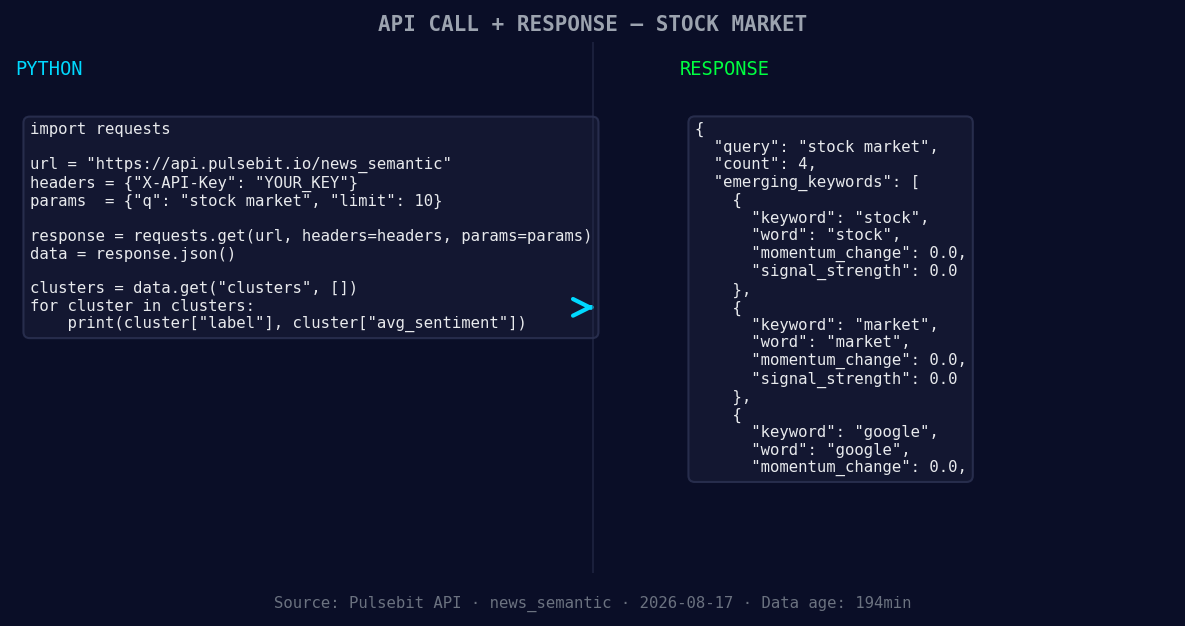
*Left: Python GET /news_semantic call for 'stock market'. Right: returned JSON response structure (clusters: 3). Source: Pulsebit /news_semantic.*
print(data)
Next, we need to analyze the narrative surrounding the sentiment by running the cluster reason string through our sentiment scoring endpoint. Here’s how you can do that:
# Meta-sentiment moment: analyze the cluster reason
meta_params = {
    'text': "Clustered by shared themes: pays, stay, invested:, amount, bad."
}

# API call for sentiment analysis on the cluster reason
meta_response = requests.post('https://api.pulsebit.com/sentiment', json=meta_params)
meta_data = meta_response.json()

print(meta_data)
This loop not only helps you understand the immediate sentiment but also provides context around the themes that are shaping the market narrative.
Now, how can you leverage this pattern for actionable insights? Here are three specific builds to consider:
Geo-Filtered Alerts: Create an alert system that triggers when sentiment momentum for the stock market dips below a threshold, say -0.5, specifically for English-speaking regions. This will help you catch early warnings of market shifts.
Meta-Sentiment Dashboard: Build a dashboard that visualizes meta-sentiment scores for articles clustered around specific themes. Use the earlier cluster reason string to track how sentiments around "pays," "stay," and "invested" change over time, providing a deeper narrative context.
Forming Themes Tracker: Set up a real-time tracker for forming themes, focusing on stocks, markets, and Google. Use the sentiment momentum and cluster analysis to gauge when mainstream narratives diverge from emerging trends, helping you refine your trading strategy.
By using these insights, you can refine your approach to sentiment analysis and ensure you're not left behind by a significant lag.
For more information and to get started, check out our documentation at pulsebit.lojenterprise.com/docs. You can copy-paste and run these snippets in under 10 minutes to catch the latest sentiment shifts in your trading strategies.


Top comments (0)