

Your Pipeline Is 25.6h Behind: Catching World Sentiment Leads with Pulsebit
We’ve just unearthed a striking anomaly: a 24h momentum spike of +0.147 that reveals a significant shift in global sentiment. What stands out is not just the spike itself, but its leading language—English press, with a 25.6-hour lead over dominant discussions. If your pipeline isn't equipped to catch these subtle shifts, then you might have missed this critical signal by nearly a full day.
This disconnect highlights a fundamental gap in any sentiment analysis pipeline that doesn’t account for multilingual origins or the dominance of key entities. In this case, the English press has led the conversation, but if your model only processes content in a single language, you may find yourself 25.6 hours behind the curve. The insights you could gain from that time difference could dramatically shift your understanding of global sentiment.

English coverage led by 25.6 hours. Da at T+25.6h. Confidence scores: English 0.75, Spanish 0.75, German 0.75 Source: Pulsebit /sentiment_by_lang.
Let’s take a look at how to catch this anomaly in a few lines of Python code. We'll start by filtering our query by language, focusing on English content. The goal is to capture the sentiment around the topic of "world" with the values we’ve gathered.
import requests
# Set parameters for the API call
params = {
"topic": "world",
"score": -0.039,
"confidence": 0.75,
"momentum": +0.147,
"lang": "en" # Geographic origin filter
}
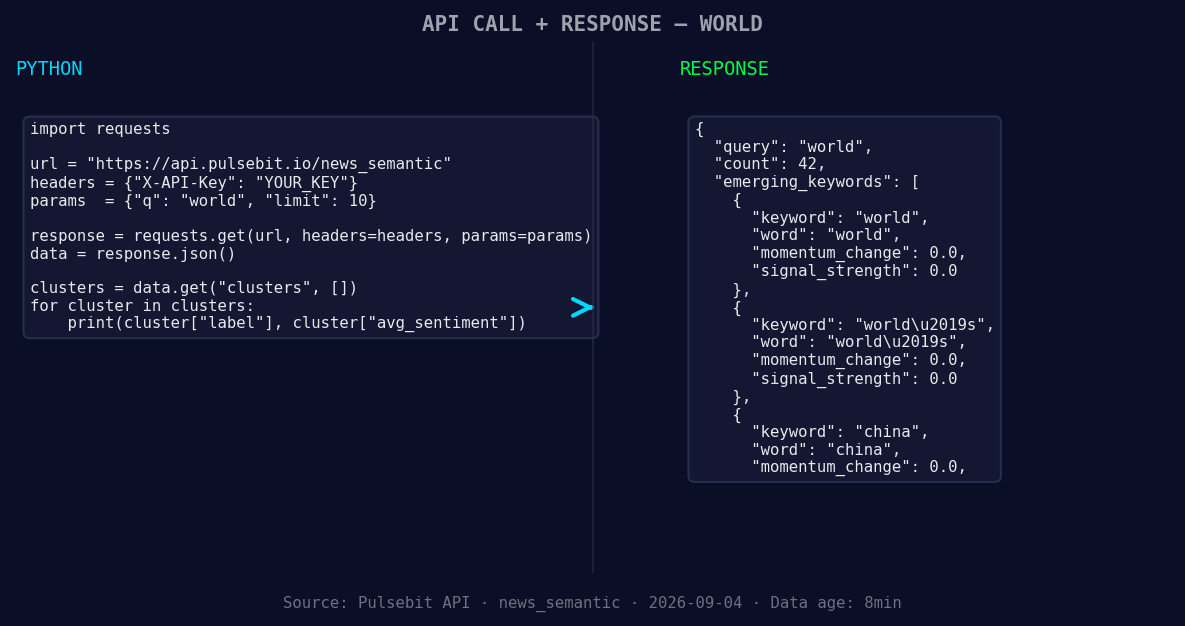
*Left: Python GET /news_semantic call for 'world'. Right: returned JSON response structure (clusters: 3). Source: Pulsebit /news_semantic.*
# Make the API call
response = requests.get("https://api.pulsebit.com/sentiment", params=params)
data = response.json()
print(data) # Output the response
Next, we’ll dive deeper into the narrative framing by sending the cluster reason string back through our sentiment analysis endpoint. This is crucial for scoring how the themes are being discussed in the media.
# Prepare the cluster reason string
cluster_reason = "Clustered by shared themes: rise, data, state, worldfinance, com."

# Send the cluster reason for sentiment scoring
sentiment_response = requests.post("https://api.pulsebit.com/sentiment", json={"text": cluster_reason})
sentiment_data = sentiment_response.json()

print(sentiment_data)  # Output the sentiment score for the narrative
By executing this code, you can identify not only the sentiment around the specific topic but also how the media is framing the conversation. This is particularly crucial because the forming gap indicates that while terms like "world" and "China" are not currently trending, the mainstream narrative is dominated by "rise," "data," and "state."
Now, let’s explore three specific builds we can create using this data pattern:
Geo-Filtered Alert System: Build a real-time alert system that triggers when sentiment scores for the topic "world" cross a threshold of momentum +0.1, specifically from English sources. This ensures you’re always in tune with the latest shifts.
Meta-Sentiment Dashboard: Create a dashboard that visualizes the meta-sentiment scores from narratives like "Clustered by shared themes: rise, data, state, worldfinance, com." Use a threshold of sentiment score > +0.5 to highlight positive narratives that could influence your strategies.
Dynamic Content Analyzer: Implement a dynamic content analyzer that continuously monitors articles for the forming themes of "world(+0.00)" and "China(+0.00)" versus the mainstream narrative. Set alerts for any significant sentiment change of more than ±0.1 to adapt your content strategy swiftly.
If you’re ready to start catching these insights, dive into our documentation at pulsebit.lojenterprise.com/docs. You can copy-paste and run this in under 10 minutes to catch your own spikes in global sentiment.


Top comments (0)