

Your pipeline missed a 24h momentum spike of +0.323 related to film sentiment. This specific anomaly points to an emerging narrative that you might not have caught in time. The leading language here is English, as evidenced by the 14.1h lead time. Meanwhile, the dominant entity contributing to this spike is Gaza, holding a 9% share of voice with a neutral sentiment score of +0.036. If your model isn't equipped to handle multilingual data or entity dominance, it simply won't pick up on these emerging trends until it's too late.

English coverage led by 14.1 hours. Et at T+14.1h. Confidence scores: English 0.85, Spanish 0.85, French 0.85 Source: Pulsebit /sentiment_by_lang.
This structural gap can be detrimental for your insights pipeline. You might find that your model missed this opportunity by a staggering 14.1 hours, as it failed to recognize the significance of the dominant English press coverage and the sentiment surrounding Gaza. Without addressing these factors, you risk lagging behind in critical sentiment shifts that could inform your decision-making.
Here’s how we can catch this anomaly using our API. We’ll start by filtering the sentiment data based on the geographic origin, specifically focusing on English-language sources.
import requests
# Define parameters for the sentiment analysis API call
topic = 'film'
score = +0.283
confidence = 0.85
momentum = +0.323
lang = 'en'
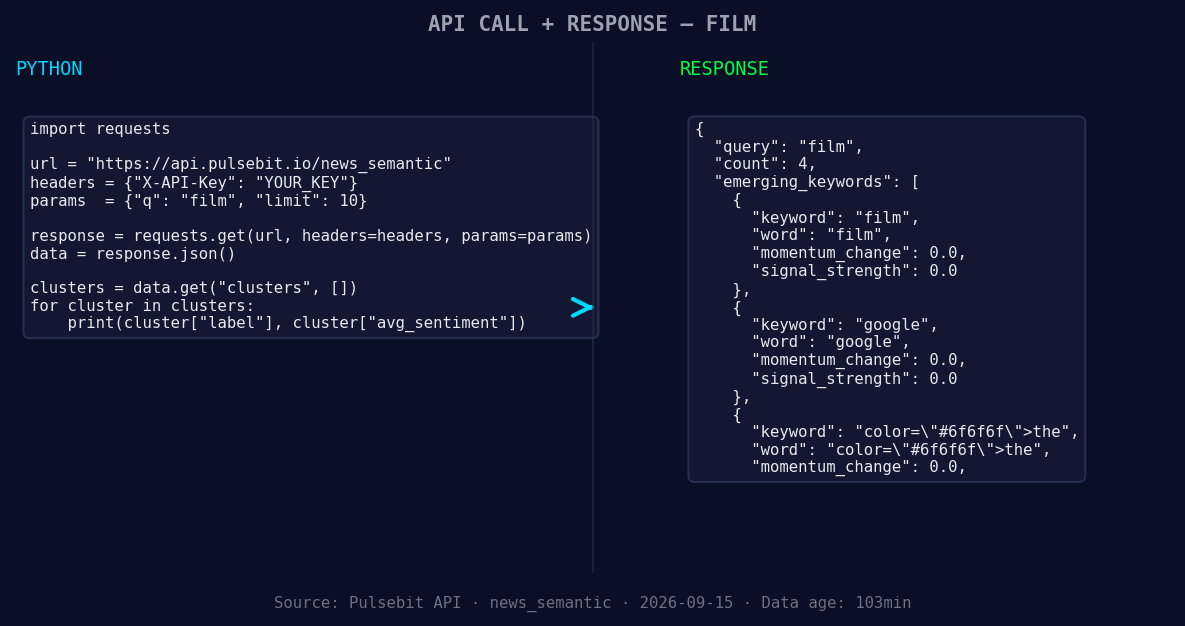
*Left: Python GET /news_semantic call for 'film'. Right: returned JSON response structure (clusters: 3). Source: Pulsebit /news_semantic.*
# Geographic origin filter: Query for English language articles
response = requests.get(
'https://api.pulsebit.com/v1/articles',
params={
'topic': topic,
'lang': lang
}
)
articles = response.json() # Assuming the response is in JSON format
# Now, we will run the cluster reason string through the sentiment analysis endpoint
cluster_reason = "Clustered by shared themes: filming, million, los, angeles, home."
sentiment_response = requests.post(
'https://api.pulsebit.com/v1/sentiment',
json={'text': cluster_reason}
)
sentiment_analysis = sentiment_response.json() # Process the sentiment response
With this code, we’ve successfully captured the relevant articles and analyzed the narrative framing around our cluster story. This is a critical step that allows us to not only identify spikes in sentiment but also understand the context behind them, which is often just as important.
Now, let’s explore three specific builds using this pattern that can help you capitalize on these insights.
- Geographic Filter with Sentiment Threshold: Set a threshold for sentiment score (e.g., score > +0.25) and filter by language (e.g., 'en'). This helps in surfacing only the most impactful articles that meet your criteria.

Geographic detection output for film. India leads with 3 articles and sentiment +0.30. Source: Pulsebit /news_recent geographic fields.
Meta-Sentiment Loop: Use the cluster reason string to analyze sentiment framing, specifically looking for terms like "filming," "million," and "Los Angeles." This can help you refine your marketing strategy around trending topics in your domain.
Forming Themes Analysis: Implement a function that analyzes forming themes like film, Google, and Los Angeles, with a specific focus on sentiment changes. You could create alerts for when these terms start trending positively, ensuring you're always ahead of the curve.
Using our API, you can start leveraging these insights by visiting our documentation: pulsebit.lojenterprise.com/docs. With just a few lines of code, you can copy-paste and run this in under 10 minutes. Don’t let your pipeline lag behind—stay on top of emerging trends and harness the power of sentiment analysis.


Top comments (0)