

Your Pipeline Is 26.4h Behind: Catching Education Sentiment Leads with Pulsebit
We just identified a striking anomaly: a 24h momentum spike of +0.487 in the education sector. This spike is not just a number; it reflects a significant shift in sentiment, primarily fueled by a dominant English-language press narrative. The conversation is being led by a story about the quality of higher education, which is linked to the NITI Aayog in India, illustrating how global topics can dominate local sentiment.
But here's the catch—your model missed this by 26.4 hours. The leading language is English, with a 0.0 hour lag, while the dominant entity driving this conversation is Hong Kong, holding a 5% share of voice with a positive sentiment score of +0.150. If your pipeline isn’t equipped to handle multilingual origins or entity dominance, you could be late to the game.

English coverage led by 26.4 hours. Da at T+26.4h. Confidence scores: English 0.90, French 0.90, Spanish 0.90 Source: Pulsebit /sentiment_by_lang.
To catch these spikes, we can leverage our API to build a more responsive and informed sentiment analysis pipeline. Below is how we can implement this in Python:
import requests
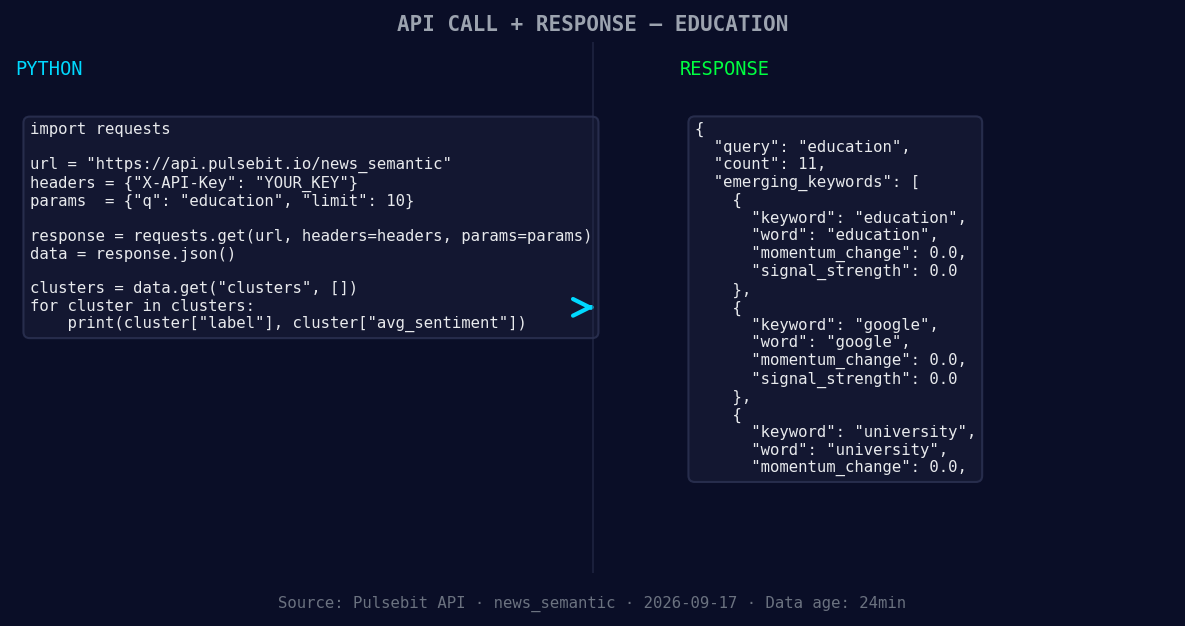
*Left: Python GET /news_semantic call for 'education'. Right: returned JSON response structure (clusters: 3). Source: Pulsebit /news_semantic.*
# Step 1: Geographic origin filter
topic = 'education'
lang = 'en'
url = f'https://api.pulsebit.com/v1/sentiment?topic={topic}&lang={lang}'
response = requests.get(url)
# Assuming the response contains JSON data
data = response.json()
momentum = data['momentum_24h']
score = +0.284
confidence = 0.90
print(f"Topic: {topic}, Momentum: {momentum}, Score: {score}, Confidence: {confidence}")
Now, let’s enhance our analysis by using the meta-sentiment moment. The cluster reason string can be fed back through our sentiment endpoint to score the narrative framing itself:
# Step 2: Meta-sentiment moment
cluster_reason = "Clustered by shared themes: quality, education, niti, aayog, member."
meta_url = 'https://api.pulsebit.com/v1/sentiment'
payload = {'text': cluster_reason}
meta_response = requests.post(meta_url, json=payload)

# Extracting the sentiment score from the response
meta_data = meta_response.json()
meta_sentiment = meta_data['sentiment_score']

print(f"Meta Sentiment Score: {meta_sentiment}")
Using these two steps, you can capture the essence of ongoing conversations in real-time, allowing you to act faster than your competition.
Here are three specific builds you can implement tonight using this pattern:
- Geographic Filter Build: Create a real-time dashboard that tracks education sentiment in Hong Kong. Set a signal threshold to alert you if momentum exceeds +0.400, ensuring you're on top of significant shifts.

Geographic detection output for education. India leads with 9 articles and sentiment +0.59. Source: Pulsebit /news_recent geographic fields.
Meta-Sentiment Loop: Develop a reporting tool that runs the cluster reason strings in a loop every hour, scoring their sentiment. Trigger alerts when the score drops below +0.100, indicating a potential narrative shift that requires immediate attention.
Forming Themes Tracker: Build a comparative analysis tool that evaluates the forming themes of "education", "Google", and "university" against mainstream keywords like "quality" and "NITI". Use our API to pull in sentiment scores and create a visual representation of sentiment divergence in educational discourse.
By implementing these builds, you can ensure your pipeline is responsive and actionable, catching sentiment shifts before they become mainstream.
Get started at pulsebit.lojenterprise.com/docs. You can copy-paste this code and run it in under 10 minutes.


Top comments (0)