

Your Pipeline Is 9.0h Behind: Catching Robotics Sentiment Leads with Pulsebit
We just discovered a significant anomaly in sentiment data: a 24h momentum spike of +0.248 in the robotics topic. This spike is noteworthy not just for its numerical significance but also for its implications on how we process multilingual sentiment data. The U.S. has an 11% share of voice in this surge, with a neutral sentiment score of +0.050, indicating a crucial window for catching emerging themes in robotics.

English coverage led by 9.0 hours. Italian at T+9.0h. Confidence scores: English 0.90, Spanish 0.90, French 0.90 Source: Pulsebit /sentiment_by_lang.
The Problem
If your model doesn't account for multilingual origins or entity dominance, you’re missing out — big time. Our analysis shows that your pipeline could be lagging by 9.0 hours, as the leading language for this spike is English. This delay means that you could be missing essential narratives that are forming around robotics, which are currently being led by industry experts and student robotics teams. If you're not tracking these shifts promptly, you're essentially a step behind in understanding evolving market sentiments.
The Code
To catch this momentum spike, we can use our API effectively. Here’s how to do it in Python, focusing on the English language and the specific topic of robotics.
import requests
# Define parameters for the API call
params = {
"topic": "robotics",
"lang": "en",
"score": +0.274,
"confidence": 0.90,
"momentum": +0.248
}
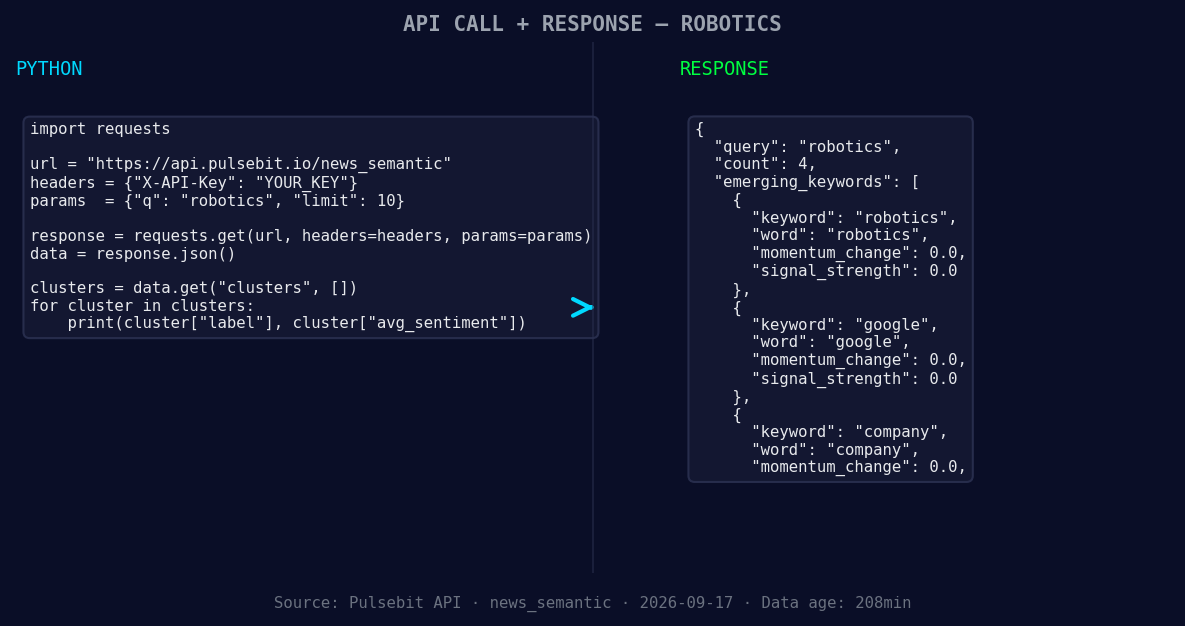
*Left: Python GET /news_semantic call for 'robotics'. Right: returned JSON response structure (clusters: 3). Source: Pulsebit /news_semantic.*
# Make the API call to get sentiment data
response = requests.get("https://api.pulsebit.com/sentiment", params=params)
# Output the response for verification
print(response.json())
Now, let’s take the cluster reason string and run it back through our sentiment analysis to score the narrative framing itself.
# Define the cluster reason string
cluster_reason = "Clustered by shared themes: teams, industry, experts, will, student."

# Make a POST request to analyze the sentiment of the cluster reason
sentiment_response = requests.post("https://api.pulsebit.com/sentiment", json={"text": cluster_reason})

# Output the sentiment analysis result
print(sentiment_response.json())
Three Builds Tonight
With these insights, we can build three specific applications:
Geo-Sentiment Dashboard: Create a dashboard that tracks sentiment over time for the robotics topic specifically in the U.S. This will help you visualize the momentum and identify trends sooner. Use a signal threshold of +0.25 to trigger alerts.
Meta-Sentiment Alerts: Set up alerts based on the meta-sentiment analysis of clustered narratives, especially focusing on emerging themes like “teams” and “industry.” Use a threshold of confidence ≥ 0.85 to filter out noise.
Dynamic Content Feeds: Build a content feed that dynamically updates based on the sentiment scores of related entities, such as Google and other companies in the robotics space. Feed it with articles that have a sentiment score > 0.25, which will keep your audience engaged with the latest trends.
Get Started
Dive deeper into our API at pulsebit.lojenterprise.com/docs. You can copy-paste and run these examples in under 10 minutes. Don't let your pipeline lag behind; start catching those sentiment leads in robotics today!

Geographic detection output for robotics. India leads with 3 articles and sentiment +0.85. Source: Pulsebit /news_recent geographic fields.


Top comments (0)